









.png?width=292&height=292&name=Copy%20Link%20(1).png)

 SIGN UP FOR FREE NEWSLETTER

Image from Getty
The financial squeeze for Australian households with a mortgage is tightening.
But for borrowers willing to act, there are still ways to fight back, with strategies capable of saving you tens of thousands of dollars in interest or effectively “manufacturing” yourself a personal interest rate cut.
The details
The latest move by the Reserve Bank of Australia has pushed the cash rate up to 4.35%, the third rate hike this year and a full reversal of 2025’s three rate cuts.
For many households, the impact will be felt almost immediately, with just about all major lenders passing on the rate hike in full to borrowers on variable-rate retail mortgages.
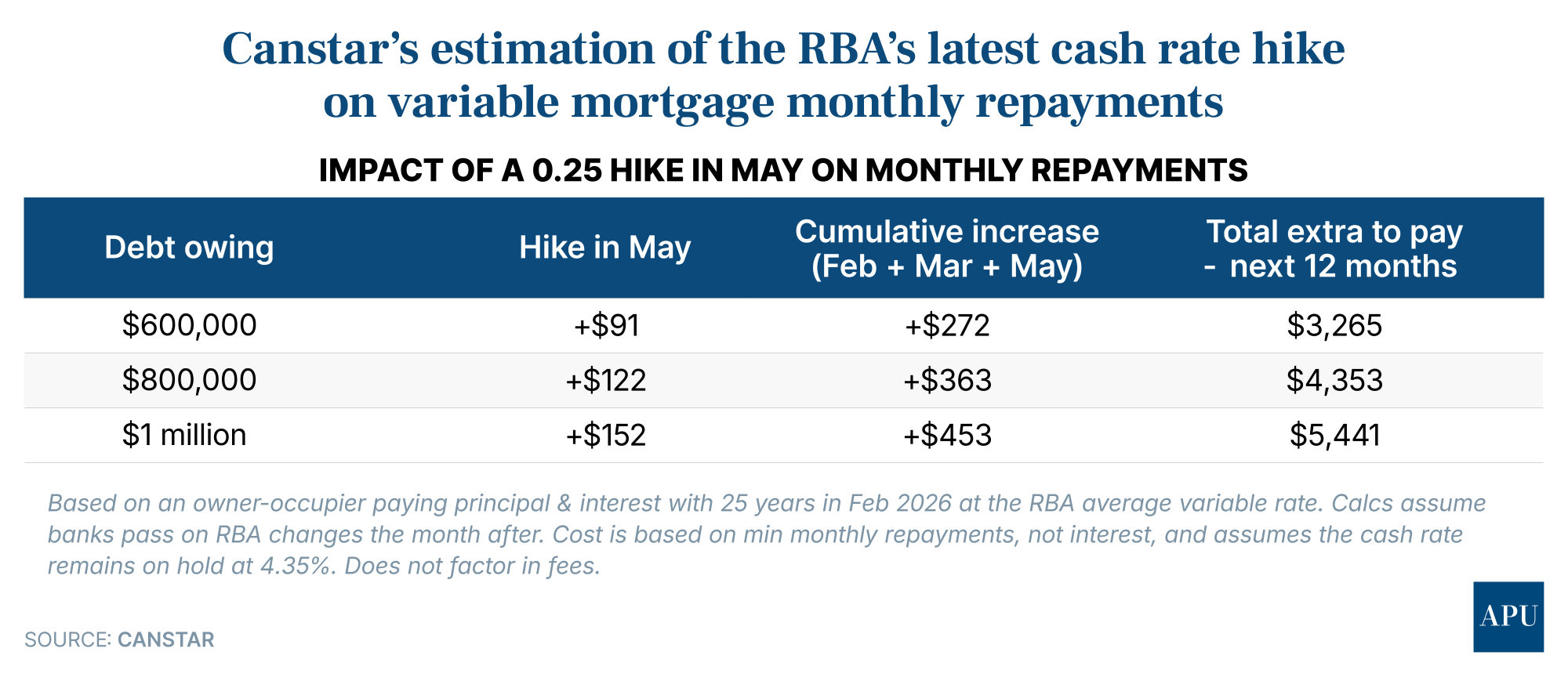
Analysis from Canstar shows the three hikes will add about $272 a month to repayments on a typical $600,000 mortgage, or more than $3,200 a year.
On a $1 million mortgage, the three rate rises should add around $453 a month to repayments or more than $5,400 per annum.
“It’s a return to Groundhog Day for borrowers across the country who are now being asked to hand over all three cash rate cuts from 2025,” says Canstar Data Insights Director, Sally Tindall.
But while the outlook for interest rates remains uncertain, with some forecasters tipping two more RBA rate hikes this year, experts say the biggest mistake borrowers can make is doing nothing.
Refinancing
One of the most effective ways to cut costs is also one of the most underused: renegotiating your loan or refinancing.
Financial planner James Gerrard says borrowers should start by challenging their current lender.
“The first thing to do, which can save thousands in interest each year, is to ring your lender and request a pricing review of your interest rate,” he says.
However, going in prepared is key.
Mr Gerrard recommends speaking to a broker first and securing a competing offer; a move that can significantly strengthen your negotiating position.
The potential upside is substantial.
Canstar estimates a borrower today stuck on a 7.01% rate could refinance to around 5.99% and save more than $11,000 over two years, even after switching costs.
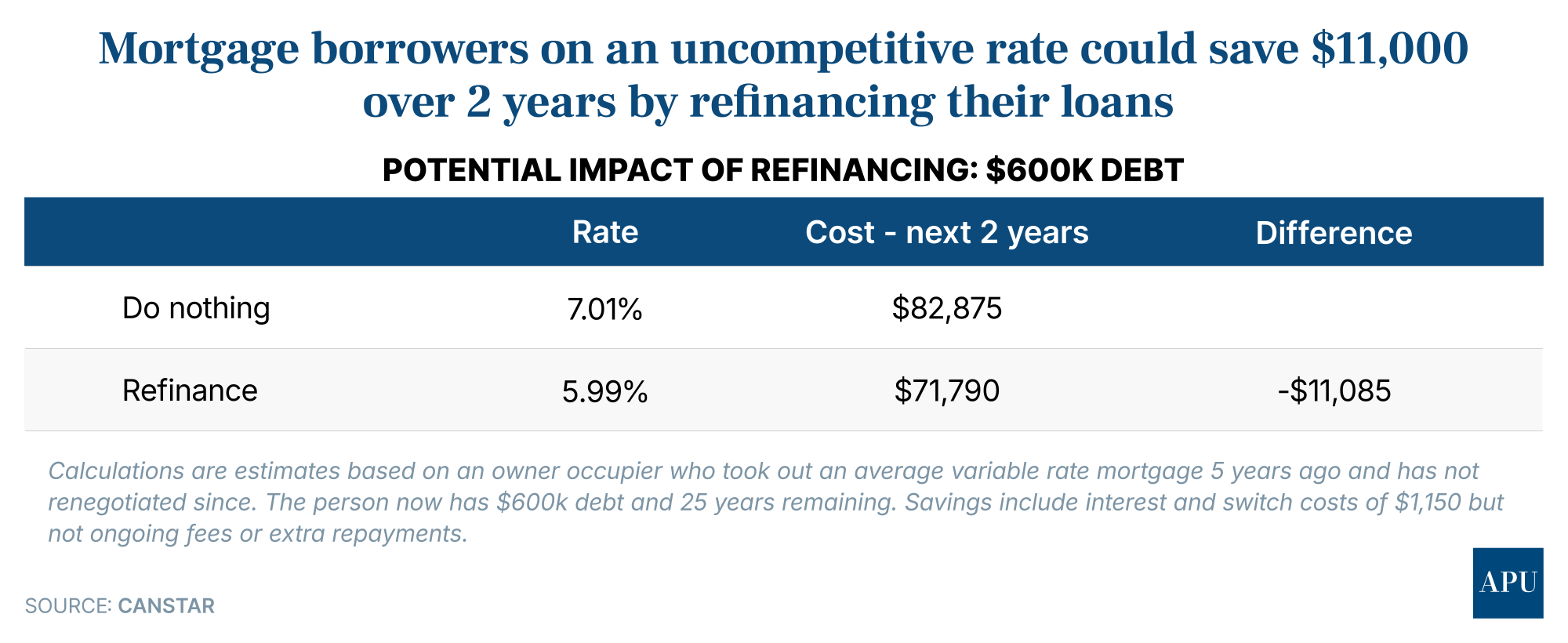
Canstar’s Sally Tindall says many borrowers are unknowingly paying a “loyalty tax”.
“Do a sense check to see if you’re paying too much,” she says.
“If you are, you can haggle with your current lender, but know that the sharpest rates are typically reserved for those that make a switch.”
Restructuring your banking
Beyond chasing a lower rate, how a loan is structured can be just as powerful.
Offset accounts remain one of the most effective, and often underutilised, tools available to borrowers.
“I cannot recall the number of times I have come across people who have a mortgage but keep sometimes hundreds of thousands of dollars in a separate transactional bank account as their ‘rainy day fund’,” financial planner James Gerrard says.
By placing savings into an offset account, borrowers reduce the balance on which interest is charged, while still retaining full access to their money.
But the real gains come from using the account actively.
Directing income into the offset and delaying expenses for as long as possible - even by just a few days - can steadily chip away at interest costs.
“Every extra dollar that stays in the offset account, even for just one day, directly reduces the amount of interest payable on the loan,” Mr Gerrard says.
For more disciplined borrowers, making extra repayments or using a redraw facility can deliver similar savings, although with less flexibility.
Small changes, big savings
Some of the most effective strategies are also the simplest.
Delaying bill payments until their due date (or a day or two after, as some companies operate with a “grace” period), rather than paying them early or when the bill first comes in, can keep money working in your offset account harder for longer.
Using credit cards strategically, and clearing them in full at the very end of the interest-free period, can further maximise cash held in offset.
So, if a utility bill for $250 comes in on the 1st of the month, giving you until the 21st to pay, you could feasibly pay that bill on the 23rd on your credit card without attracting a penalty fee from the utility company.
Depending on your credit card’s terms and billing cycle, purchases can have up to 55 days interest-free.
Therefore, if you time things right, the $250 for your utility bill might not actually need to leave your offset account for nearly 80 days after the bill comes in, giving you the benefit of that money for considerably extra time to reduce your interest burden.
Also, remember that even modest extra repayments into mortgages can have a compounding effect, reducing both the loan balance and the total interest paid over time.
Another often overlooked move is tackling higher-interest debts first.
Paying down credit cards or personal loans first can free up cash flow more quickly than focusing solely on the mortgage.
For borrowers seeking stability, there’s also the option of split loans, where you fix a portion of your mortgage while keeping the rest at a variable rate.
This can provide some certainty in a volatile rate environment.


Proceed with care!!!
For households already in severe mortgage stress, lenders may offer temporary relief - including switching to interest-only repayments for a time, reducing repayments, or extending the loan term.
But these measures come with long-term costs.
Canstar analysis shows switching a $600,000 loan to interest-only could cut repayments by $407 a month, but add more than $30,000 in interest over the life of the loan.
Similarly, extending the loan term by five years could reduce repayments by $264 a month, but add a whopping $142,000 in extra interest.
“If you can’t clear the higher amount being asked of you, you probably won’t be able to refinance your way out of the issue, but don’t put your head in the sand,” Canstar’s Sally Tindall says.
“Call your bank and tell them this new, higher amount is a stretch too far, before you miss a repayment.
“Hardship options can provide breathing room, but they’re not a free pass – they often come with a longer-term cost that borrowers need to weigh up carefully.”
The takeout
With inflation still elevated and global pressures - including higher energy prices - feeding into the economic picture, many economists expect interest rates to remain higher for longer.
That makes borrower behaviour more important than ever.
The difference between a competitive mortgage rate and an outdated one, between an idle savings account and an optimised offset, or between minimum repayments and small extra contributions, can add up to tens of thousands of dollars in savings over the life of a loan.
In that environment, the biggest risk isn’t just rising rates.
It’s doing nothing.









.jpg?width=1920&height=1080&name=WTF%20Is%20Happening%20To%20The%20Housing%20Market!%20$500%20Billion%20Wiped%20Out%20As%20Prices%20Fall%20Faster%20Every%20Month%20Scott%20Kuru%20YPU%20027%20(1).jpg)
%20Scott%20Kuru%20YPU%20025.jpg?width=1920&height=1080&name=This%20Is%20Worse%20Than%20A%20Recession%20RBA%20Admits%20Australias%20Wage%20Collapse%20Cant%20Be%20Stopped%20(Prepare%20Now)%20Scott%20Kuru%20YPU%20025.jpg)




























.jpg?width=1920&height=1080&name=EXPOSED%20How%20The%20Govt%20Let%20These%20Oil%20Giants%20Get%20Away%20With%20Paying%20Zero%20Tax%20For%20Aussie%20Gas%20Scott%20Kuru%20DPU%20256%20(1).jpg)







%20Scott%20Kuru%20DPU%20248.jpg?width=1920&height=1080&name=Major%20Banks%20CAUGHT%20Preparing%20For%20Australia%E2%80%99s%20Biggest%20Housing%20Crash%20(Defaults%20%26%20Bankruptcies%20Coming)%20Scott%20Kuru%20DPU%20248.jpg)
%20Scott%20Kuru%20DPU%20247.jpg?width=1920&height=1080&name=This%20Is%20How%20Australia%20Gets%20Pushed%20Into%20the%20Next%20Big%20Reset%20(Trust%20Collapse%20Has%20Officially%20Begun)%20Scott%20Kuru%20DPU%20247.jpg)







%20Scott%20Kuru%20DPU%20239.jpg?width=1920&height=1080&name=URGENT%20Life%20In%20Australia%20Has%20Become%20Impossible%20For%20Millions%20Of%20Aussies%20(It%E2%80%99s%20About%20To%20Get%20Worse)%20Scott%20Kuru%20DPU%20239.jpg)











%20Scott%20Kuru%20DPU%20227.jpg?width=1920&height=1080&name=URGENT%20ALERT%20Australia%E2%80%99s%20Property%20Market%20Is%20Sliding%20Into%20Something%20Much%20Bigger%20(Prepare%20Now)%20Scott%20Kuru%20DPU%20227.jpg)