









.png?width=292&height=292&name=Copy%20Link%20(1).png)

 SIGN UP FOR FREE NEWSLETTER
The current conflict in the Middle East has unnerved markets and sent oil prices skyrocketing.
It’s also bad news for consumers, with more pain at the petrol bowser and the prospect of higher prices as supply chains for goods are disrupted.
If you are an investor - in shares, property or other asset classes - or have superannuation, it can be a worrying time.
Plenty of people have been asking me questions like: Scott, should I stop investing? Should I hold off on buying property?
Those kinds of reactions are completely understandable because war is incredibly destabilising, and as a rule, investors dislike unpredictability.
However, it’s worth noting that markets also have a habit of panicking first and later adapting - often quite quickly - to the new reality.
This is exactly what happened after the Gulf War, after 9/11, the Global Financial Crisis, the Asian Financial Crisis, the Covid 19 pandemic and Donald Trump’s tariff war.
People who understand this pattern and take the time to observe what’s actually happening behind the headlines are usually the ones that prosper during these uncertain periods and end up making sound financial decisions.
I’ve broken this down step-by-step in this video:
Otherwise, read on…
The details
Whenever an international conflict begins or a global crisis unfolds, the first reaction you almost always see in financial markets is panic.
The reason for that panic is actually quite simple - financial markets absolutely hate uncertainty.
Investors suddenly start asking questions like “How long will this conflict last?”, “Will it spread to other regions?” and “Are key commodities like oil going to suddenly become harder to access?”
When nobody has answers to those questions, markets tend to react emotionally rather than rationally.
This is often why you see stock markets falling sharply in the early stages of a crisis, even though the actual economic impact is still unclear.
That emotional reaction creates a feedback loop, where investors see markets falling and assume something catastrophic might be happening, which then causes even more selling and even more panic.
But if you look at the aftermath of past crises, you begin to realise that these early reactions are often temporary.
Once investors start understanding the scale and the scope of the conflict, the market begins to adjust to the new reality.
This is the most important insight that many everyday investors miss, because while headlines make it feel like everything is collapsing, markets are often simply going through a predictable adjustment process.
If you study how markets behave during geopolitical shocks, you start noticing that they almost always move through three very distinct phases.
Understanding each of these phases can make a huge difference in how you interpret what is happening around you.
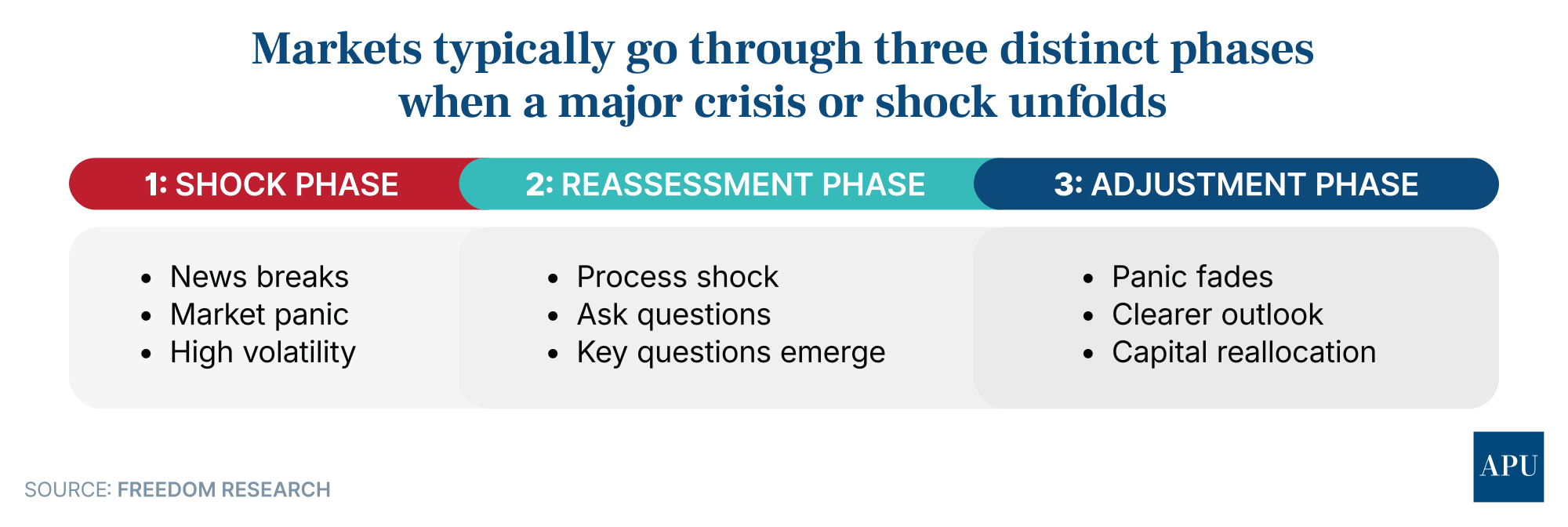
The first phase is the “shock” phase.
This is when the news of the crisis or conflict first emerges and markets react immediately.
Oil prices might spike, stock markets can fall and volatility increases because investors are trying to price in a situation they still do not fully understand.
The second phase is the “reassessment” phase, which begins once investors have had time to process the initial shock and start asking more practical, long-term questions about the economic consequences of the conflict or event.
During this phase, markets begin analyzing how things like oil price movements might affect inflation, how inflation might influence interest rates and which industries might be positively or negatively affected by those changes.
Then we reach the third phase, which is the “adjustment” phase.
This is where financial markets begin reallocating capital towards assets and sectors that are expected to perform better under the new economic conditions.
By this third stage, the initial panic has usually faded.
Investors have a clearer understanding of the situation and money starts flowing into areas of the market that are benefiting from the new reality or the new environment.
Once you recognize this pattern, it becomes much easier to understand why markets behave the way they do during a crisis.
This is not about predicting the future - no one can do that consistently. It’s about maintaining a rational framework for thinking about money when markets become volatile.
That’s because the biggest mistakes investors make during crises usually come from reacting emotionally rather than thinking strategically.
When markets become uncertain, many instinctively move all their money into cash, freeze and avoid making any decisions (so-called “analysis paralysis”), or chase whatever asset has already gone up sharply in value.
But if you step back and observe, you realize that volatility often reveals where capital is flowing and how economic forces are shifting underneath the surface.
For everyday Aussies who are trying to build wealth over the long term, moments like these are often better approached with patience and observation rather than panic, because watching how commodities, interest rates and other sectors move during uncertainty can provide valuable insights into how the next stage of the economic cycle might unfold.
During uncertainty, people gravitate towards assets that have intrinsic value and form the foundation of the economy.
When supply chains tighten or energy prices rise, commodities often move higher because they sit at the center of global production.
Many everyday investors then assume the obvious move is to rush into sectors like oil, energy, or defence stocks.
The problem is that by the time most people start looking at those sectors, prices have already moved sharply higher, which means you are often buying at the peak rather than at the beginning of the price cycle.
So instead of chasing what has already spiked, the smarter approach is to step back and focus on stable assets that historically perform well when markets become unsettled.
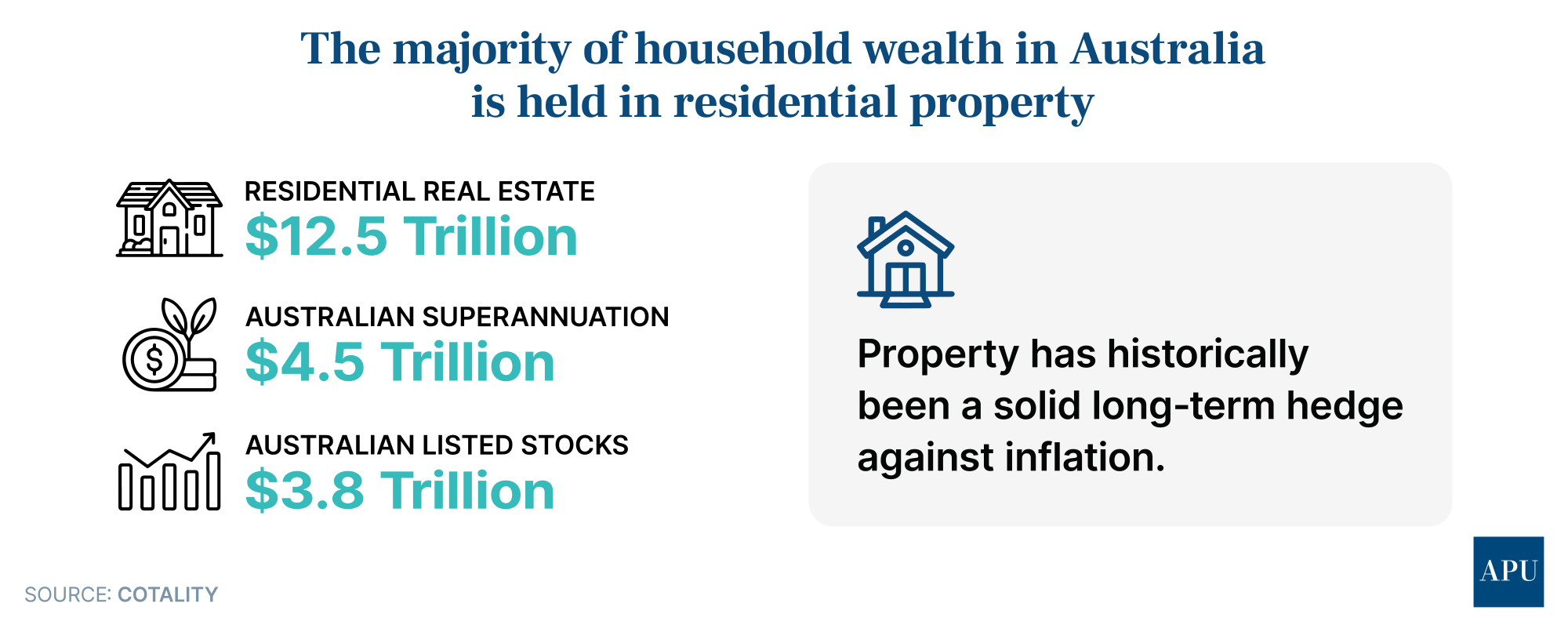
Residential property sits right at the center of that conversation.
In Australia, property functions very differently to many other parts of the world because it is not only regarded as shelter - it’s widely viewed as one of the most important vehicles for building long-term wealth.
When borrowing costs rise, many people start questioning whether they should wait, and that hesitation causes buyers to step back from the property market.
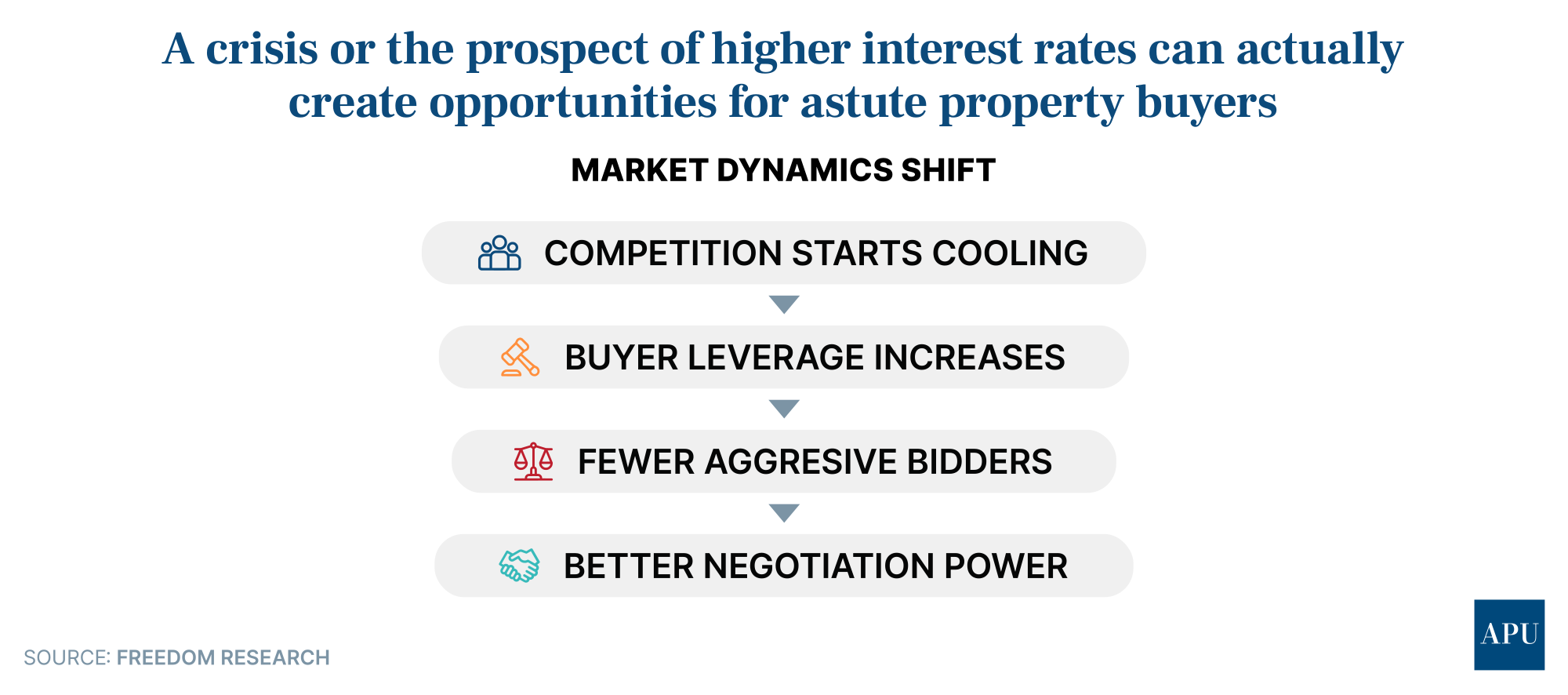
When that happens, competition cools down and the balance of power in the market shifts towards buyers, because there are fewer people bidding aggressively on the same properties.
That creates something we don’t see very often in a rising property market, which is a window where buyers can negotiate harder and secure assets with less competition.
The fundamentals are still the same.
Australia still has a chronic housing shortage and population growth (primarily from immigration) remains strong.
Even if interest rates rise temporarily, history shows that once rates eventually stabilise or begin falling again, demand tends to surge back quickly.
So uncertainty never crashes the market.
It will simply put the market on pause.
We saw that pattern during COVID when interest rates fell and property prices accelerated sharply.
Then, property markets dipped briefly as interest rates went up sharply.
But after a short time, the cycle reset and property values started rising again, as Australians realised the fundamentals had not changed.
For investors who stay calm and understand the pattern, those moments when others start to panic can become powerful opportunities to build long-term wealth.
While I can’t give you specific financial advice, my general guidance to you during periods of uncertainty, like the current conflict in the Middle East, is simple.
Do not panic.
Take a step back, observe what is happening, educate yourself and make thoughtful financial decisions with your money during these volatile periods.
Because if you study these cycles properly, they can actually create opportunities to build a lot of wealth over time.



.jpg?width=1920&height=1080&name=WTF%20Is%20Happening%20To%20The%20Housing%20Market!%20$500%20Billion%20Wiped%20Out%20As%20Prices%20Fall%20Faster%20Every%20Month%20Scott%20Kuru%20YPU%20027%20(1).jpg)
%20Scott%20Kuru%20YPU%20025.jpg?width=1920&height=1080&name=This%20Is%20Worse%20Than%20A%20Recession%20RBA%20Admits%20Australias%20Wage%20Collapse%20Cant%20Be%20Stopped%20(Prepare%20Now)%20Scott%20Kuru%20YPU%20025.jpg)









.jpg?width=1920&height=1080&name=EXPOSED%20How%20The%20Govt%20Let%20These%20Oil%20Giants%20Get%20Away%20With%20Paying%20Zero%20Tax%20For%20Aussie%20Gas%20Scott%20Kuru%20DPU%20256%20(1).jpg)


%20Scott%20Kuru%20DPU%20248.jpg?width=1920&height=1080&name=Major%20Banks%20CAUGHT%20Preparing%20For%20Australia%E2%80%99s%20Biggest%20Housing%20Crash%20(Defaults%20%26%20Bankruptcies%20Coming)%20Scott%20Kuru%20DPU%20248.jpg)
%20Scott%20Kuru%20DPU%20247.jpg?width=1920&height=1080&name=This%20Is%20How%20Australia%20Gets%20Pushed%20Into%20the%20Next%20Big%20Reset%20(Trust%20Collapse%20Has%20Officially%20Begun)%20Scott%20Kuru%20DPU%20247.jpg)
%20Scott%20Kuru%20DPU%20239.jpg?width=1920&height=1080&name=URGENT%20Life%20In%20Australia%20Has%20Become%20Impossible%20For%20Millions%20Of%20Aussies%20(It%E2%80%99s%20About%20To%20Get%20Worse)%20Scott%20Kuru%20DPU%20239.jpg)



%20Scott%20Kuru%20DPU%20227.jpg?width=1920&height=1080&name=URGENT%20ALERT%20Australia%E2%80%99s%20Property%20Market%20Is%20Sliding%20Into%20Something%20Much%20Bigger%20(Prepare%20Now)%20Scott%20Kuru%20DPU%20227.jpg)




%20Scott%20Kuru%20DPU%20221.jpg?width=1920&height=1080&name=The%20AI%20Situation%20in%20Australia%20Just%20Hit%20a%20Point%20of%20No%20Return...%20(Major%20Bank%20Proves%20It)%20Scott%20Kuru%20DPU%20221.jpg)