










 SIGN UP FOR FREE NEWSLETTER
Australia’s housing market may be in a downturn, but three powerful forces continue to provide support for property investors: population growth, a persistent shortage of new homes and a rental market that remains unusually tight.
Despite moves by the Albanese Government to slow migration, Australia is still adding people substantially faster than it is adding housing, while the construction industry faces serious capacity problems and rents continue to rise.
Those pressures do not prevent home prices falling when interest rates are high and borrowing capacity is being squeezed.
But they do help explain why many economists and property analysts expect the underlying housing shortage to remain a powerful influence once demand recovers.
The details
1. Population is still growing strongly
Australia’s post-pandemic migration surge has slowed considerably, but the country is still adding hundreds of thousands of people each year.
Official ABS figures show net overseas migration added 306,000 people in 2024–25, while total population growth reached 412,500 in the year to December 2025, including 301,000 from overseas migration.
That’s important for housing because virtually every additional household eventually requires somewhere to live - whether as a renter, owner-occupier or through some form of shared accommodation.
The bottom line is Australia is continuing to add population at a pace that requires a large amount of new housing.
And the latest ABS population data show the pressure has not disappeared.
Australia’s population reached 27.8 million by the end of 2025, up 1.5% in a year.
2. Australia is still not building enough
The second problem is supply.
The National Housing Accord requires 1.2 million homes to be completed between July 2024 and June 2029, equivalent to an average of 240,000 homes a year.
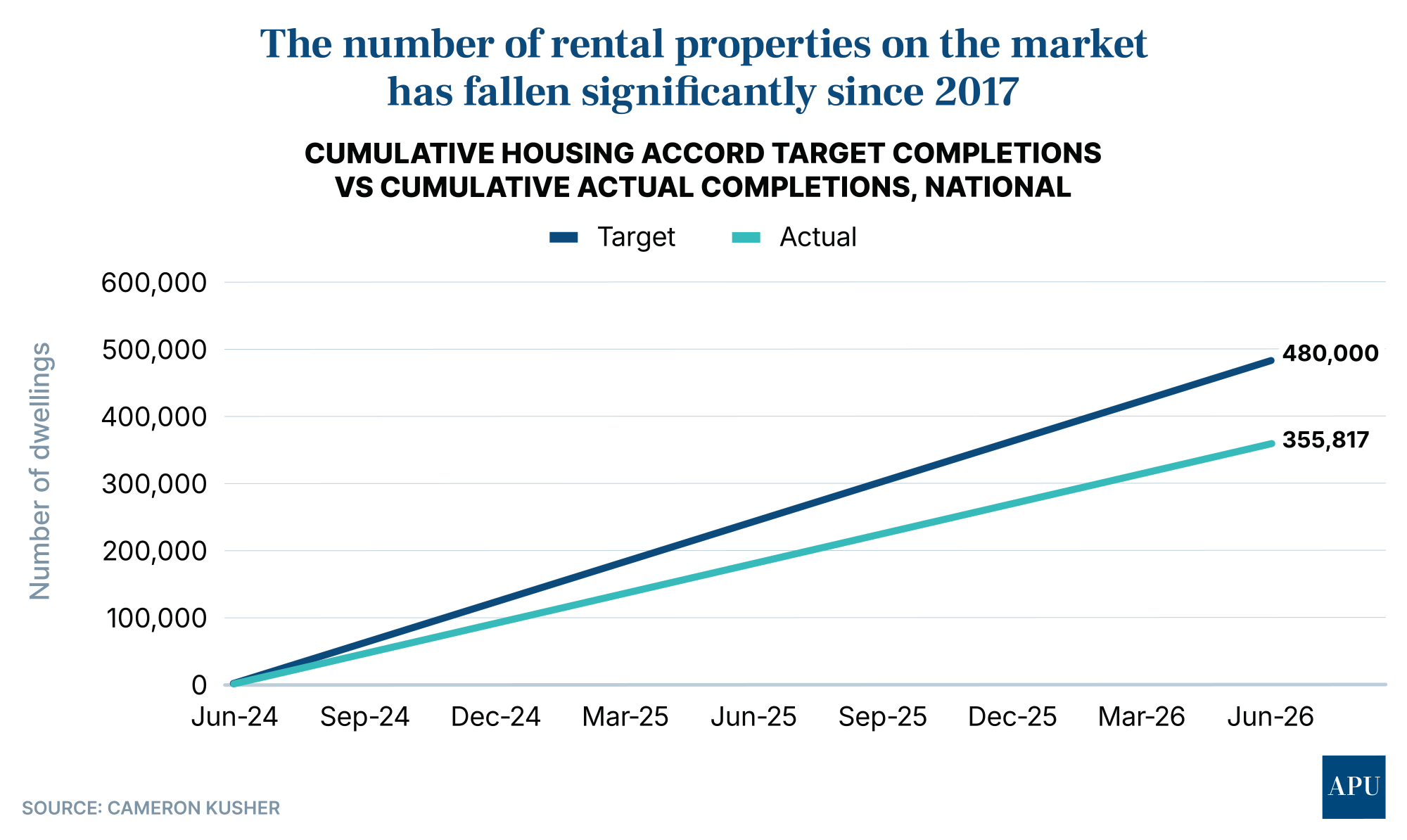
By the end of June 2026, just 355,817 dwellings had been completed against a target of 480,000.
That’s a shortfall of 124,183 dwellings, or a shortfall of just under 26%, as you can see in the chart above from independent housing analyst Cameron Kusher.
The latest ABS Building Activity figures contain some encouraging news.
Total dwelling commencements rose 7% in the June quarter to 52,201, while detached house starts jumped 11.6%.
But the part of the market Australia most needs to accelerate barely moved: private higher-density commencements slipped 0.1% to 19,126.
That result has alarmed Master Builders Australia.
“The flat result for higher-density housing is particularly concerning because that part of the market needs to do the heavy lifting if Australia is to meet its housing targets,” Master Builders CEO Denita Wawn says.
And more recent indicators have weakened.
Building approvals fell 6.1% in August, with approvals for private dwellings excluding houses plunging 21.2%.
Master Builders has now downgraded its construction forecasts and estimates Australia could finish 262,000 homes short of the Housing Accord target.
“That’s 262,000 less homes for Australian families, first-home buyers and renters,” Ms Wawn says.
The industry also has a workforce problem.
Master Builders estimates construction is currently short around 141,000 workers, and its latest workforce modelling warns that the gap cannot be closed quickly.
“Recent policy decisions have been death by a thousand cuts for small building businesses at exactly the time Australia needs them delivering more homes and critical infrastructure,” Ms Wawn says.
So while there has been a June-quarter lift in commencements, there is little evidence Australia is about to embark on the sustained construction boom required to erase the existing housing deficit.
Cameron Kusher says it’s welcome that residential building activity has lifted, but he sounds a note of caution.
“I doubt the surge in commencements will continue with construction costs and interest rates rising,” he says
3. Rental conditions remain supportive for investors
The third force is the rental market.
Cotality says the national vacancy rate eased to 2.1% in September 2026, up from a record low of 1.5% in February.
However, rival data house REA Group’s latest rental report listed the national vacancy rate as still only 1.5%.
Nevertheless, both estimates remain well below the pre-COVID decade average of 3.3%.
National rents are also still 5.5% higher than a year ago, while gross rental yields have risen to 3.85%, their highest level since 2019.
There’s also evidence that properties are being lost from the rental pool.
Research group FoundIt analysed more than 760,000 listings and estimated that in the first seven weeks after the May Budget, only 61 new rental properties entered the market for every 100 rental homes sold.
Around 10,100 rented homes were sold during the period, compared with only 6,140 investor purchases subsequently offered for lease, implying a net reduction of about 570 rental homes a week during the period studied.
Research from Ray White’s data arm Neoval points in the same direction.
“Historically, when interest rates fall, we tend to see rental availability improve as investor activity picks up,” says Ray White’s Chief Economist, Nerida Conisbee.
“We are now seeing the reverse.
“Interest rates have risen, making property investment more expensive, while the May Budget changes have added another disincentive for investors.”
Ms Conisbee says this is now showing up in the availability of rental properties.
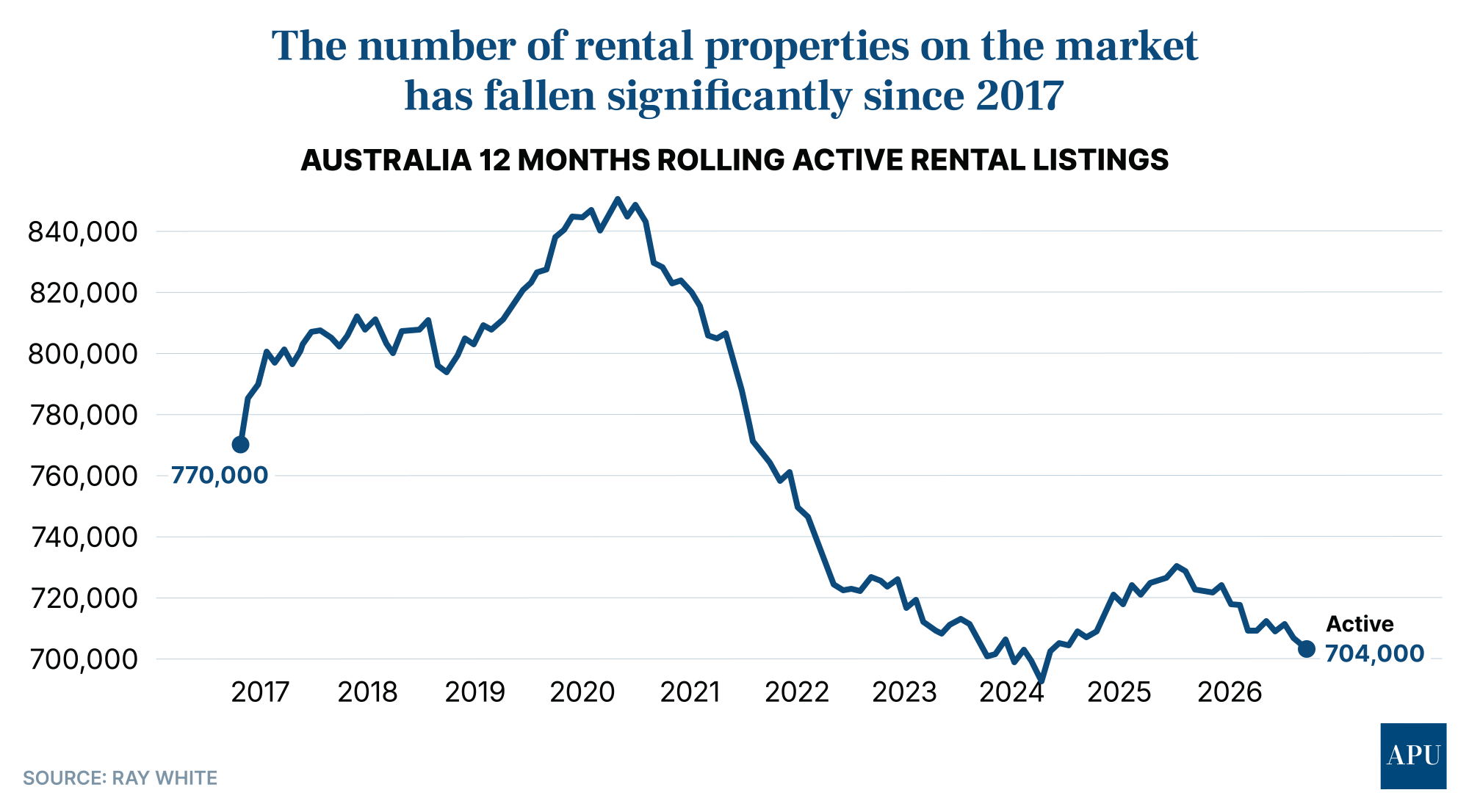
“Across Australia, there were just over 700,000 active rental listings over the 12 months to September, down 3.1% from a year earlier and only 1.2% above the lowest level in the past decade.
“Sydney has been hit hardest, with listings down 7.3% over the year to 161,580, the lowest since January 2018.
“Melbourne is down 5.3%, representing almost 9,000 fewer listings over the past year,” she says.
The findings from FoundIt and Ray White don’t mean every investor sale has removed a dwelling from the housing system.
Some properties have been bought by former renters, reducing rental demand at the same time.
But it does reinforce the broader supply problem: Australia needs thousands of additional rental properties merely to accommodate population growth before replacing any rental stock that disappears.
The take-out
None of this means property values cannot fall further.
Higher interest rates have reduced borrowing power sharply, sentiment is weak and both Cotality and REA Group have recorded six consecutive months of national price declines.
But falling prices are only one part of the market.
Behind them sits a population that continues to grow, housing construction that remains well behind target and a rental market where vacancies remain historically low and rents are still increasing.
For investors, that creates an unusual combination: softer purchase prices alongside improving rental income and yields.
The risk, of course, is that higher interest rates, tax changes and holding costs offset those gains.
But the structural shortage has not disappeared.
If anything, the latest construction data suggest Australia still has a long way to go before supply catches up with the demand already in the system.