










 SIGN UP FOR FREE NEWSLETTER
Cotality says Australia’s housing downturn deepened again in October 2026, with national home values falling for a seventh consecutive month and the property data company warning the decline is on track to become the sharpest in at least 40 years.
However, separate figures from rival data providers SQM Research and housing economist Dr Andrew Wilson show price rises in Sydney and Melbourne in October, suggesting the downturn may have begun to stabilise in Australia’s two largest housing markets.
The details
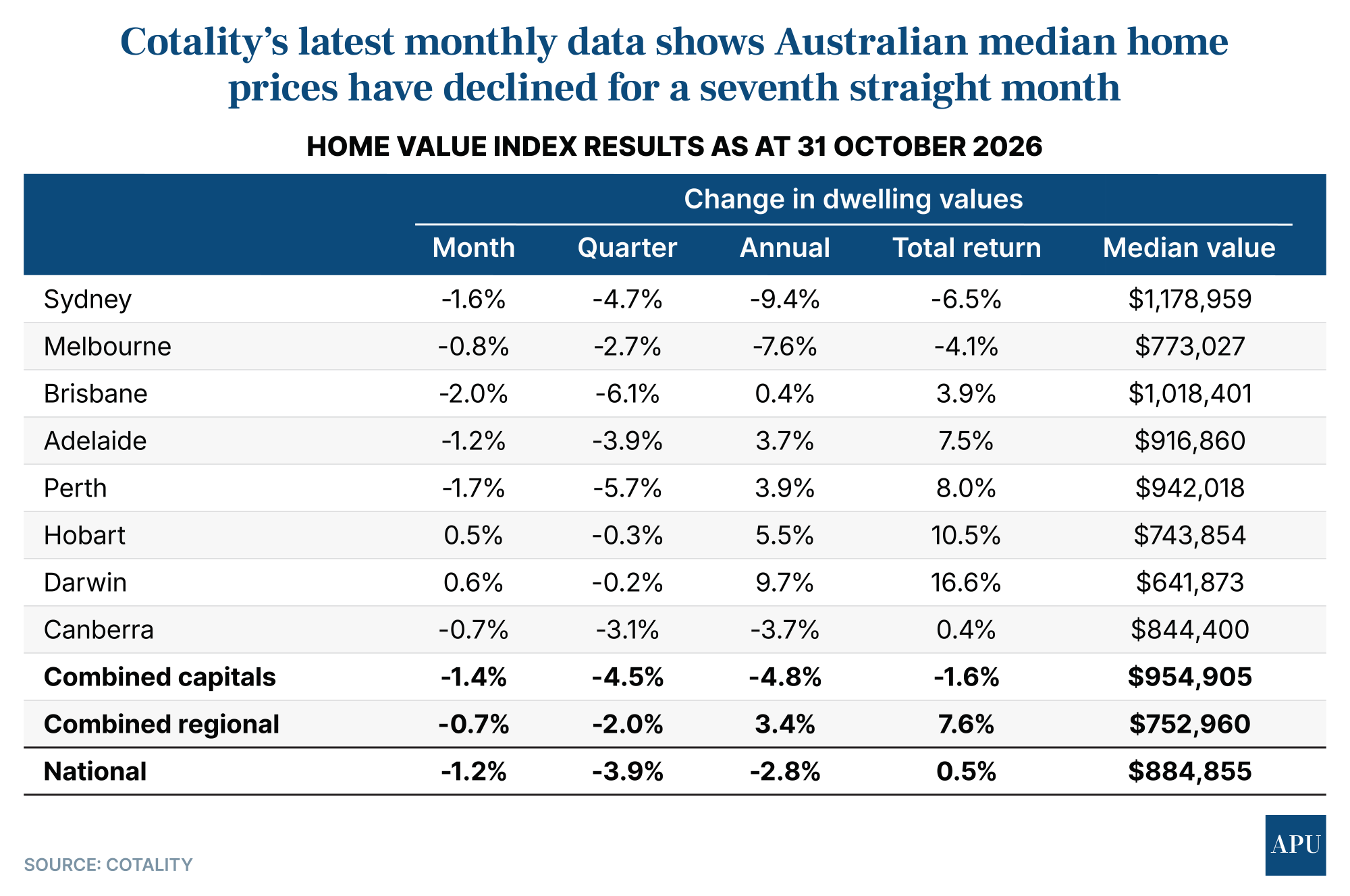
Cotality’s latest Home Value Index shows national dwelling values fell 1.2% in October, taking them 6.7% below their March 2026 peak.
On Cotality’s numbers, that represents a decline of about $63,400 in the value of the median Australian dwelling.
The fall has also accelerated across the major capitals, with Cotality’s combined capital-city index now down 8.1% in seven months.
That is a faster decline over the same period than either the 2022-23 or 2017-19 downturns.
Cotality research director Tim Lawless says multiple pressures are now weighing on housing demand at the same time.
“Affordability and serviceability constraints were the earliest factors weighing on housing demand, with these headwinds amplified by four interest rate hikes, persistently low confidence and ongoing cost-of-living pressures,” he says.
“The Federal Budget has added to the downside pressure since mid-May.”
Cotality says Brisbane and Perth have now overtaken Sydney as the fastest-falling capital-city markets.
Brisbane dwelling values fell 2% in October and are down 6.1% over the past three months.
Perth values fell 1.7% during the month and 5.7% over the quarter, while Sydney dropped 1.6% in October and 4.7% over three months.
“The mid-sized capitals, where home values recorded extreme growth conditions over the past six years, are now well and truly in a correction,” Mr Lawless says.
“Virtually every suburb across Brisbane, Perth and Adelaide has recorded a drop in values over the past three months.”
Over the past year, Cotality says Sydney has recorded the largest annual fall, down 9.4%, followed by Melbourne at 7.6%.
Brisbane is still 0.4% higher than a year ago, while Adelaide is up 3.7% and Perth 3.9%, reflecting the scale of the gains those markets recorded before the downturn began.
“Buyers have a lot more stock to choose from, they have more leverage and there isn’t the same urgency to buy as there was a year ago when home values were rising rapidly,” Mr Lawless says.
“But despite this being a buyer’s market, they are noticeably absent, reflecting low confidence and ongoing serviceability barriers.”
Dr Andrew Wilson
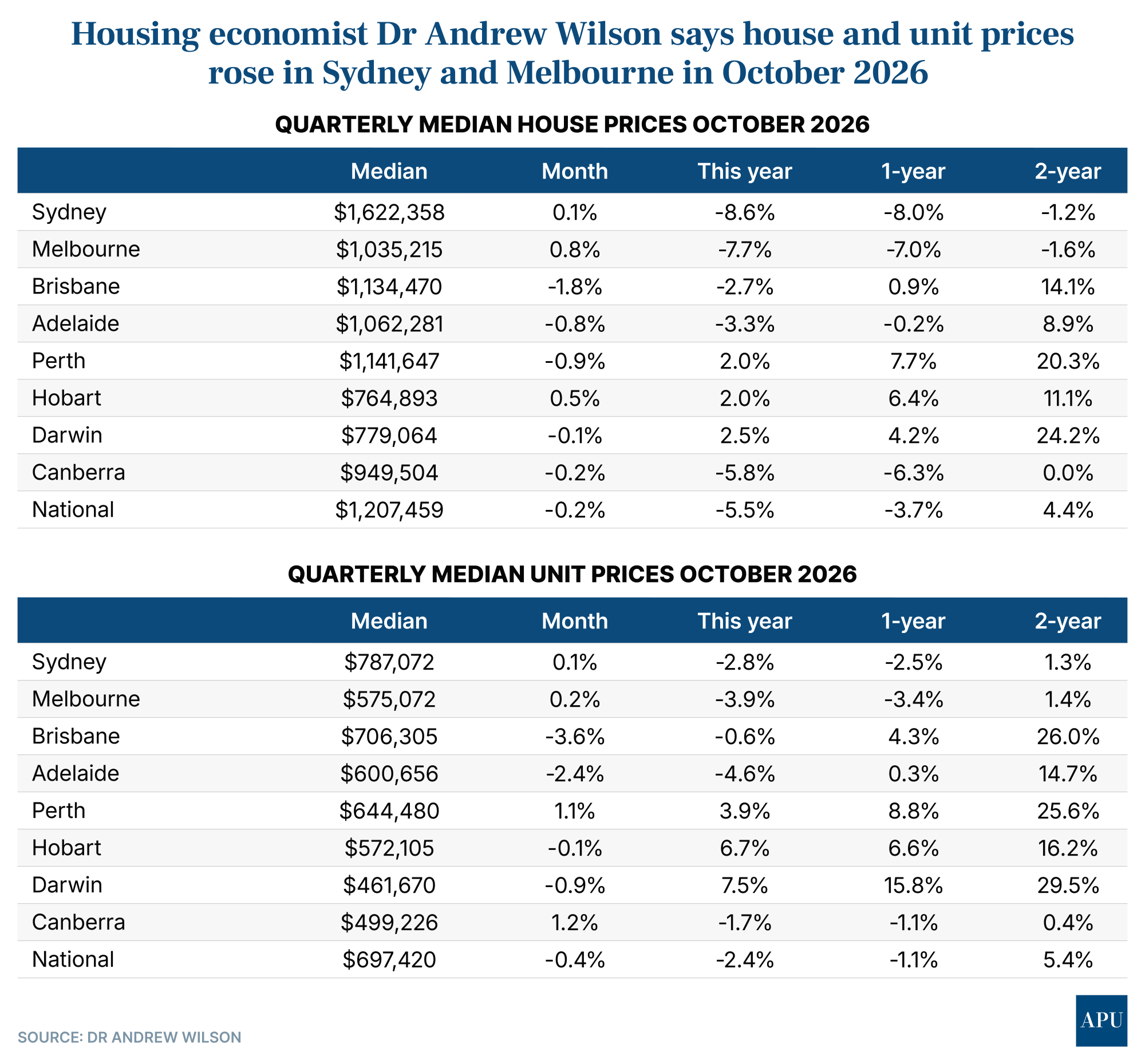
Cotality’s bleak outlook isn’t reflected in the latest data from housing analyst Dr Andrew Wilson, who has just published figures showing the first monthly home price growth in Sydney and Melbourne since April 2026.
Dr Wilson says Melbourne, Hobart and Sydney reported higher house prices over the month – up by 0.8%, 0.5% and 0.1% respectively, while prices were lower in Darwin, Canberra, Perth, Adelaide and Brisbane - falling by 0.1%, 0.2%, 0.9%, 0.9% and 1.8% respectively.
“With the exception of Brisbane and Adelaide, all capitals reported higher growth rates over October compared to the rates of the previous month,” he says.
Annual house price growth remains mixed with Perth, Hobart, Darwin and Brisbane up by 7.7%, 6.5%, 4.2% and 0.9% respectively.
Adelaide, Canberra, Melbourne and Sydney house prices, however, are down 0.2%, 6.3%, 7.0% and 8.0% respectively over the past year.
Dr Wilson says Canberra, Perth, Melbourne and Sydney also had higher unit prices over the three months to the end of October - rising by 1.2%, 1.1%, 0.2% and 0.1% respectively.
SQM
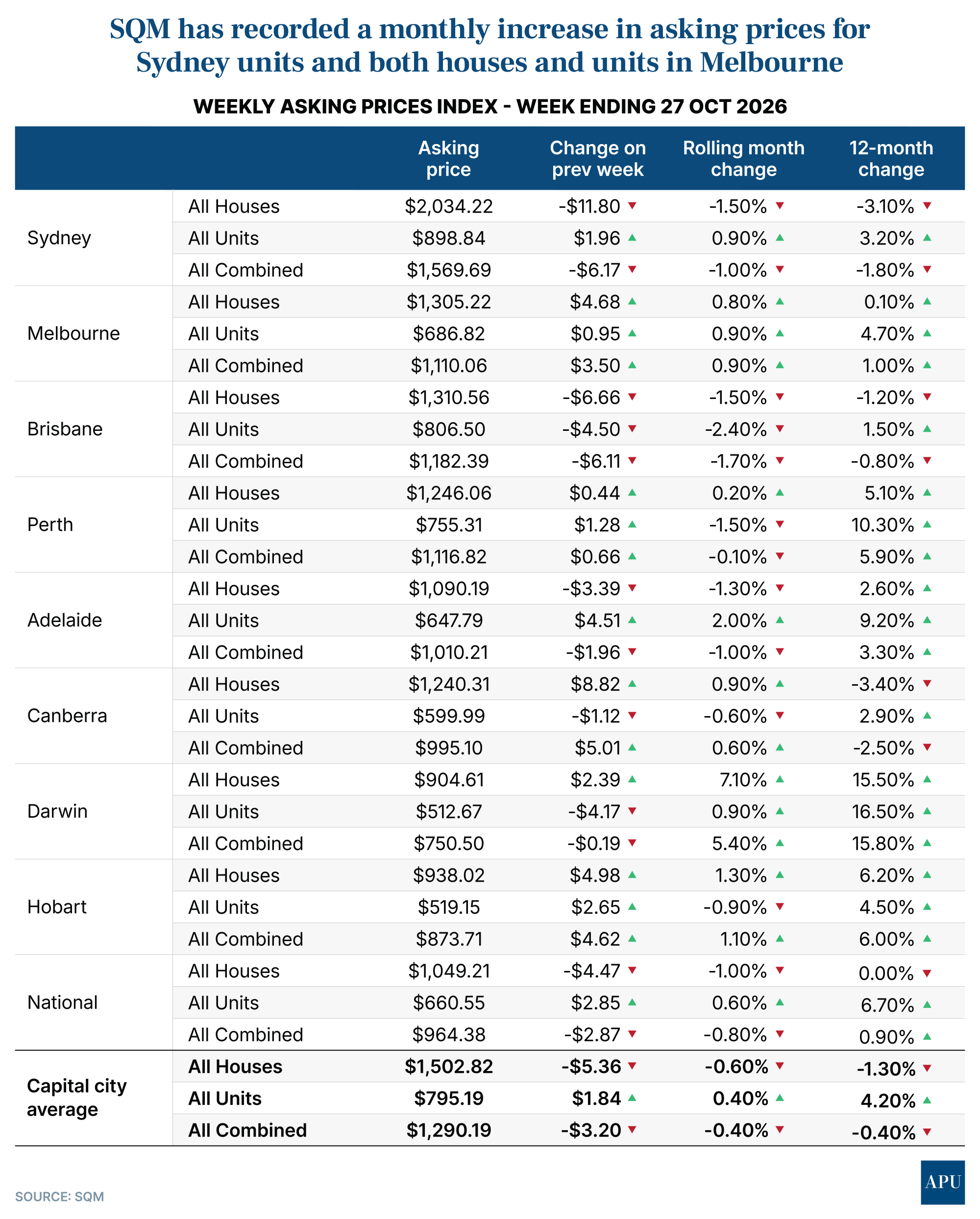
Weekly data from veteran property analyst Louis Christopher’s SQM Research also point to some upward pressure in asking prices for Sydney units and both houses and units in Melbourne.
Over the month to 27 October 2026, SQM says asking prices for Sydney units rose 0.9%, while Melbourne house prices increased 0.8% and unit asking prices 0.9%.
SQM’s figures measure vendor asking prices rather than final sale prices, so they do not account for subsequent discounting.
However, they indicate Sydney unit sellers were asking 3.2% more than a year earlier, while Melbourne unit asking prices were 4.7% higher and houses 0.1% higher.
The outlook
Looking ahead, Cotality says an expected RBA rate rise on Melbourne Cup Day, which would be the fifth upward move this year, could have a further dampening effect on the property market.
“Another rate hike would mean borrowing capacity has dropped by around 11.5%, or more than $105,000 through the rate-hiking cycle to date,” Mr Lawless says.
For buyers, he says that would more than offset the roughly $63,400 decline in the national median dwelling value since March.
Cotality says the balance of risks remains “skewed to the downside, with the decline in home values now on track to be the largest in at least 40 years.”
While there are forces limiting the extent of the downturn, particularly low levels of new housing supply and continued population growth, Cotality believes further interest-rate rises, reduced borrowing capacity, softer employment conditions, weak consumer sentiment and lower investor demand will all weigh on home prices.
Housing economist Dr Andrew Wilson has a more optimistic take.
“The spring selling season has however predictably generated increased buyer and seller activity with consistent signs now emerging of improved price growth trends,” he says.
“Underlying drivers generally remain relatively positive notwithstanding uncertainty over the near-term trajectory of interest rates.”
“Rising confidence and a steadying of interest rates clearly remain the key to a sustained housing market revival,” Dr Wilson says.