









.png?width=292&height=292&name=Copy%20Link%20(1).png)

 SIGN UP FOR FREE NEWSLETTER
Last week’s 0.25% rate hike by the Reserve Bank of Australia - the first rise in more than 2 years - has prompted 3 of Australia’s “Big 4” retail banks to revise their forecasts.
The Commonwealth Bank and Westpac have now joined NAB in predicting that the central bank will hike rates again in May this year, while ANZ has downgraded some of its expectations for house price growth.
Nevertheless, calculations by Canstar based on ANZ’s new forecasts show cities such as Perth and Brisbane could still see their median house prices increase by around $100,000 in 2026 alone.
CBA and Westpac change rate outlook
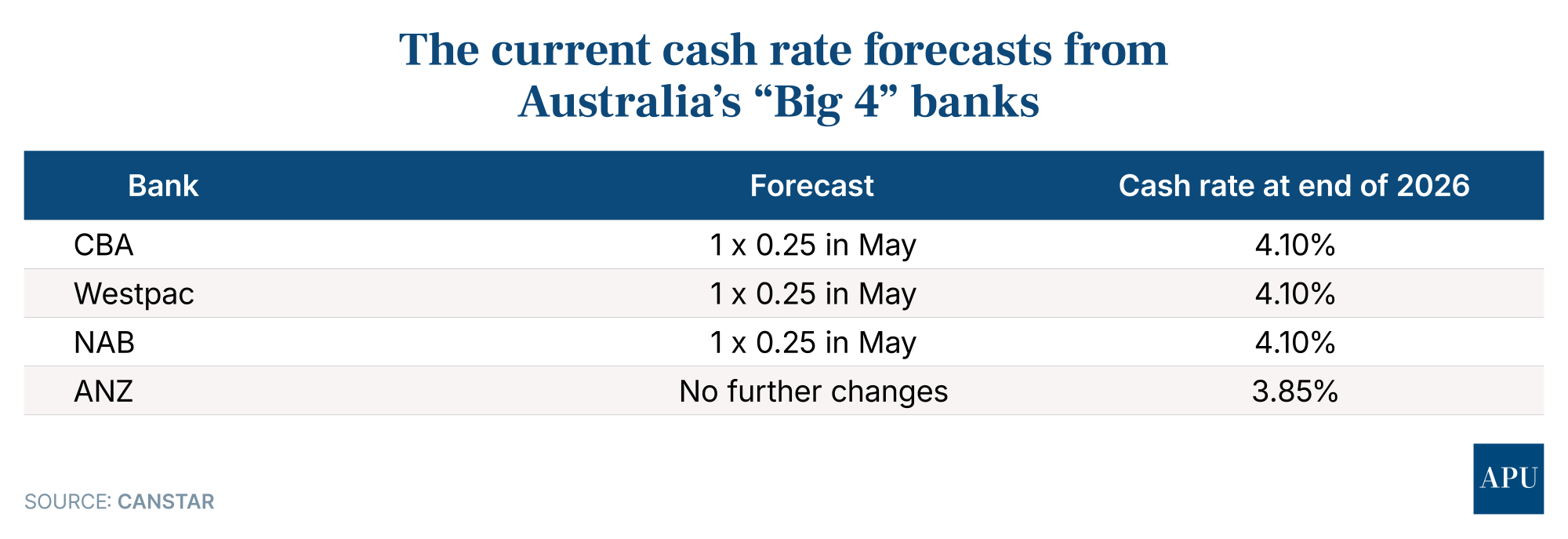
Australia’s largest bank and largest housing lender - CBA - now believes the RBA will hike interest rates again in May.
Previously, it had been predicting only one rate this year - in February - with rates to remain on hold indefinitely.
But CBA’s Head of Australian Economics, Belinda Allen, says the bank has now changed its view.
“The RBA have revised up their inflation forecasts and trimmed mean inflation is expected to remain above 3% through all of 2026.
“This is too high and will not be tolerated by the RBA.
“With the labour market now in a better position than a few months ago, and an increased resolve from the RBA, on the balance of probabilities we now see the RBA hiking again in May to take the cash rate to 4.10%.”
The country’s second-largest bank, Westpac, has also changed its rate outlook.
“The shift in the interest rate outlook in Australia since six months ago is quite the turnaround,” says Luci Ellis, the Chief Economist at Westpac and a former RBA Assistant Governor.
“Inflation has kicked up in ways that were not apparent or expected in mid-2025.
“We believe that another cash rate increase will occur in May.”
Ms Ellis says there “are pathways that result in the next rate hike occurring at the (RBA Monetary Policy Board’s) March meeting, but this is less likely.”
“The RBA believes (as we do) that much of the recent increase in inflation is temporary, which reduces the urgency of follow-up hikes.
“If things turn out as we expect, the RBA will be able to point to some turnaround in inflation, as temporary factors wash out by the time the August meeting comes around.
“This will enable the Board to take a ‘wait-and-see’ approach with policy already restrictive.”
ANZ now the outlier
The ANZ Bank is now the outlier among the Big 4 banks when it comes to predicting future interest rate movements.
It believes the 0.25% hike in February was an “insurance move” by the central bank, which is tasked with keeping annual inflation in a target band between 2-3%, and preferably at 2.5%.
The latest quarterly data from the Australian Bureau of Statistics showed a surprise uptick in inflation in the three months until the end of December 2025, with the headline CPI measure now at 3.8% and “trimmed mean” or core inflation at 3.3%.
However, ANZ’s Head of Australian Economics, Adam Boyton, thinks the central bank might have overestimated inflation pressures in the economy.
“We suspect,” he says, “that the RBA may end up (marginally) pleasantly surprised on the inflation front.
“We also think that a likely slowing in real household income growth, the current low level of consumer confidence and today’s rate hike will see weaker consumer spending growth.
“As a result, while the RBA’s base case might be that another hike is more likely than not, we think that today’s action from the RBA Board should end up being the only move this year.”
ANZ’s Housing forecasts
While ANZ believes the cash rate will remain steady at 3.85% “over the next few years”, it says it now expects the 0.25% February rate hike by the RBA will slow momentum in the residential housing market.
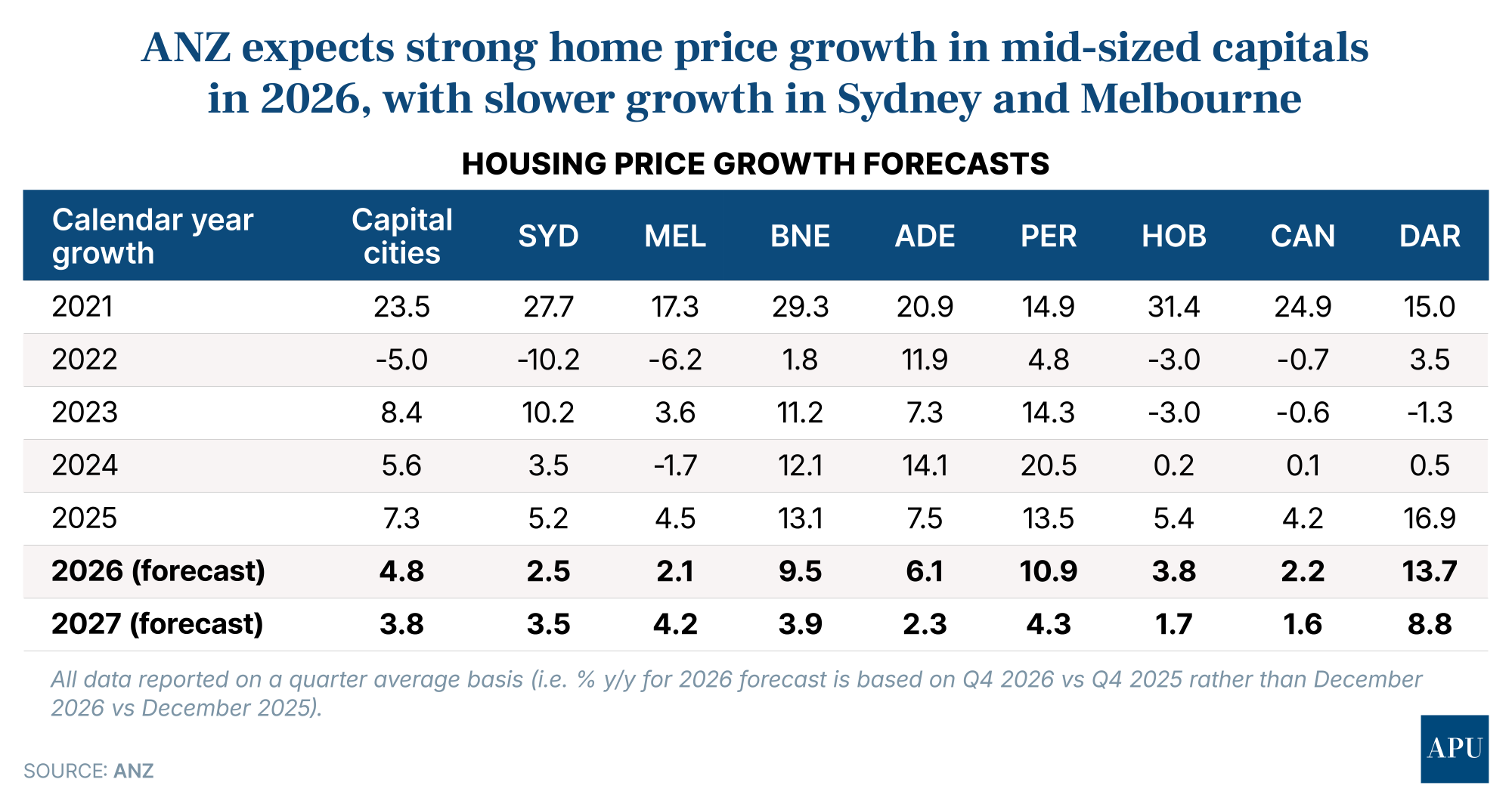
After a strong 2025 in which capital city housing prices rose 7.3%, ANZ is now forecasting home prices to rise 4.8% in 2026 and 3.8% in 2027.
In its latest Australian Housing Outlook, published on the 6th of February 2026, ANZ says, “Uncertainty around the outlook for interest rates is likely to take some heat out of the market, especially in Sydney and Melbourne.”
It points to an easing of auction clearance rates in the two cities over the last few months of 2025.
However, it’s worth noting that in what’s regarded as the first real test of the 2026 auction season, Cotality recorded the preliminary clearance rate on the weekend of the 7th and 8th of February as 73.7%, the highest since September 21st 2025.
In ANZ’s Housing Outlook, authors Adam Boyton and Madeline Dunk also point to the 0.1% easing in Cotality home values in both Sydney and Melbourne in December 2025.
However, their report makes no mention that both cities clawed back up into positive territory in January 2026, with Cotality reporting a +0.2% lift in Sydney and a +0.1% rise in Melbourne.
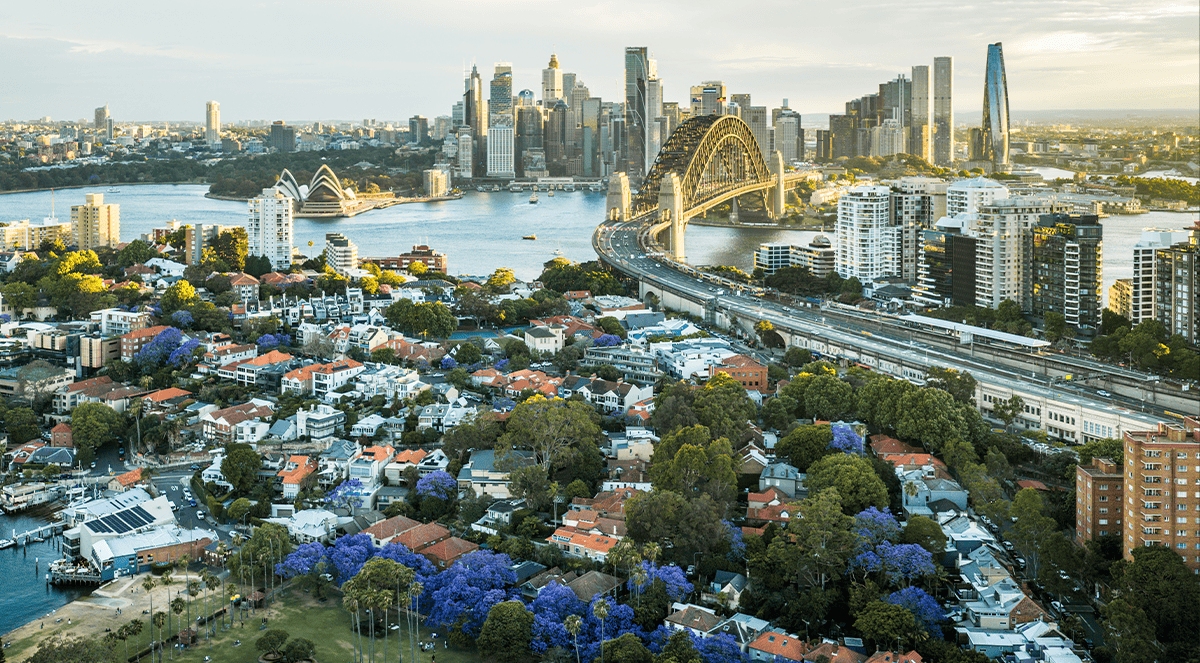
ANZ says it now expects dwelling prices in Sydney to grow by a modest 2.5% this year, accelerating to 3.5% in 2027.
Melbourne homes are tipped to eke out 2.1% growth this year, before the pace doubles to 4.2% in 2027.
Boyton and Dunk say they expect the smaller capitals to continue outperforming, particularly in the first half of 2026.
“We see Brisbane, Perth, Darwin and Adelaide housing prices rising over 6% in 2026.
“In these smaller capitals, total listings are more than 50% below normal for this time of year.
“This is keeping these markets tight and placing upward pressure on prices.”
ANZ expects Darwin to lead the way with stunning 13.7% price growth this year, before easing in 2027 to a more sustainable 8.8%.
Perth homes are forecast to see 10.9% growth in 2026 and then slow sharply to 4.3% in 2027.
Brisbane is set for another solid year of price growth, with homes there tipped to grow 9.5% before easing to 3.9% in 2027.
Adelaide’s market will continue to slow to 6.1% this year and 2.3% in 2027.
More generally, ANZ expects upward pressure on housing prices as “supply is likely to remain constrained” and “labour availability remains a key challenge for many construction firms.”
The bank also believes the RBA’s February rate hike will curtail any imminent pick-up in already lacklustre building approvals numbers, further restricting the new supply of homes.
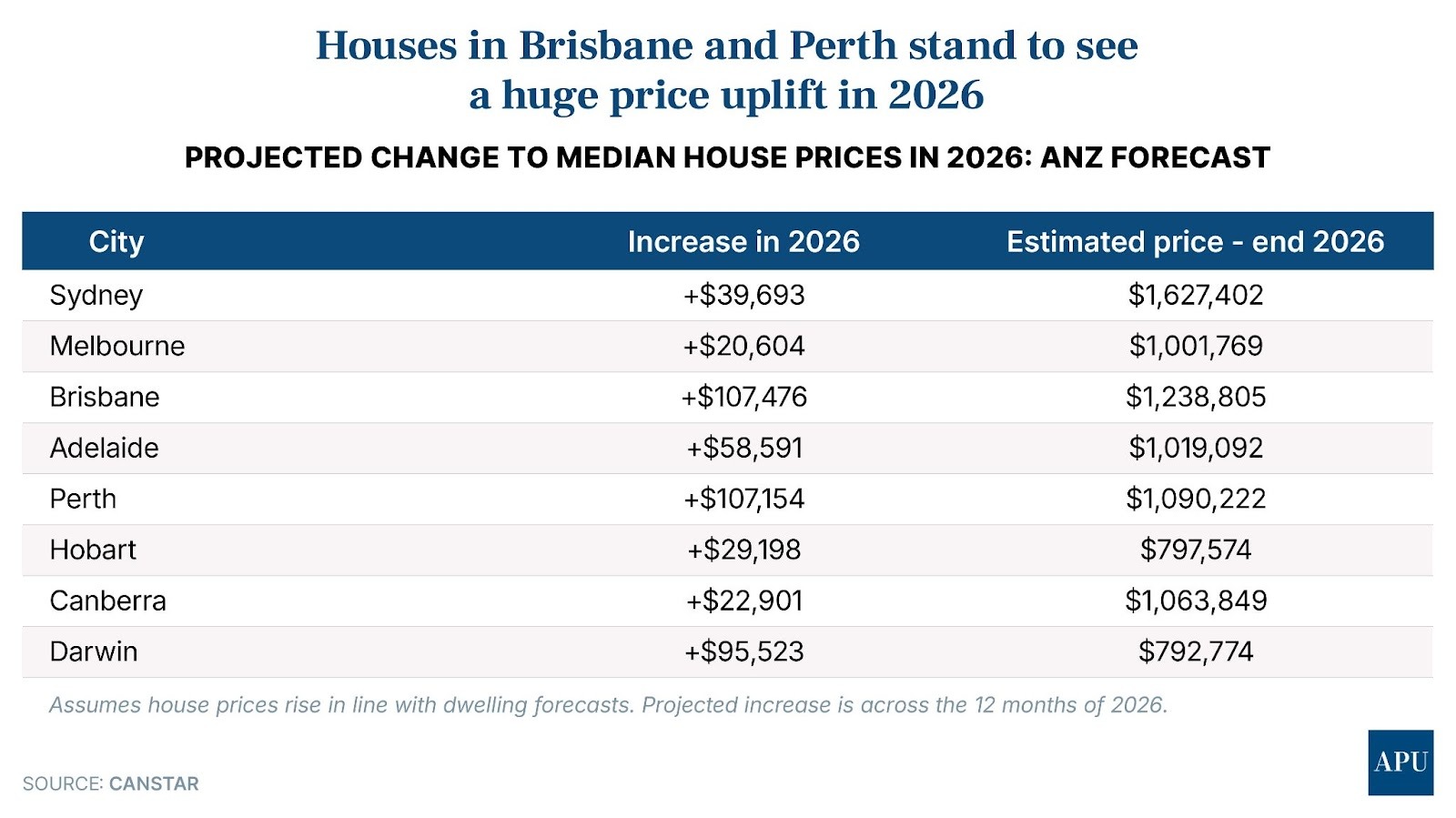
Comparison service Canstar has done an analysis of ANZ’s latest Housing Outlook.
Using Cotality data, the analysis shows that if the ANZ’s price forecasts are applied to houses, the median house price in Brisbane could rise by $107,476 in 2026, while Perth could rise by $107,154.
Canstar’s Data Insights Director, Sally Tindall, says the RBA’s cash rate hike is likely to act as a “speed bump rather than a full-blown brake on house prices, with some pockets barely tapping the brakes at all.”
“Markets such as Brisbane and Perth are being driven by tight supply and strong demand, which is why six-figure price gains remain on the table in 2026, even with higher rates in the mix.”
While Canstar notes ANZ is expecting the Sydney property market to slow, it says the median house price in harbour city could still rise to a jaw-dropping $1.63 million by the end of 2026.
By then, the median house prices in six capital cities – Sydney, Brisbane, Perth, Canberra, Adelaide and Melbourne - would sit above the million-dollar mark.
“Higher interest rates inevitably squeeze borrowing power,” Sally Tindall says.
“Canstar research shows a single rate hike can reduce an average income earner’s borrowing capacity by around $12,000, with two hikes doubling that impact.
“For buyers looking at price tags of $1 million plus, the reduction in borrowing capacity is a drop in the ocean, but for those with no wiggle room left, it could force them to remain a spectator for now,” she says.
“Buyer confidence is also likely to be tested, particularly if the RBA proves to the country it’s prepared to do what it takes to get the inflation job done, by firing off another hike in May.”






.jpg?width=1920&height=1080&name=WTF%20Is%20Happening%20To%20The%20Housing%20Market!%20$500%20Billion%20Wiped%20Out%20As%20Prices%20Fall%20Faster%20Every%20Month%20Scott%20Kuru%20YPU%20027%20(1).jpg)
%20Scott%20Kuru%20YPU%20025.jpg?width=1920&height=1080&name=This%20Is%20Worse%20Than%20A%20Recession%20RBA%20Admits%20Australias%20Wage%20Collapse%20Cant%20Be%20Stopped%20(Prepare%20Now)%20Scott%20Kuru%20YPU%20025.jpg)























.jpg?width=1920&height=1080&name=EXPOSED%20How%20The%20Govt%20Let%20These%20Oil%20Giants%20Get%20Away%20With%20Paying%20Zero%20Tax%20For%20Aussie%20Gas%20Scott%20Kuru%20DPU%20256%20(1).jpg)







%20Scott%20Kuru%20DPU%20248.jpg?width=1920&height=1080&name=Major%20Banks%20CAUGHT%20Preparing%20For%20Australia%E2%80%99s%20Biggest%20Housing%20Crash%20(Defaults%20%26%20Bankruptcies%20Coming)%20Scott%20Kuru%20DPU%20248.jpg)
%20Scott%20Kuru%20DPU%20247.jpg?width=1920&height=1080&name=This%20Is%20How%20Australia%20Gets%20Pushed%20Into%20the%20Next%20Big%20Reset%20(Trust%20Collapse%20Has%20Officially%20Begun)%20Scott%20Kuru%20DPU%20247.jpg)







%20Scott%20Kuru%20DPU%20239.jpg?width=1920&height=1080&name=URGENT%20Life%20In%20Australia%20Has%20Become%20Impossible%20For%20Millions%20Of%20Aussies%20(It%E2%80%99s%20About%20To%20Get%20Worse)%20Scott%20Kuru%20DPU%20239.jpg)










%20Scott%20Kuru%20DPU%20227.jpg?width=1920&height=1080&name=URGENT%20ALERT%20Australia%E2%80%99s%20Property%20Market%20Is%20Sliding%20Into%20Something%20Much%20Bigger%20(Prepare%20Now)%20Scott%20Kuru%20DPU%20227.jpg)





%20Scott%20Kuru%20DPU%20221.jpg?width=1920&height=1080&name=The%20AI%20Situation%20in%20Australia%20Just%20Hit%20a%20Point%20of%20No%20Return...%20(Major%20Bank%20Proves%20It)%20Scott%20Kuru%20DPU%20221.jpg)