









.png?width=292&height=292&name=Copy%20Link%20(1).png)

 SIGN UP FOR FREE NEWSLETTER
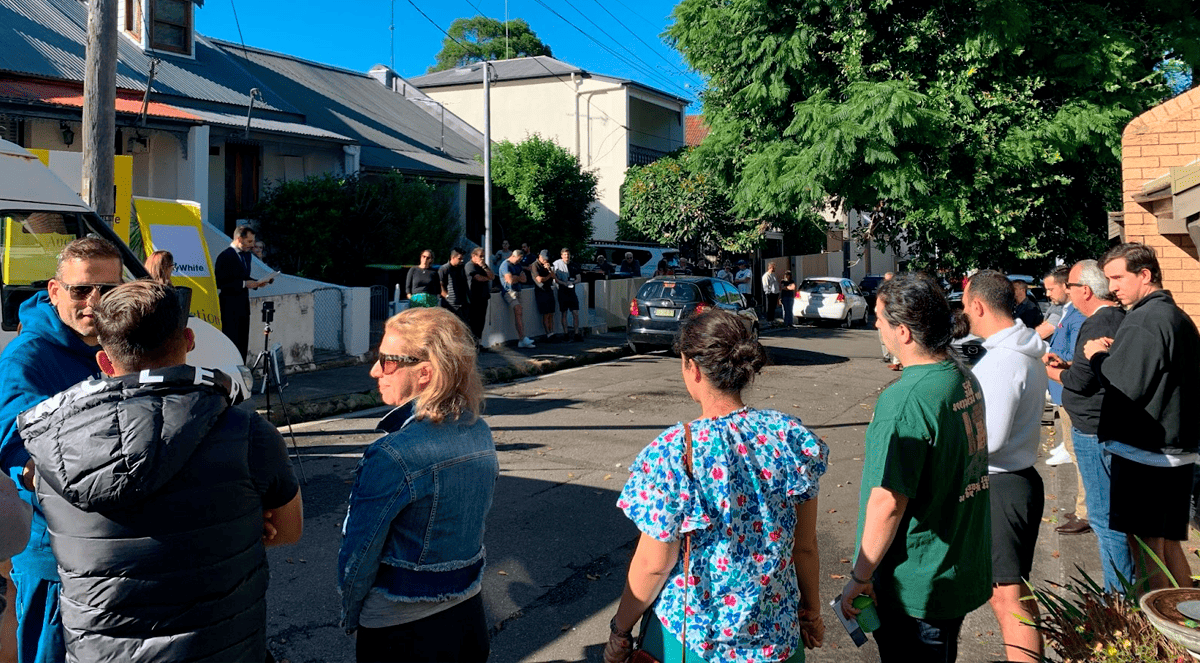
Image from Ray White
Australia’s housing affordability crisis is often summed up in a single number: the price-to-income ratio.
That’s the price of the median property divided by the annual median household income.
But that headline figure only tells part of the story.
Even if homeownership levels are slowly falling from their peak in the mid-1960s, the property market is still robust, and many younger Australians are still finding ways to get a foot on the property ladder.
So, how are Australians getting around the affordability hurdle?
It’s a question Nerida Conisbee, the Chief Economist at Ray White, has tried to answer in a new essay called “What price-to-income ratios miss about affordability”.
The details
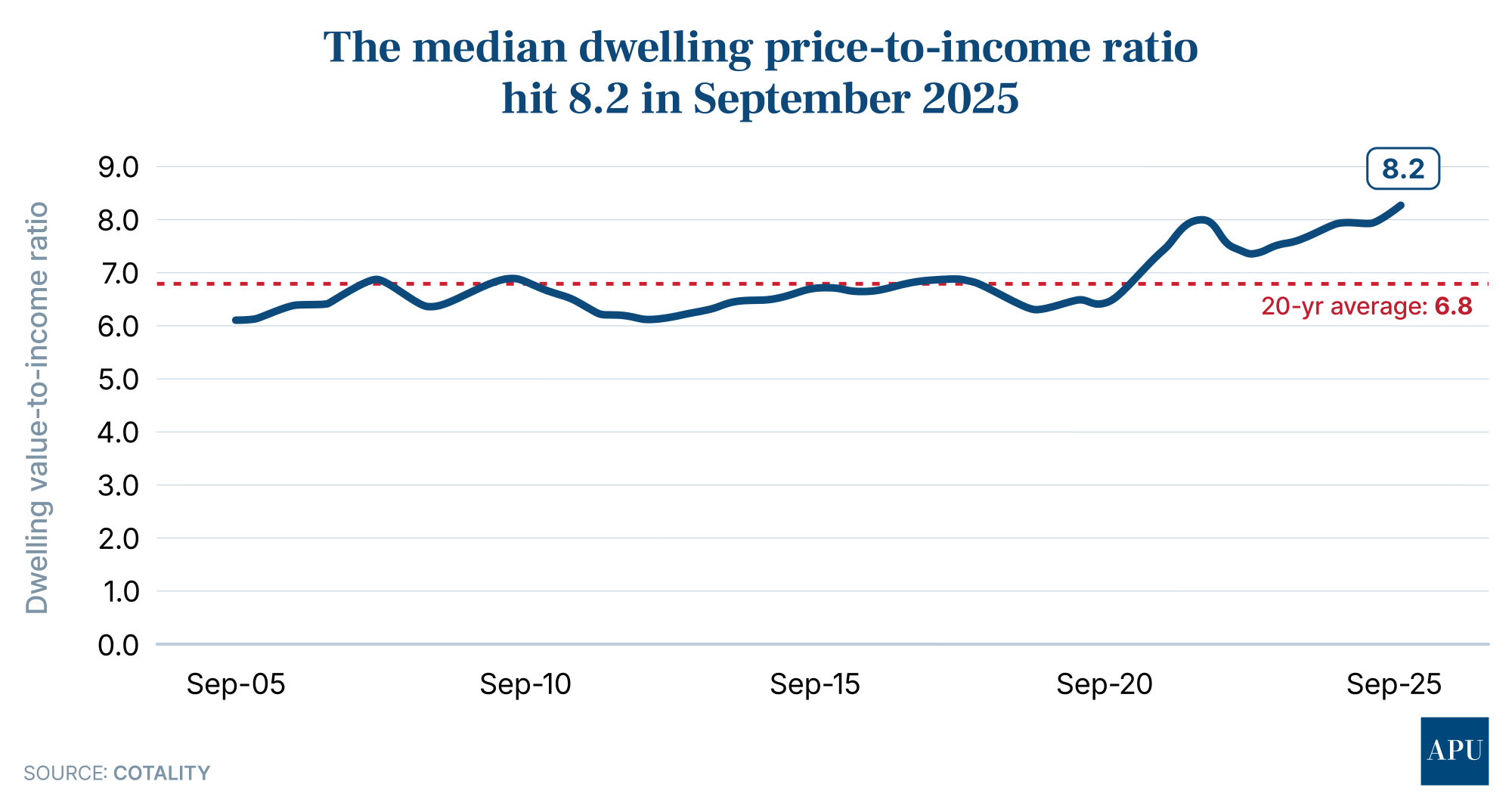
Across much of the developed world, housing price-to-income ratios are sitting well above their long-run averages - and Australia is no exception.
The latest Housing Affordability Report from Cotality shows the national dwelling value-to-income ratio reached 8.2 in September 2025, compared with a 20-year average of 6.8.
It now takes 11 years to save a standard 20% deposit - much longer in an expensive city like Sydney - while 45% of gross household income is required to service a new mortgage.
Three of the four key affordability measures in Cotality’s report are at their weakest levels on record.
So, on the surface, the picture looks bleak.
But Ray White’s Nerida Conisbee argues the more important question is how buyers are still managing to purchase homes under strained affordability conditions.
“The more relevant question is not why housing is expensive, but how buyers are still able to transact at these levels,” she writes.
The median myth
Nerida Conisbee says one key flaw in the price-to-income ratio measure is that it compares the median dwelling price to the median household income.
The implication is that people with a median household income are trying to buy a median-priced home.
In reality, that’s rarely the case.
“Half of all homes sell below the median price,” she says.
“The median is not the entry-level benchmark; it is simply the midpoint of the market.”
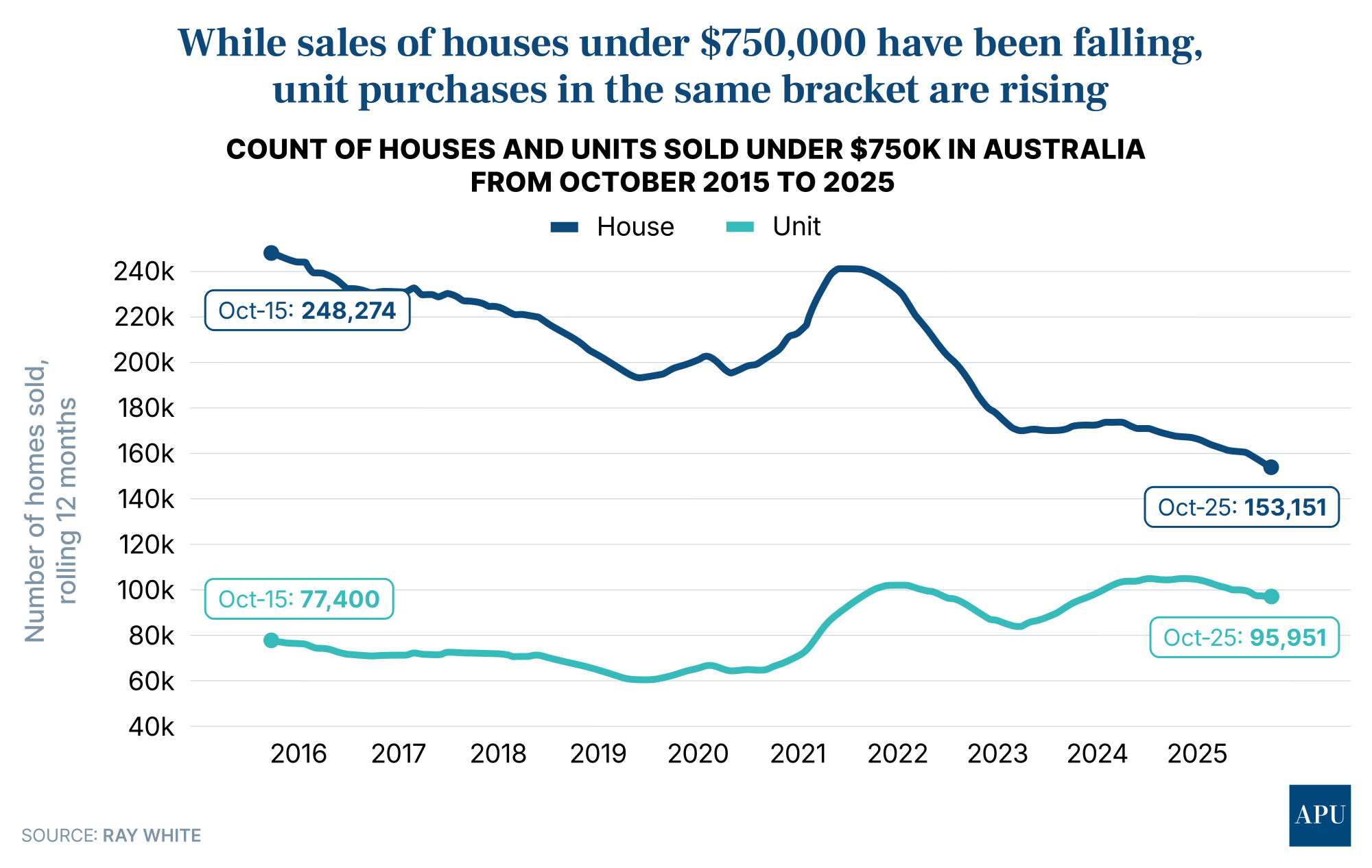
First-home buyers typically purchase in the lower half of the market, and as affordability pressures intensify, they are moving even further down the price ladder.
The shift is clear in the data.
Over the past decade, national house sales under $750,000 have fallen sharply - from about 248,000 in 2015 to roughly 153,000 in 2025.
Entry-level detached homes are disappearing.
By contrast, unit sales under $750,000 have risen from around 77,000 to nearly 96,000 over the same period.
“This divergence suggests affordability pressures are reshaping demand rather than eliminating it,” Nerida Conisbee says.
In other words, buyers are substituting: swapping land for location, size for access and houses for apartments.
Policy and family support
Government policy is also playing a bigger role in keeping buyers in the market.
ABS data shows first-home buyer owner-occupier loan commitments rose 6.8% in the December quarter of 2025 and are up 9.1% over the year.
That lift coincided with the expansion of the Federal government’s 5% Deposit Guarantee Scheme and the introduction of the “Help to Buy” shared equity program.
Such policies “materially reduce the deposit hurdle, which is often the most binding constraint for first-home buyers,” Ms Conisbee notes.
While saving a traditional 20% deposit for the median home typically takes 11 years, being able to enter the market with just 5% shortens that timeline significantly.
Shared equity arrangements also reduce initial loan sizes and ease repayment pressures.
“These programs do not make housing inexpensive, but they change the structure of entry by redistributing risk and bringing forward demand,” the Ray White Chief Economist says.
Then there’s the so-called “Bank of Mum and Dad”.
Parents who have benefited from decades of capital growth are increasingly gifting deposits or providing loan guarantees, effectively recycling housing wealth to help younger buyers enter the market.
Credit
Nerida Conisbee also argues that affordability is shaped not just by prices and incomes, but by credit settings.
Thirty-year loan terms are now standard, high loan-to-valuation lending is common, and refinancing is widely used to manage repayments.
ABS data shows the average first-home buyer loan reached $607,624 in the December quarter of 2025, reflecting both higher prices and greater borrowing capacity.
“Affordability is not determined solely by the relationship between income and price, but by what banks are willing to lend and what households can service,” she says.
The take-out
None of this, Nerida Conisbee stresses, means affordability hasn’t deteriorated.
Deposit hurdles remain historically high, mortgage burdens are elevated, and rental pressures are intensifying.
Home ownership rates among younger Australians are falling.
But the persistence of buyer activity shows the market is adapting.
“Price-to-income ratios provide a valuable structural indicator of long-term pressure, but they cannot explain behavioural adaptation, institutional support or compositional change within the market,” she says.
The price-to-income ratio tells us housing is getting more expensive relative to income.
But the broader data, Ms Conisbee argues, shows how Australians are still finding ways to buy - by adjusting what they purchase, how they finance it and who helps them along the way.
Understanding housing affordability in 2026, she concludes, requires looking beyond a single headline number.











.jpg?width=1920&height=1080&name=WTF%20Is%20Happening%20To%20The%20Housing%20Market!%20$500%20Billion%20Wiped%20Out%20As%20Prices%20Fall%20Faster%20Every%20Month%20Scott%20Kuru%20YPU%20027%20(1).jpg)
%20Scott%20Kuru%20YPU%20025.jpg?width=1920&height=1080&name=This%20Is%20Worse%20Than%20A%20Recession%20RBA%20Admits%20Australias%20Wage%20Collapse%20Cant%20Be%20Stopped%20(Prepare%20Now)%20Scott%20Kuru%20YPU%20025.jpg)






















.jpg?width=1920&height=1080&name=EXPOSED%20How%20The%20Govt%20Let%20These%20Oil%20Giants%20Get%20Away%20With%20Paying%20Zero%20Tax%20For%20Aussie%20Gas%20Scott%20Kuru%20DPU%20256%20(1).jpg)






%20Scott%20Kuru%20DPU%20248.jpg?width=1920&height=1080&name=Major%20Banks%20CAUGHT%20Preparing%20For%20Australia%E2%80%99s%20Biggest%20Housing%20Crash%20(Defaults%20%26%20Bankruptcies%20Coming)%20Scott%20Kuru%20DPU%20248.jpg)
%20Scott%20Kuru%20DPU%20247.jpg?width=1920&height=1080&name=This%20Is%20How%20Australia%20Gets%20Pushed%20Into%20the%20Next%20Big%20Reset%20(Trust%20Collapse%20Has%20Officially%20Begun)%20Scott%20Kuru%20DPU%20247.jpg)







%20Scott%20Kuru%20DPU%20239.jpg?width=1920&height=1080&name=URGENT%20Life%20In%20Australia%20Has%20Become%20Impossible%20For%20Millions%20Of%20Aussies%20(It%E2%80%99s%20About%20To%20Get%20Worse)%20Scott%20Kuru%20DPU%20239.jpg)









%20Scott%20Kuru%20DPU%20227.jpg?width=1920&height=1080&name=URGENT%20ALERT%20Australia%E2%80%99s%20Property%20Market%20Is%20Sliding%20Into%20Something%20Much%20Bigger%20(Prepare%20Now)%20Scott%20Kuru%20DPU%20227.jpg)