









.png?width=292&height=292&name=Copy%20Link%20(1).png)

 SIGN UP FOR FREE NEWSLETTER
Image by Chris Hopkins/SMH
There’s yet more evidence that the Federal government’s 5% Deposit Guarantee Scheme for first-home buyers is rapidly making entry-level housing unaffordable.
New figures from the Real Estate Institute of Australia show housing affordability declined in the last quarter of 2025.
Separate data covering the same three months from the banking regulator - APRA - reveals Australian banks also approved a record amount in riskier loans to owner-occupiers with deposits of 5% or less.
The latest figures follow recent research by Cotality and Ray White that indicates lower-priced homes, typically favoured by first-home buyers, are experiencing much stronger price growth than the broader market because of the intense competition caused by the 5% Deposit scheme.
REIA
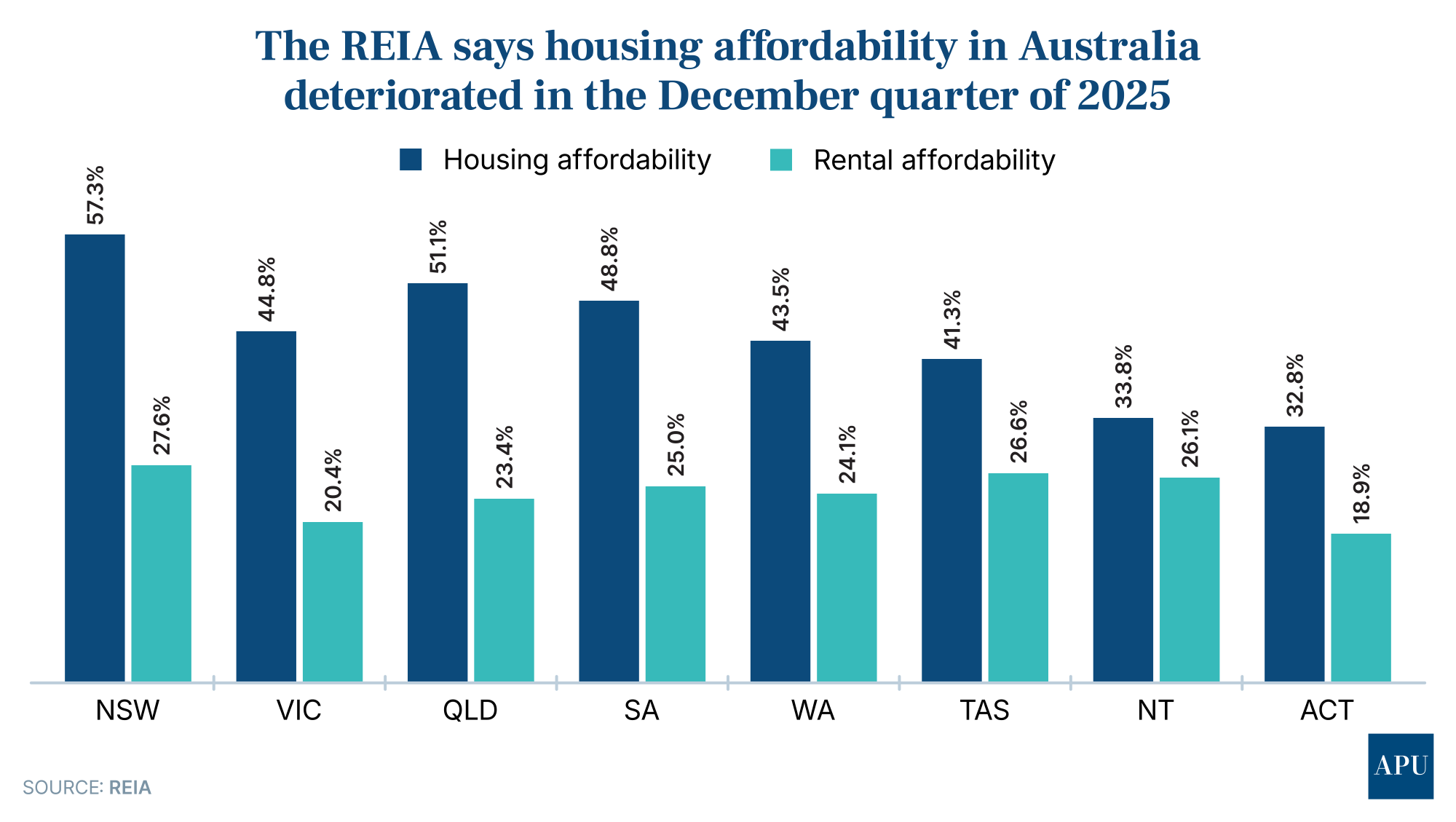
The Real Estate Institute of Australia says its latest Housing Affordability Report shows affordability declined in the December quarter of 2025.
The REIA says the decline in affordability was largely driven by increased first-home buyer activity, following the significant expansion of the Albanese Government’s 5% Deposit Scheme.
From the 1st of October 2025, the scheme was expanded, with caps on scheme places and annual incomes scrapped, while price thresholds were lifted significantly to more closely match median home values in individual markets around Australia.
REIA President Jacob Caine says while the scheme has helped more Australians enter the housing market, it has also had an adverse impact on affordability, as buyers take on larger and larger loans.
“The expansion of the 5% Deposit Scheme has clearly succeeded in enabling more Australians, particularly first-home buyers, to enter the housing market,” he says.
“However, the consequence has been that many new buyers have been able to commit to larger loans under the scheme, which has increased the proportion of household income required to service a mortgage.”
The REIA measures “affordability” by comparing the cost of servicing a standard variable-rate mortgage on an average home in different parts of Australia to the combined median household income.
Its latest report shows the average home loan repayment now represents 49.2% of the median family income, reflecting a large decline in housing affordability of 2.2% over the quarter.


Despite the quarterly decline, affordability remains 0.7% better than in the December quarter of 2024, when higher interest rates placed greater pressure on borrowers.
Affordability declined in all states and territories, with Western Australia seeing the biggest fall at 3%.
There’s also a wide divergence across the country, with households in New South Wales having to dedicate a crippling 57.3% of household income to mortgage repayments.
That’s nearly double the figure in the ACT, where 32.8% of household income needs to be set aside for mortgage repayments.
The average household with a mortgage in all states and territories also falls into the “housing stress” category - defined as when a household has to dedicate more than 30% of its income to housing.
REIA’s Housing Affordability Report notes an above-average number of first-home buyers were active in the quarter, clearly reflecting the impact of the enhanced 5% Deposit Guarantee scheme in allowing many prospective buyers to purchase a home sooner.
“Reducing the deposit hurdle is helping more Australians achieve home ownership,” REIA’s President Jacob Caine says.
“But policies that stimulate demand must be considered alongside the broader housing affordability picture.
“Demand-side initiatives (such as the 5% Deposit Guarantee Scheme) can support home ownership, but improving housing affordability ultimately requires supply to keep pace with demand,” he says.
“Ensuring Australia delivers enough housing will remain critical to improving affordability outcomes in the years ahead.”
APRA
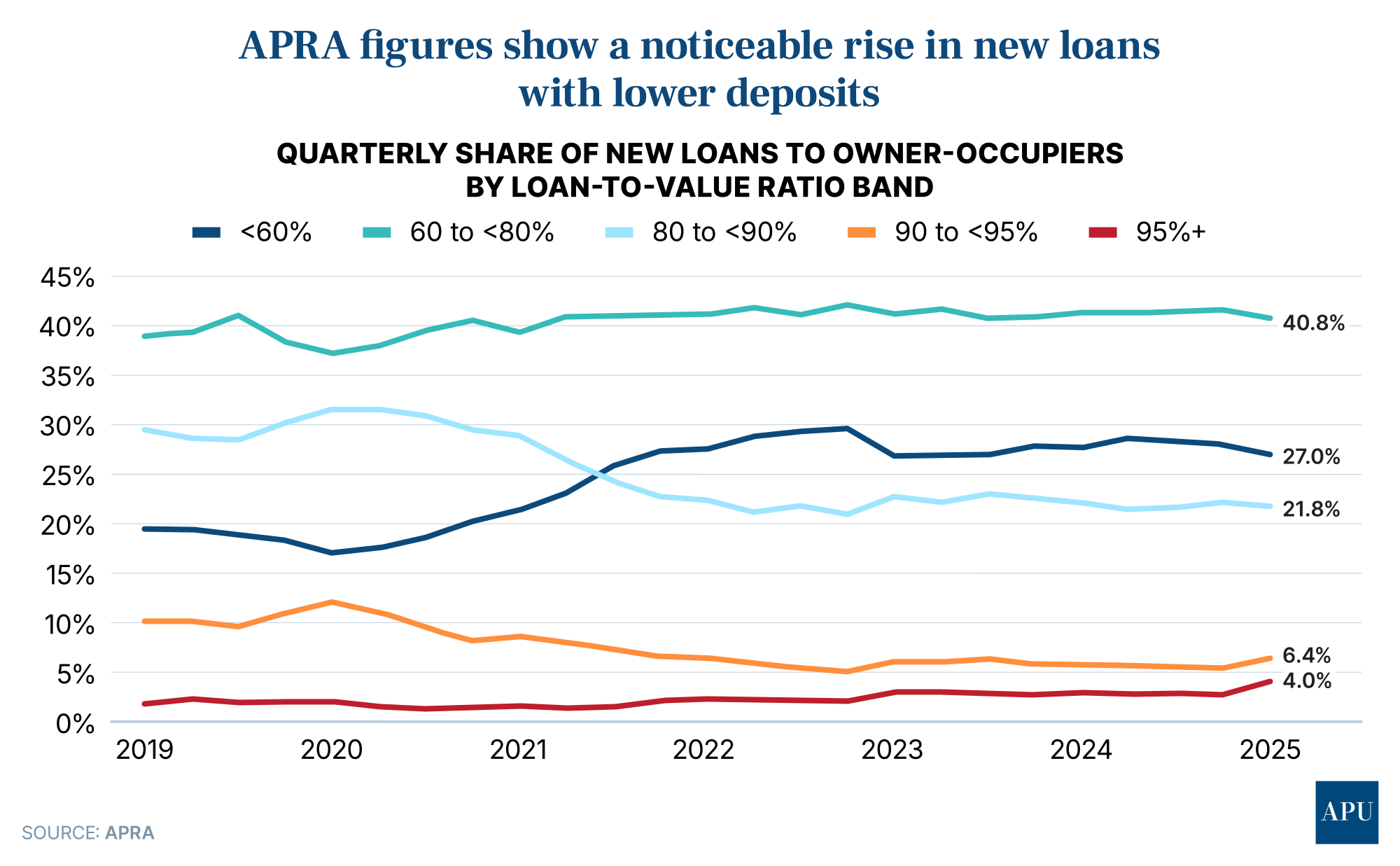
APRA’s latest property exposure statistics show Australian banks approved a record $5.4 billion worth of loans to owner-occupiers with deposits of 5% or less in the December quarter of 2025, following the uncapping of the government’s Home Guarantee Scheme.
This was an increase of $2.1 billion or 63% on the previous quarter.
“These risky low-deposit loans now account for 4% of all new owner-occupier mortgages, the highest proportion on record since the APRA dataset began in 2019,” says comparison site Canstar.
“The effect of the Home Guarantee Scheme may not seem huge but it is apparent,” says independent housing commentator Cameron Kusher.
Mr Kusher points out that the APRA data also shows a strong rise in what’s effectively the next riskiest tier of lending - the share with a Loan-to-Value Ratio of 90% to <95% - suggesting that the scheme may also be attracting more buyers with slightly larger deposits of up to 10%.
Cameron Kusher says that segment has risen from 5.4% of the total number of loans in the previous quarter to 6.4% in the December 2025 quarter - and is at its highest share since December 2022.
“What's potentially concerning is interest rates have already risen once and are expected to rise further this year,” Mr Kusher says.
“While the lower end of the market is still seeing growth so far, values are already broadly falling in Sydney and Melbourne and this may continue as rates increase and remain elevated.”
Mr Kusher raises the prospect of “negative equity”, where borrowers with big loans may find themselves in financial trouble if the outstanding balance of their mortgages exceeds the market value of their homes.
“This would be bad news for recent buyers such as first-home buyers who have been attracted to buy with these generous government incentives.”
Canstar says the APRA figures also show that new loans where the borrower has a debt-to-income ratio of six times or more rose by $2.8 billion from the previous quarter.
“This risky lending now accounts for 6.8% of all new owner-occupier and investor lending, up from 5.5% six months prior.
“The rise in this risky lending, and the marked acceleration in investor lending, prompted APRA to announce new caps on high debt-to-income (DTI) loans in November of last year, with the cap coming into effect on 1st February (2026),” the comparison site says.
“That said, it is well below both the new 20% cap and the record high back in late 2021 when over 24% of new loans had a DTI ratio of six times or more.”
The take-out
The REIA figures and APRA data are yet more evidence that plenty of first-home buyers have rushed to take up the chance of getting into the property market with just a 5% deposit.
They’ve brought forward - sometimes by years - their plans to buy a home, because they no longer need to save a standard 20% deposit to avoid paying expensive lenders mortgage insurance.
But you have to wonder, with inflation high and the Reserve Bank of Australia making it increasingly clear that interest rates will have to keep going up in the short-term, if these already highly-leveraged first-home buyers are prepared for the bigger and bigger repayments they are going to have to make.
Meanwhile, the rapid death of affordable property in Australia continues at pace…













.jpg?width=1920&height=1080&name=WTF%20Is%20Happening%20To%20The%20Housing%20Market!%20$500%20Billion%20Wiped%20Out%20As%20Prices%20Fall%20Faster%20Every%20Month%20Scott%20Kuru%20YPU%20027%20(1).jpg)

%20Scott%20Kuru%20YPU%20025.jpg?width=1920&height=1080&name=This%20Is%20Worse%20Than%20A%20Recession%20RBA%20Admits%20Australias%20Wage%20Collapse%20Cant%20Be%20Stopped%20(Prepare%20Now)%20Scott%20Kuru%20YPU%20025.jpg)





























.jpg?width=1920&height=1080&name=EXPOSED%20How%20The%20Govt%20Let%20These%20Oil%20Giants%20Get%20Away%20With%20Paying%20Zero%20Tax%20For%20Aussie%20Gas%20Scott%20Kuru%20DPU%20256%20(1).jpg)







%20Scott%20Kuru%20DPU%20248.jpg?width=1920&height=1080&name=Major%20Banks%20CAUGHT%20Preparing%20For%20Australia%E2%80%99s%20Biggest%20Housing%20Crash%20(Defaults%20%26%20Bankruptcies%20Coming)%20Scott%20Kuru%20DPU%20248.jpg)
%20Scott%20Kuru%20DPU%20247.jpg?width=1920&height=1080&name=This%20Is%20How%20Australia%20Gets%20Pushed%20Into%20the%20Next%20Big%20Reset%20(Trust%20Collapse%20Has%20Officially%20Begun)%20Scott%20Kuru%20DPU%20247.jpg)







%20Scott%20Kuru%20DPU%20239.jpg?width=1920&height=1080&name=URGENT%20Life%20In%20Australia%20Has%20Become%20Impossible%20For%20Millions%20Of%20Aussies%20(It%E2%80%99s%20About%20To%20Get%20Worse)%20Scott%20Kuru%20DPU%20239.jpg)











%20Scott%20Kuru%20DPU%20227.jpg?width=1920&height=1080&name=URGENT%20ALERT%20Australia%E2%80%99s%20Property%20Market%20Is%20Sliding%20Into%20Something%20Much%20Bigger%20(Prepare%20Now)%20Scott%20Kuru%20DPU%20227.jpg)