









.png?width=292&height=292&name=Copy%20Link%20(1).png)

 SIGN UP FOR FREE NEWSLETTER
Residential property remains a fundamentally secure and rewarding investment strategy, despite budget changes outlined by the Albanese Federal government.
Treasurer Jim Chalmers has confirmed that negative gearing will no longer be available to investors who purchase existing property after budget night on the 12th of May 2026.
The 50% Capital Gains Tax discount will also be rolled back from the 1st of July 2027, replaced with a less generous inflation-adjusted scheme.
The government has clearly designed the changes to make property investment appear less attractive, and to give first-home buyers less competition from investors.
“The truth is that we've thrown everything at the housing supply issue,” Prime Minister Anthony Albanese said, explaining the new investor tax regime, “but young people still aren't getting a crack.”
Although revenue raised from the tax grab will help fund personal income tax offsets for workers, the stated aim of the policy is to get 75,000 more owner-occupiers into the property market over the next ten years.
There’s been an outcry from everyone, from big developers like Meriton’s Harry Triguboff to CEOs of start-up firms that have become ensnared in the CGT changes, to tax advisers representing wealthy clients with big share portfolios.
While there’s no doubt the confidence of investors - particularly property investors - will be shaken by the biggest overhaul in investment rules in a generation - the fundamentals of property remain the same; Australia has a chronic undersupply of homes in the face of strong population growth and demand for housing.
And as a result, rents are likely to remain strong, meaning tenants - the people who can least afford it - could end up bearing much of the cost of the government’s property tax changes.
New property
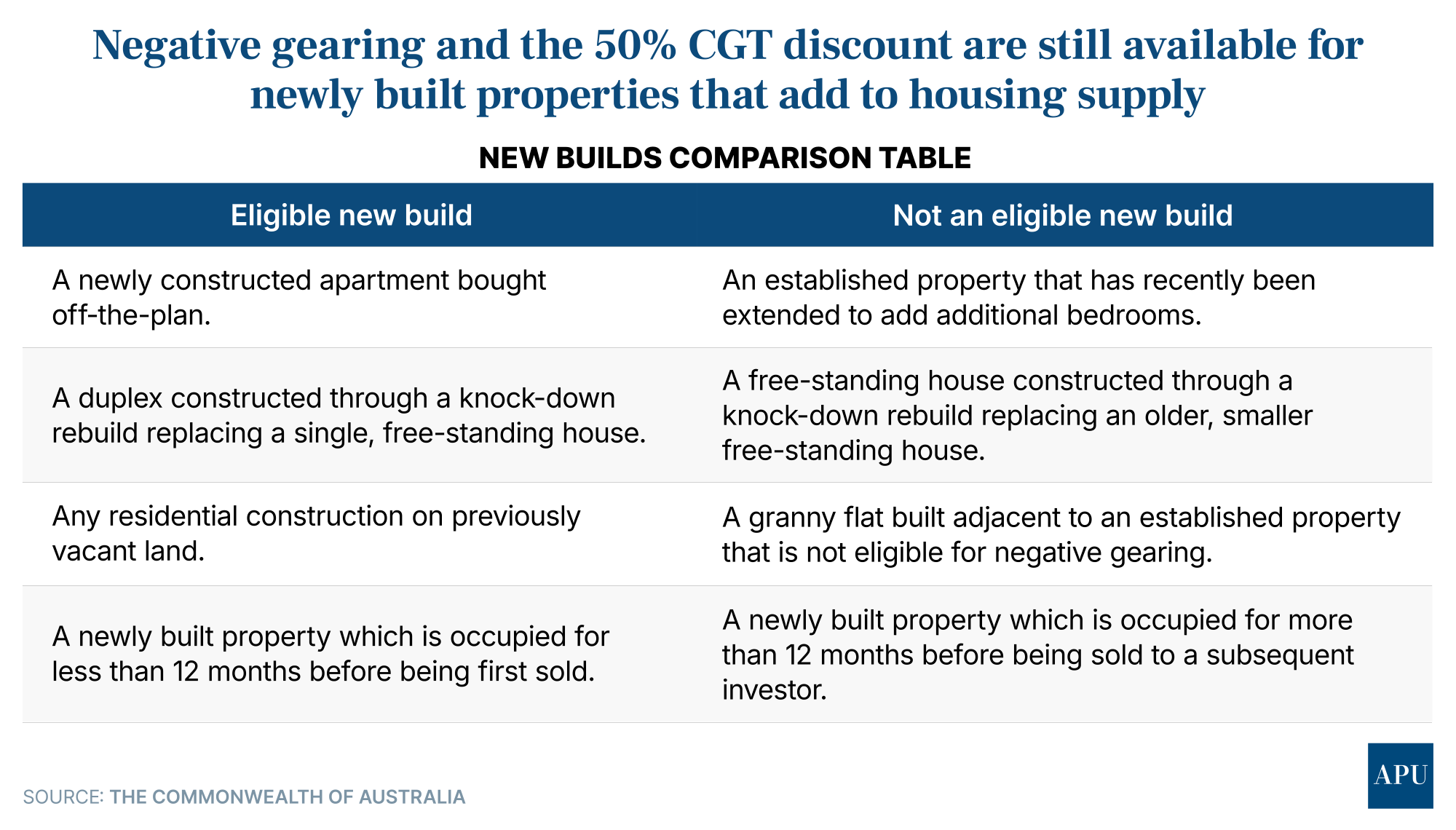
The first thing to note is that investment in newly built housing is totally exempt from the changes.
This is a deliberate strategy by the government to encourage investment in new supply.
Investors who buy newly built property will still have access to negative gearing. This means if they make a rental loss on their investment, they can still use that loss to reduce their taxable income (including salary and wages).
They can also choose either the 50% CGT discount or the new CGT indexation method (gains minus inflation with a minimum rate of 30% taxation) when they sell the property.
The government defines “new builds” as “residential properties which genuinely add to supply”.
This includes:
- dwellings constructed on vacant land, or
- where existing properties are demolished and replaced with a greater number of dwellings.
Knock-down rebuilds or substantial renovations that do not increase supply are not eligible.
The budget fact sheet on negative gearing and CGT changes also notes that “a new build also cannot have been previously sold, unless first owned by the builder and not occupied for more than 12 months.”
Nerida Conisbee, the Chief Economist at Ray White, says that while limiting negative gearing to new homes will likely create a tax preference for new housing, “that is not the same as guaranteeing more homes will be built.”
“For the policy to increase supply, investors need to buy new properties at prices that make projects viable,” she says, which “depends on planning approvals, infrastructure, construction costs, labour availability, finance and whether the finished product is in a location where people actually want to rent.”
You can still claim losses
While negative gearing may have been killed off for investors who buy an existing property, that doesn’t mean they can’t claim losses.
It just means that any rental losses they make will only be deductible from property income.
And if they make a loss in any particular year, they’ll be able to “carry forward” those losses to future years.
Here’s an example from the budget papers:
"In 2027–28, Jason incurs a net rental loss of $10,000 from his property. Under the quarantining arrangements, the $10,000 cannot offset Jason's other taxable income in 2027–28 but can offset residential property rental income and/or residential property capital gains, including in future years.



"In 2028–29, Jason earns $6,000 in net rental income from his property. As the $10,000 carry forward loss from the previous financial year is applied against this income, Jason would pay no tax on the rental income in this year. Jason now has a $4,000 quarantined loss that can continue to be carried forward.”
However, this does require investors who own existing property to have the capacity to deal with short-term losses.
“Wealthy investors are likely to be the only ones in a position to make investments in established properties because they are more likely to be able to afford to carry forward the losses to future years,” says independent property analyst Cameron Kusher.
Rents likely to be higher
The budget papers say Treasury has modelled the axing of negative gearing for existing properties and the change in the CGT regime to lower home prices by “around 2% less over a couple years relative to no tax policy change.”
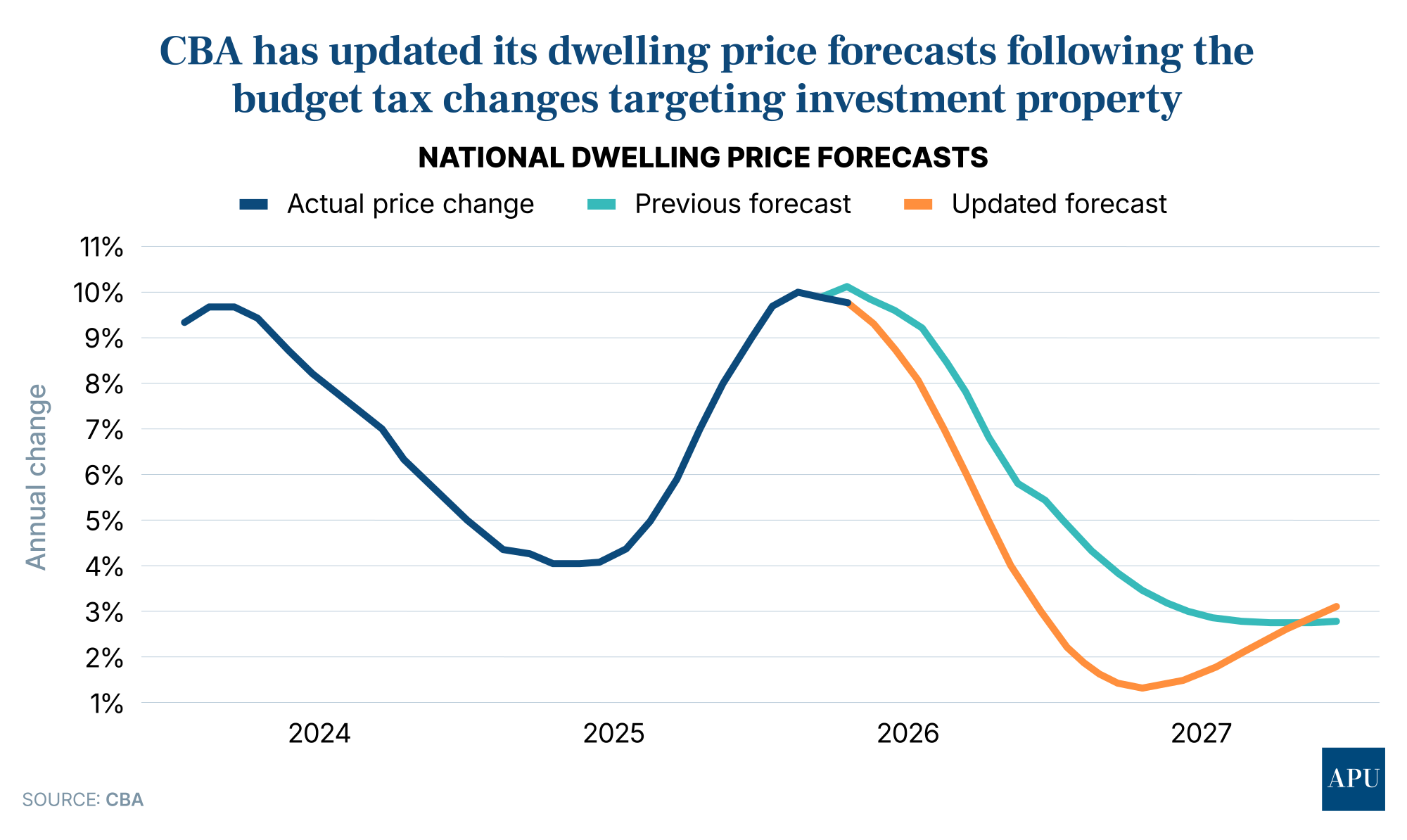
In an updated housing forecast issued after the budget, Commonwealth Bank predicted the hit to confidence from recent RBA rate hikes and the government’s tax changes would knock about 3% off dwelling prices to December 2026.
When you subtract the effect of the RBA’s rate hikes, CBA says the expected impact of the property investment tax changes is only about 0.6% this year and just under 1% in 2027, when prices are expected to bounce back.
If CBA is right, this suggests any softening of home prices as a result of the changes may be only temporary and perhaps less than Treasury expects.
Treasury also says rents are likely to be higher, but only by around $2 per week for a median rental property.
Most analysts regard that figure as fanciful.
“On the back of these changes, investors are likely to have much more of a focus on the rental return of an investment property rather than focusing on capital growth potential,” Cameron Kusher says.
Ray White’s Nerida Conisbee agrees.
“The risk with these changes is that they do not remove housing pressure; they change where it shows up,” she says.
“If investor demand for established homes falls, some buyers may face less competition.
“But grandfathering means many existing investors are likely to hold rather than sell, limiting the number of established homes coming to market and muting the buyer benefit.
“Where rental homes do move into owner-occupation, the rental pool shrinks,” she says.
“The pressure does not disappear - it shifts from house prices into rents.”
And if that happens, Cameron Kusher says renters will be paying higher rents for longer, making the challenge of “transitioning to ownership…more difficult.”
Supply
Treasurer Jim Chalmers admits government modelling shows the impact of the negative gearing and CGT tax changes for property investors will likely see 35,000 fewer homes built over the course of a decade.
The Federal Opposition has seized on this.
“The extraordinary thing is that they (the government) admit in their own budget papers that their tax changes are going to bring about fewer homes being built,” says Opposition leader Angus Taylor, “and that's the opposite of what we need.”
To help counter this, the budget sets aside an extra $2 billion of Commonwealth money to be offered to the states and territories over four years to boost supply of the enabling infrastructure for new housing.
The package is predicted to pave the way for 65,000 new homes.
However, the funding will only be rolled out if the states commit to reforms to improve productivity, including faster and simpler development approvals, releasing more shovel-ready land and making more progress towards delivering a national construction code.
Even if the states co-operate fully, a net gain of 30,000 extra homes over four years that might otherwise not have been built seems unlikely to do much to address the continuing dwelling supply shortfall - in the face of still strong population growth - which is likely to keep upward pressure on rents.
Before you head for the exit…
While TV news bulletins, radio talkback and newspaper columns will be full of investors and so-called experts crying foul about the property tax changes, the actual fundamentals of investing in Australian residential property remain sound.
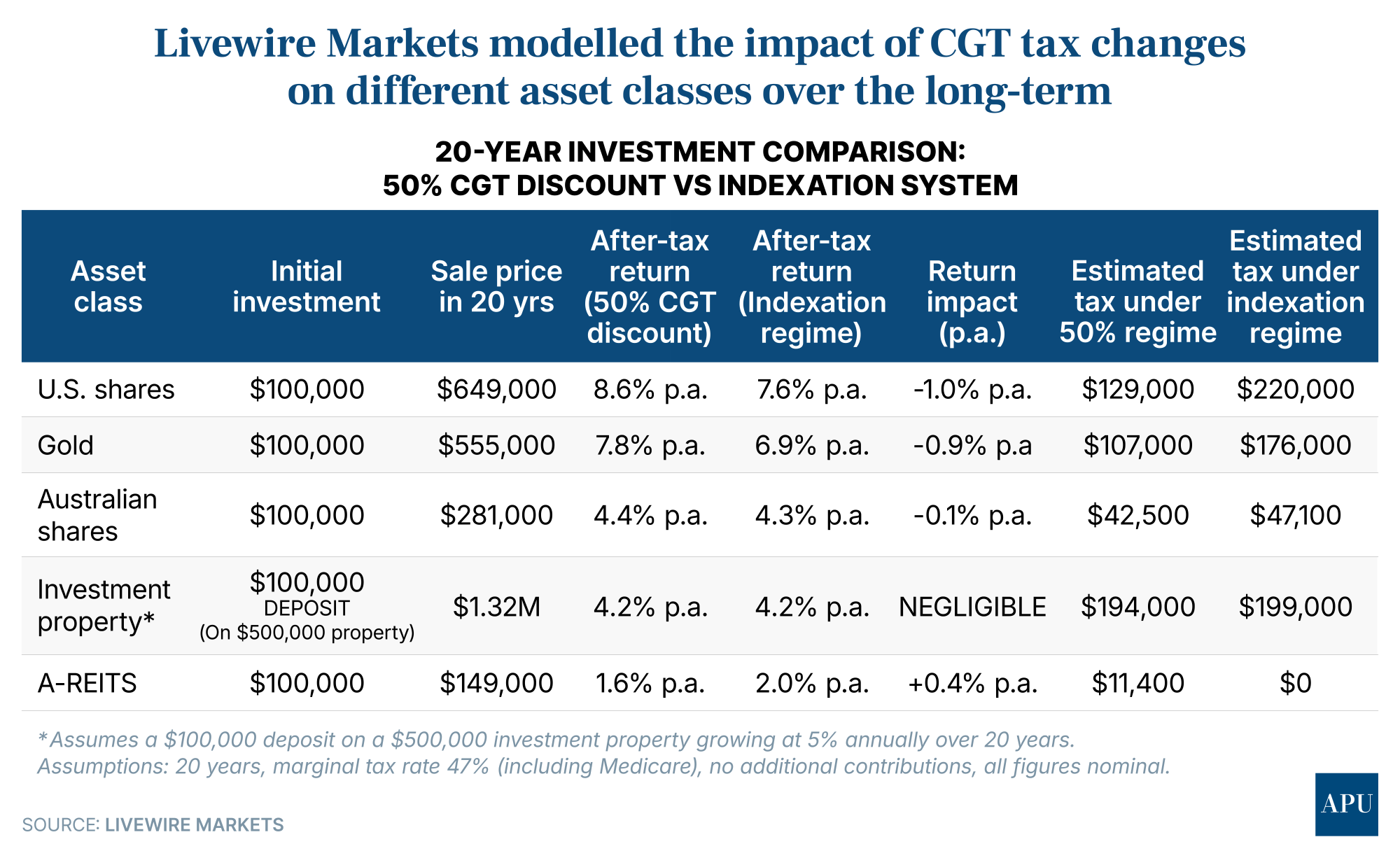
Recent modelling done by stock market newsletter Livewire Markets using a CGT calculator found that, over a 20-year time-frame, the difference in return between the 50% CGT discount and CGT indexed for inflation was negligible for investment property.
There wasn’t much difference for shares held over the same period as well.
Separate modelling by Dr Sam Wylie - a lecturer at the Melbourne Business School who runs his own investment education and advisory firm - puts an even more compelling case for currently negatively-geared investors to hang on to their existing property assets, not dump them in a fire-sale.
Using the example of a borrower who put up a 30% deposit and took out a 70% investment loan to buy a property, Dr Wylie recently demonstrated that over the long term, blue-chip investment properties handsomely reward taxpayers who pay the top rate of income tax.
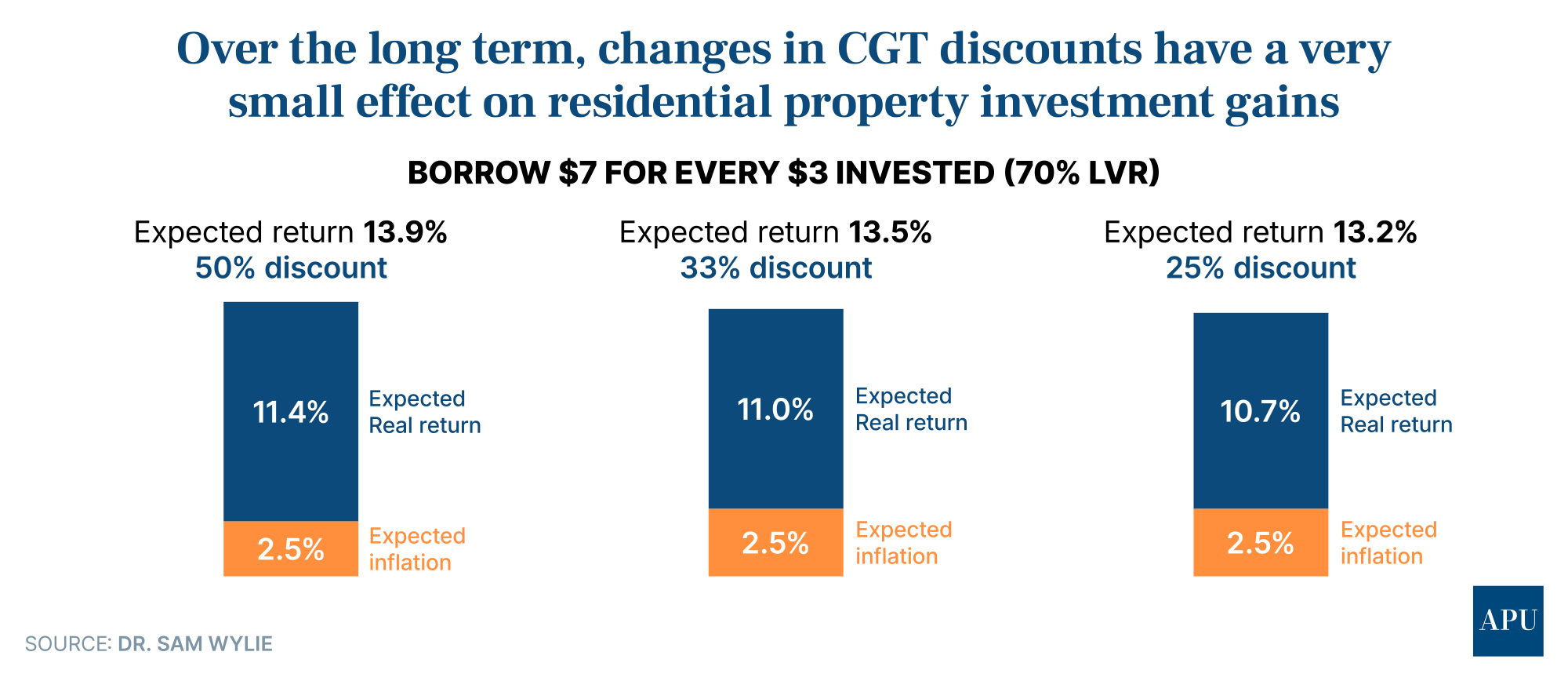
His stunning finding was that after 30 years, there was not much difference between a realised property investment with a 50% CGT discount (13.9% per annum growth in gross terms, 11.4% after inflation), a 33% CGT discount (13.5% per annum growth in gross terms, 11% after inflation) and a 25% CGT discount (13.2% per annum in gross terms, 10.7% after inflation).
Given the government has landed on a minimum 30% CGT discount rate, on Dr Wylie’s numbers, you would be looking at something like 13.4% per annum growth - 10.9% after discounting for inflation.
“That doubles your real after-tax money every 6-and-a-half years,” Dr Wylie says.
“Fantastic opportunity.
“Commentators are overestimating the detrimental effect of a reduction in the Capital Gains Tax discount for residential property investors,” he says.
“And the reason that they are overestimating it is that they don’t understand the effect of delay.
“They don’t understand how important delay is, and especially they don’t understand that delay in capital gains will be even more effective if the discount goes down.”
So maybe don’t go out and sell that negatively-geared investment property in a fit of pique at Anthony Albanese and Jim Chalmers.
Maybe don’t spend your weekends away from your family trying to “manufacture value” on an investment property that you intend to “flip” quickly.
Instead, maybe take some advice from one of the nation’s sharpest investment minds - someone who teaches investment and tax strategy for a living and who advises some of Australia’s wealthiest families.
Slow and steady wins the race.













.jpg?width=1920&height=1080&name=WTF%20Is%20Happening%20To%20The%20Housing%20Market!%20$500%20Billion%20Wiped%20Out%20As%20Prices%20Fall%20Faster%20Every%20Month%20Scott%20Kuru%20YPU%20027%20(1).jpg)

%20Scott%20Kuru%20YPU%20025.jpg?width=1920&height=1080&name=This%20Is%20Worse%20Than%20A%20Recession%20RBA%20Admits%20Australias%20Wage%20Collapse%20Cant%20Be%20Stopped%20(Prepare%20Now)%20Scott%20Kuru%20YPU%20025.jpg)





























.jpg?width=1920&height=1080&name=EXPOSED%20How%20The%20Govt%20Let%20These%20Oil%20Giants%20Get%20Away%20With%20Paying%20Zero%20Tax%20For%20Aussie%20Gas%20Scott%20Kuru%20DPU%20256%20(1).jpg)







%20Scott%20Kuru%20DPU%20248.jpg?width=1920&height=1080&name=Major%20Banks%20CAUGHT%20Preparing%20For%20Australia%E2%80%99s%20Biggest%20Housing%20Crash%20(Defaults%20%26%20Bankruptcies%20Coming)%20Scott%20Kuru%20DPU%20248.jpg)
%20Scott%20Kuru%20DPU%20247.jpg?width=1920&height=1080&name=This%20Is%20How%20Australia%20Gets%20Pushed%20Into%20the%20Next%20Big%20Reset%20(Trust%20Collapse%20Has%20Officially%20Begun)%20Scott%20Kuru%20DPU%20247.jpg)







%20Scott%20Kuru%20DPU%20239.jpg?width=1920&height=1080&name=URGENT%20Life%20In%20Australia%20Has%20Become%20Impossible%20For%20Millions%20Of%20Aussies%20(It%E2%80%99s%20About%20To%20Get%20Worse)%20Scott%20Kuru%20DPU%20239.jpg)











%20Scott%20Kuru%20DPU%20227.jpg?width=1920&height=1080&name=URGENT%20ALERT%20Australia%E2%80%99s%20Property%20Market%20Is%20Sliding%20Into%20Something%20Much%20Bigger%20(Prepare%20Now)%20Scott%20Kuru%20DPU%20227.jpg)