









.png?width=292&height=292&name=Copy%20Link%20(1).png)

 SIGN UP FOR FREE NEWSLETTER

The Albanese Government's flagship capital gains tax reforms could actually end up raising less revenue than expected if Australia's housing market slows and inflation remains elevated, according to new analysis.
While the Budget decision to replace the long-standing 50% capital gains tax discount with an inflation-indexed system has been widely interpreted as a tax increase on property investors, Ray White’s Chief Economist argues the reality may be far more complicated.
In some market conditions, Nerida Conisbee says the new system could actually result in investors paying less tax than they would under the existing regime.
The details
“The Federal Budget’s move from the 50% property CGT discount to inflation indexation sounds, at first glance, like a tougher tax treatment for investors,” Ms Conisbee says.
“In some market conditions, it will be. But in a weak housing market with elevated inflation, the opposite can occur.”
The key issue is the way the new tax system calculates capital gains.
Under the old rules, investors who held a property for more than 12 months received a 50% discount on any capital gain before tax was applied.
Under the new regime, the property's cost base will instead be indexed for inflation, meaning investors are only taxed on gains above inflation.
“That is a significant change,” Ms Conisbee says.
“It moves the system from taxing half the nominal gain to taxing the real gain.”
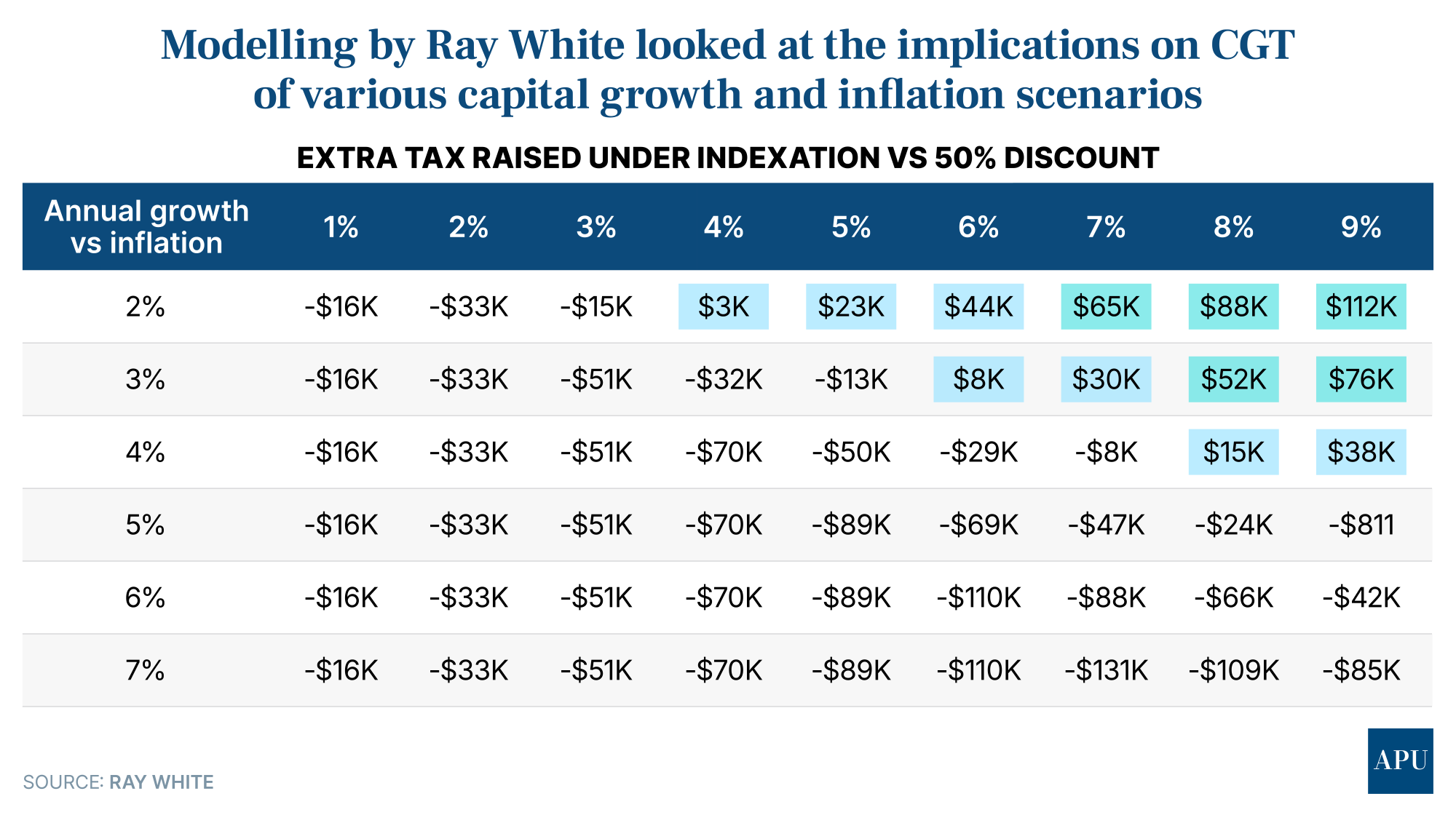
The effectiveness of the new tax regime in generating government revenue depends heavily on one crucial factor: the gap between house price growth and inflation.
When property prices rise strongly and comfortably outpace inflation, the indexed system can produce larger taxable gains and higher tax collections.
But Ms Conisbee says Australia may be heading into exactly the opposite environment.
“The outlook is now likely to become weaker,” she says.
“The budget’s housing tax changes are designed to reduce investor demand for established property, which will weigh on prices.”
At the same time, inflation remains stubbornly high.
Annual inflation was running at 4.2% in April, well above the Reserve Bank's 2-3% target range, while underlying inflation remains elevated.
“If inflation is running at four or five per cent and property prices are growing at only one or two per cent, then the indexed cost base rises faster than the asset value,” Ms Conisbee says.
“In that scenario, there may be little or no taxable real gain.”
Her analysis suggests this could substantially reduce CGT collections in the years immediately after the reform is introduced.
Housing market already losing momentum
The warning comes as a growing number of indicators suggest Australia's housing market is entering a softer phase.
Ms Conisbee notes Sydney and Melbourne are already recording much weaker growth than the rest of the country, while rising interest rates, weaker consumer confidence and cost-of-living pressures are weighing on buyer demand.
The Reserve Bank has raised interest rates three times this year, lifting the cash rate to 4.35%.
At the same time, Ray White's own buyer activity data has deteriorated sharply.
“Ray White open home attendance has fallen sharply, with the national four-week rolling average falling to 2.5 attendees per open home by late May,” Ms Conisbee says.
“Sydney and Melbourne are now particularly soft, both sitting close to two attendees per open home.”
She also points to forecasts that investor demand could weaken substantially following the Budget's property tax changes.
Investors may simply sit tight
A further complication is investor behaviour.
Even if capital gains remain positive, a weaker housing market could encourage investors to hold properties rather than sell them, delaying tax collections even further.
“If prices soften, some investors may simply hold rather than sell, particularly where rental income remains strong,” Ms Conisbee says.
That matters because capital gains tax revenue depends not only on the size of gains, but also on how many investors choose to transact.
“In a weaker market, with policy uncertainty and higher interest rates, transaction volumes are likely to be lower than they otherwise would have been,” she says.
Revenue assumptions
Ms Conisbee says the broader question for the Budget is whether the government is assuming a level of CGT revenue that may not materialise.
“The policy may be defensible if the aim is to tax real gains rather than inflation,” she says.
“But it should not be assumed to raise more tax from property investors in the near term.”
Her conclusion is blunt.
“In the market conditions Australia now faces, the shift from the 50% discount to indexation could reduce, rather than increase, near-term CGT revenue from property investors.”
For a government relying on higher taxes from investors to help fund its broader Budget agenda, that may prove to be an unintended consequence of one of the most significant housing tax reforms in a generation.












.jpg?width=1920&height=1080&name=WTF%20Is%20Happening%20To%20The%20Housing%20Market!%20$500%20Billion%20Wiped%20Out%20As%20Prices%20Fall%20Faster%20Every%20Month%20Scott%20Kuru%20YPU%20027%20(1).jpg)
%20Scott%20Kuru%20YPU%20025.jpg?width=1920&height=1080&name=This%20Is%20Worse%20Than%20A%20Recession%20RBA%20Admits%20Australias%20Wage%20Collapse%20Cant%20Be%20Stopped%20(Prepare%20Now)%20Scott%20Kuru%20YPU%20025.jpg)




























.jpg?width=1920&height=1080&name=EXPOSED%20How%20The%20Govt%20Let%20These%20Oil%20Giants%20Get%20Away%20With%20Paying%20Zero%20Tax%20For%20Aussie%20Gas%20Scott%20Kuru%20DPU%20256%20(1).jpg)







%20Scott%20Kuru%20DPU%20248.jpg?width=1920&height=1080&name=Major%20Banks%20CAUGHT%20Preparing%20For%20Australia%E2%80%99s%20Biggest%20Housing%20Crash%20(Defaults%20%26%20Bankruptcies%20Coming)%20Scott%20Kuru%20DPU%20248.jpg)
%20Scott%20Kuru%20DPU%20247.jpg?width=1920&height=1080&name=This%20Is%20How%20Australia%20Gets%20Pushed%20Into%20the%20Next%20Big%20Reset%20(Trust%20Collapse%20Has%20Officially%20Begun)%20Scott%20Kuru%20DPU%20247.jpg)







%20Scott%20Kuru%20DPU%20239.jpg?width=1920&height=1080&name=URGENT%20Life%20In%20Australia%20Has%20Become%20Impossible%20For%20Millions%20Of%20Aussies%20(It%E2%80%99s%20About%20To%20Get%20Worse)%20Scott%20Kuru%20DPU%20239.jpg)










%20Scott%20Kuru%20DPU%20227.jpg?width=1920&height=1080&name=URGENT%20ALERT%20Australia%E2%80%99s%20Property%20Market%20Is%20Sliding%20Into%20Something%20Much%20Bigger%20(Prepare%20Now)%20Scott%20Kuru%20DPU%20227.jpg)