









.png?width=292&height=292&name=Copy%20Link%20(1).png)

 SIGN UP FOR FREE NEWSLETTER

Image by Cason Ho/ABC News
Australian landlords have received an unlikely financial cushion from the Albanese Government, with high migration helping to sustain rental demand even as interest rates, tax changes and falling property values put pressure on investors.
That’s the view of economics writer and commentator Tarric Brooker, who says Australia’s prolonged rental shortage in the face of strong migration has delivered investors much stronger rent growth than their counterparts in Canada, New Zealand and the United States.
The details
“With the impending change to the capital gains tax and negative gearing already phased out for buyers of established properties, Prime Minister Anthony Albanese doesn't appear to be the best friend of property investors,” Tarric Brooker says.
“But they should be thanking him.”
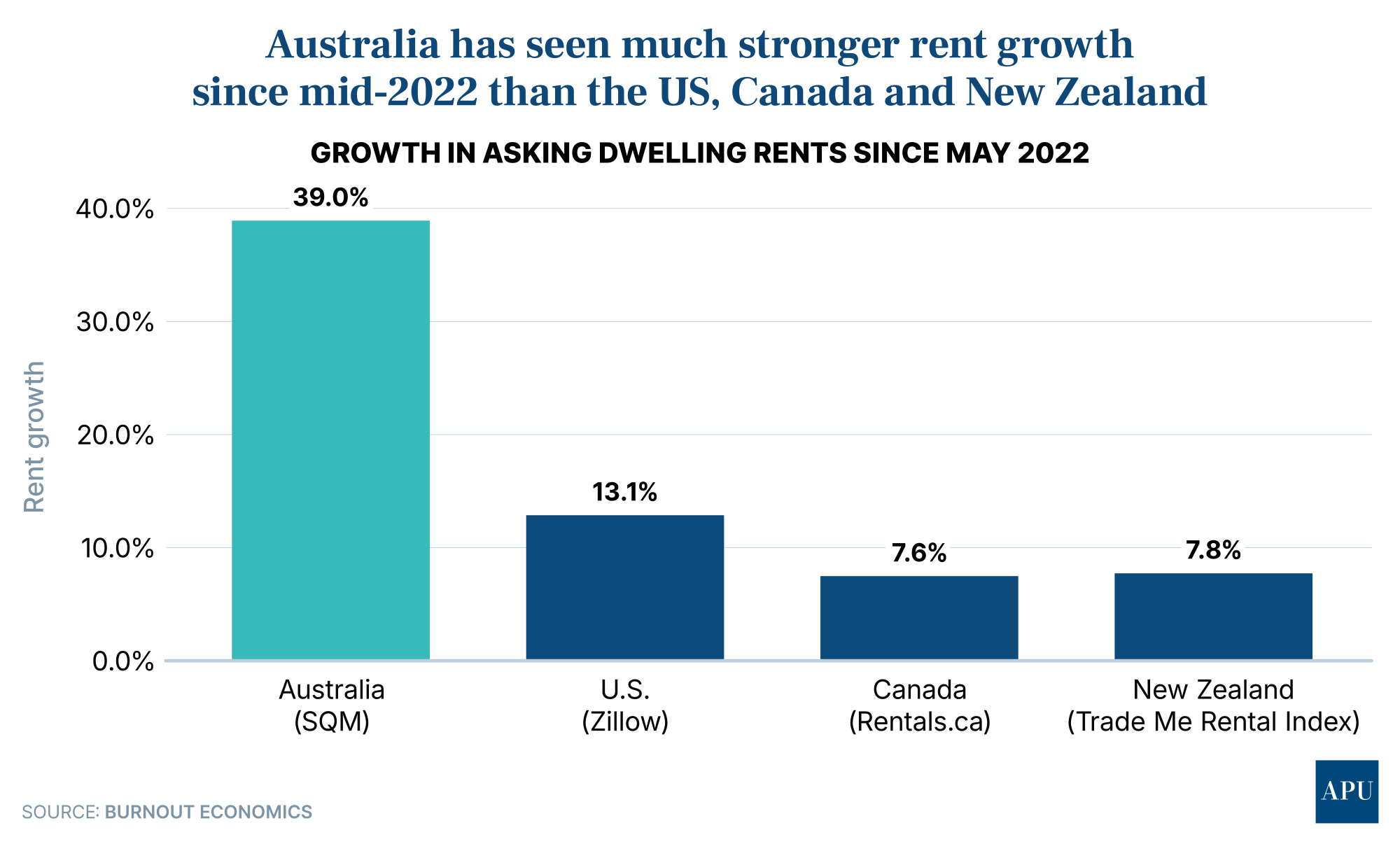
Mr Brooker’s analysis found national asking rents had increased by 39% since the Albanese Government came to office in May 2022, compared with just 13.1% in the United States, 7.8% in New Zealand and 7.6% in Canada.
“The Albanese government has helped deliver a windfall to the nation’s property investors that has effectively offered a bailout to those hit by rising costs and rising interest rates,” Mr Brooker writes in a piece published by Yahoo Finance Australia.
He points to an increasingly important difference between Australia and two comparable countries that have moved more aggressively to reduce migration after housing shortages became politically and economically unsustainable.
Canada is now deliberately shrinking its temporary-resident population, while New Zealand’s net migration has collapsed from its post-pandemic peak.
Australia’s migration intake has also fallen, but remains much higher than New Zealand’s in absolute terms and on a per-capita basis and continues to provide substantial underlying demand for housing.
Australia recorded net overseas migration of 301,000 people in the year to December 2025, according to the latest Australian Bureau of Statistics population data.
That was down 8.9% from a year earlier and well below the post-pandemic peak of 556,000 in the year to September 2023.
However, overseas migration still accounted for almost three-quarters of Australia’s total population increase over the year, with the population growing by 412,500, or 1.5%, to 27.8 million.
Through net overseas migration alone, Australia added more people in 12 months than the population of Canberra.
Each additional household requires somewhere to live, and when construction fails to keep pace, the immediate pressure is generally felt in the rental market because many newly arrived migrants rent before they are able or willing to buy.
Migration is not the only cause of Australia’s rental shortage.
Smaller household sizes, construction delays, higher building costs and the loss of rental properties in some markets also matter.
But rapid population growth has increased demand at a time when rental vacancies have remained extremely low and housing completions have failed to meet the number of additional homes required.
Mr Brooker argues this has produced a uniquely strong result for Australian landlords.
Using SQM Research figures, he says the national asking rent increased from $501.70 a week when Labor took office in 2022 to $697.40.
Had Australian rents followed Canada’s rate of growth over the same period, Mr Brooker estimates the national asking rent would have been $157.80 a week lower.
Had they followed New Zealand, the difference would have been about $156.50.
Mr Brooker argues the Government’s migration settings have been highly favourable to landlords.
“By effectively choosing to run a level of migration that the federal government's own agency, the National Housing Supply and Affordability Council, believes has created a massive housing deficit, the Albanese government has arguably been property investors' best friend in government,” Tarric Brooker says.
Canada changes direction
Canada experienced its own extraordinary migration surge after the pandemic, driven by both permanent immigration and rapid growth in international students and temporary workers.
But its Federal Government has since acknowledged that population growth was putting too much pressure on housing, health care and other public services.
Canada’s latest immigration plan aims to cut new temporary-resident arrivals to 385,000 in 2026 and 370,000 in each of the following two years.
Permanent-resident admissions are being held at 380,000 annually from 2026 to 2028.
That change is already having a dramatic demographic effect.
Canada’s population fell by an estimated 55,000 people in the first three months of 2026, after declining by more than 103,000 in the December quarter of 2025.
New Zealand’s migration boom fades
New Zealand has experienced an even more dramatic reversal.
Its net migration gain reached about 128,300 in 2023, an enormous increase for a country of little more than five million people.
By 2025, however, annual net migration had fallen to just 14,200.
The fall reflects fewer migrant arrivals and a large number of departures, including New Zealand citizens moving overseas.
With population pressure easing, New Zealand rents have been broadly flat in Mr Brooker's comparison, while Canadian rents have recently declined in some measures.
Good for landlords, painful for tenants
For property investors, strong migration does not remove the impact of higher mortgage repayments, maintenance expenses, insurance or changing tax treatment.
But it does provide something increasingly scarce in weaker housing markets: persistent demand from tenants.
Low vacancies give landlords greater confidence that properties will remain occupied and that rents can be increased when leases are renewed, subject to local rules and tenant affordability.
Mr Brooker argues that without the 39% increase in asking rents since May 2022, significantly more investors would have faced financial distress as interest rates and other ownership costs rose.
“In reality, they were delivered the largest rise in asking rents in decades since the pandemic began and a rental crisis that continues to give landlords strong leverage to continue to push up rents to this day,” he writes.
For tenants, it means genuine rental relief is unlikely until the number of new homes begins to match the number of people who need somewhere to live.













.jpg?width=1920&height=1080&name=WTF%20Is%20Happening%20To%20The%20Housing%20Market!%20$500%20Billion%20Wiped%20Out%20As%20Prices%20Fall%20Faster%20Every%20Month%20Scott%20Kuru%20YPU%20027%20(1).jpg)
%20Scott%20Kuru%20YPU%20025.jpg?width=1920&height=1080&name=This%20Is%20Worse%20Than%20A%20Recession%20RBA%20Admits%20Australias%20Wage%20Collapse%20Cant%20Be%20Stopped%20(Prepare%20Now)%20Scott%20Kuru%20YPU%20025.jpg)



























.jpg?width=1920&height=1080&name=EXPOSED%20How%20The%20Govt%20Let%20These%20Oil%20Giants%20Get%20Away%20With%20Paying%20Zero%20Tax%20For%20Aussie%20Gas%20Scott%20Kuru%20DPU%20256%20(1).jpg)







%20Scott%20Kuru%20DPU%20248.jpg?width=1920&height=1080&name=Major%20Banks%20CAUGHT%20Preparing%20For%20Australia%E2%80%99s%20Biggest%20Housing%20Crash%20(Defaults%20%26%20Bankruptcies%20Coming)%20Scott%20Kuru%20DPU%20248.jpg)
%20Scott%20Kuru%20DPU%20247.jpg?width=1920&height=1080&name=This%20Is%20How%20Australia%20Gets%20Pushed%20Into%20the%20Next%20Big%20Reset%20(Trust%20Collapse%20Has%20Officially%20Begun)%20Scott%20Kuru%20DPU%20247.jpg)







%20Scott%20Kuru%20DPU%20239.jpg?width=1920&height=1080&name=URGENT%20Life%20In%20Australia%20Has%20Become%20Impossible%20For%20Millions%20Of%20Aussies%20(It%E2%80%99s%20About%20To%20Get%20Worse)%20Scott%20Kuru%20DPU%20239.jpg)











%20Scott%20Kuru%20DPU%20227.jpg?width=1920&height=1080&name=URGENT%20ALERT%20Australia%E2%80%99s%20Property%20Market%20Is%20Sliding%20Into%20Something%20Much%20Bigger%20(Prepare%20Now)%20Scott%20Kuru%20DPU%20227.jpg)