









.png?width=292&height=292&name=Copy%20Link%20(1).png)

 SIGN UP FOR FREE NEWSLETTER

The Albanese Government's flagship housing tax reforms could leave Australia with thousands fewer homes, higher rents and almost 4,000 fewer construction jobs, according to new modelling commissioned by some of the nation's largest property and building industry groups.
The analysis, commissioned by the Property Council of Australia, Master Builders Australia, the Real Estate Institute of Australia and the Housing Industry Association, challenges the government’s claim that the Federal Budget housing package will ultimately boost supply and improve affordability.
Master Builders Australia chief executive Denita Wawn says the modelling raises serious questions about whether the Budget’s housing measures are compatible with the Government’s own housing ambitions.
“If we’re serious about improving affordability, we need to turbocharge supply and remove the barriers to building,” Ms Wawn says.
“Right now, those barriers are rising, not falling.”
The details
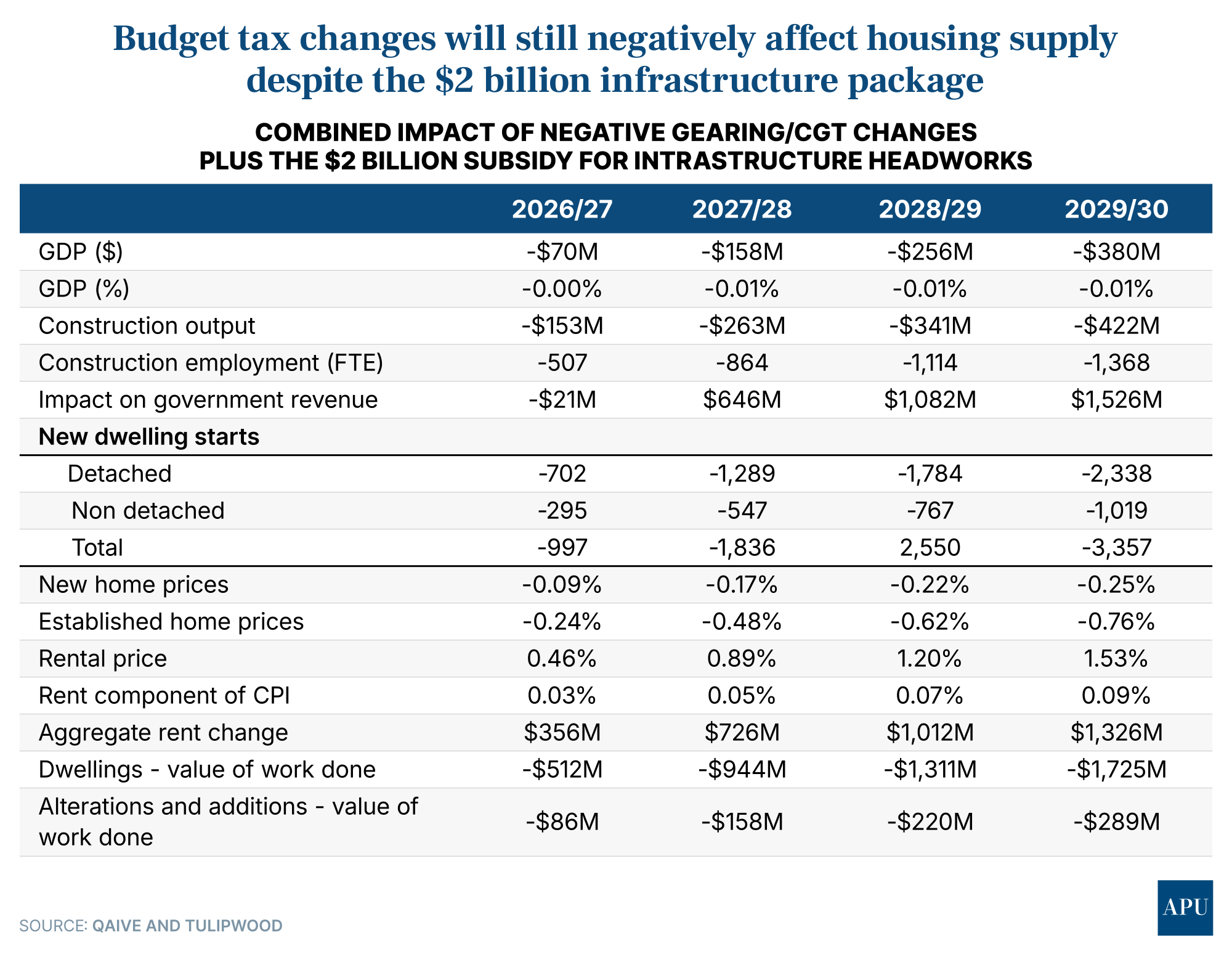
The modelling by Qaive and Tulipwood Economics concludes that the combined effect of changes to negative gearing, capital gains tax concessions and the Government’s $2 billion infrastructure fund would leave Australia with 8,742 fewer homes over the next four years, while pushing rents higher and reducing economic activity.
The findings come as the Government defends its controversial decision to abolish negative gearing for purchases of existing investment properties from July 2027 and replace the long-standing 50% capital gains tax discount with a new inflation-indexed system.
The modelling largely agrees with Treasury estimates on one key point: the tax changes are expected to reduce housing supply.
Where they differ sharply is on whether the Government’s new $2 billion housing infrastructure support program can offset that damage.
Treasury estimates the infrastructure package will help deliver 65,000 additional homes over a decade.
But Qaive and Tulipwood argue that figure is overly optimistic, estimating the fund would generate just 5,291 additional dwelling starts over four years, compared with Treasury’s implied pace of around 26,000 homes over the same period.
The report states that while the methodology behind Treasury’s estimate is unclear, “there are supply constraints to automatically expanding housing supply, such as land availability, regulatory constraints and labour force constraints.”
The report also warns that because the infrastructure fund depends on states implementing planning and productivity reforms, its estimated impact should be treated as a “maximum impact” rather than a guaranteed outcome.
The modelling finds the tax changes alone would reduce dwelling starts by 14,032 homes over four years, a figure almost identical to Treasury’s own estimate when adjusted to the same timeframe.
“The main driver of the impacts were the changes to negative gearing, rather than the changes to the CGT discount,” the report says.
Master Builders’ CEO Denita Wawn says the findings suggest the tax changes risk undermining efforts to increase housing supply at a time when Australia is already struggling to meet ambitious home-building targets.
“On one hand, construction will be hit hard by the proposed tax hikes on private investment, resulting in less housing supply and affordability,” she says.
While the infrastructure spending would partially offset that decline, the report concludes it would not come close to fully replacing the lost supply.
After combining both policies, the researchers estimate a net reduction of 8,742 dwelling starts by 2029-30.
That would place additional pressure on Australia’s already strained housing market and complicate efforts to meet the National Housing Accord target of 1.2 million new homes by the end of the decade.
Interestingly, the Qaive and Tulipwood modelling suggests the Budget tax changes would lower home prices only marginally compared with a "business as usual" scenario, indicating they are unlikely to significantly improve housing affordability.

Rents
The modelling forecasts a larger rental impact than Treasury’s estimate, which suggested rents would rise by around $2 per week for a median rental property.
Qaive and Tulipwood estimate rents would increase by about $3 per week in 2026-27, rising to around $9 per week by 2029-30 as the effects of lower housing supply accumulate.
For a household paying $600 a week in rent, that translates into an additional $142 a year initially, rising to $477 a year by 2029-30.
The report says landlords are expected to absorb roughly 60% of the reduction in investment returns themselves, while passing about 40% through to tenants in the form of higher rents.
Even so, the modelling suggests the cumulative increase in rents would eventually be around five times larger than Treasury’s longer-term estimates.
Beyond housing
The report argues the consequences of the government’s tax changes would extend beyond the property market.
Researchers estimate the combined package would reduce national economic output by $864 million over four years, cut construction activity by around $1.2 billion, and leave the industry with 3,854 fewer full-time equivalent workers by 2029-30.
Construction output is forecast to decline because higher taxes reduce the attractiveness of residential property investment, leading to lower levels of housing investment and fewer projects proceeding.
At the same time, government revenue would rise significantly, with the modelling estimating an additional $3.23 billion flowing to Canberra over the four-year period.
Notably, the researchers point out that this increase in government revenue is broadly comparable to the projected rise in the national rent bill, which they estimate at $3.42 billion.
Industry calls
The industry groups backing the modelling say the findings show the Budget settings are not aligned with the Government’s goal of delivering 1.2 million homes under the National Housing Accord.
“Should the tax hikes proceed, it ultimately means fewer homes and higher costs for renters and buyers,” Master Builders’ CEO Denita Wawn says.
She also warned the reforms could have wider consequences for the construction sector itself, noting that most building businesses are small operators.
“The 98% of the industry who are small businesses will be negatively affected by the tax increases on capital gains and trusts,” she says.
“Genuine consultation must occur to ensure these serious impacts on small business are addressed.”
The industry groups are now calling on Parliament to amend the legislation containing the property tax changes before it is passed.










.jpg?width=1920&height=1080&name=WTF%20Is%20Happening%20To%20The%20Housing%20Market!%20$500%20Billion%20Wiped%20Out%20As%20Prices%20Fall%20Faster%20Every%20Month%20Scott%20Kuru%20YPU%20027%20(1).jpg)

%20Scott%20Kuru%20YPU%20025.jpg?width=1920&height=1080&name=This%20Is%20Worse%20Than%20A%20Recession%20RBA%20Admits%20Australias%20Wage%20Collapse%20Cant%20Be%20Stopped%20(Prepare%20Now)%20Scott%20Kuru%20YPU%20025.jpg)




























.jpg?width=1920&height=1080&name=EXPOSED%20How%20The%20Govt%20Let%20These%20Oil%20Giants%20Get%20Away%20With%20Paying%20Zero%20Tax%20For%20Aussie%20Gas%20Scott%20Kuru%20DPU%20256%20(1).jpg)







%20Scott%20Kuru%20DPU%20248.jpg?width=1920&height=1080&name=Major%20Banks%20CAUGHT%20Preparing%20For%20Australia%E2%80%99s%20Biggest%20Housing%20Crash%20(Defaults%20%26%20Bankruptcies%20Coming)%20Scott%20Kuru%20DPU%20248.jpg)
%20Scott%20Kuru%20DPU%20247.jpg?width=1920&height=1080&name=This%20Is%20How%20Australia%20Gets%20Pushed%20Into%20the%20Next%20Big%20Reset%20(Trust%20Collapse%20Has%20Officially%20Begun)%20Scott%20Kuru%20DPU%20247.jpg)







%20Scott%20Kuru%20DPU%20239.jpg?width=1920&height=1080&name=URGENT%20Life%20In%20Australia%20Has%20Become%20Impossible%20For%20Millions%20Of%20Aussies%20(It%E2%80%99s%20About%20To%20Get%20Worse)%20Scott%20Kuru%20DPU%20239.jpg)










%20Scott%20Kuru%20DPU%20227.jpg?width=1920&height=1080&name=URGENT%20ALERT%20Australia%E2%80%99s%20Property%20Market%20Is%20Sliding%20Into%20Something%20Much%20Bigger%20(Prepare%20Now)%20Scott%20Kuru%20DPU%20227.jpg)