









.png?width=292&height=292&name=Copy%20Link%20(1).png)

 SIGN UP FOR FREE NEWSLETTER
Australia’s two biggest banks have unveiled their latest housing forecasts, painting very different scenarios for price growth in the nation’s capital cities.
While both the Commonwealth Bank and Westpac expect national home price growth to slow to around 5% this year and further in 2027, they remain split on how individual cities will perform, with particularly sharp differences over their forecasts for Melbourne, Perth and Brisbane.
Commonwealth Bank
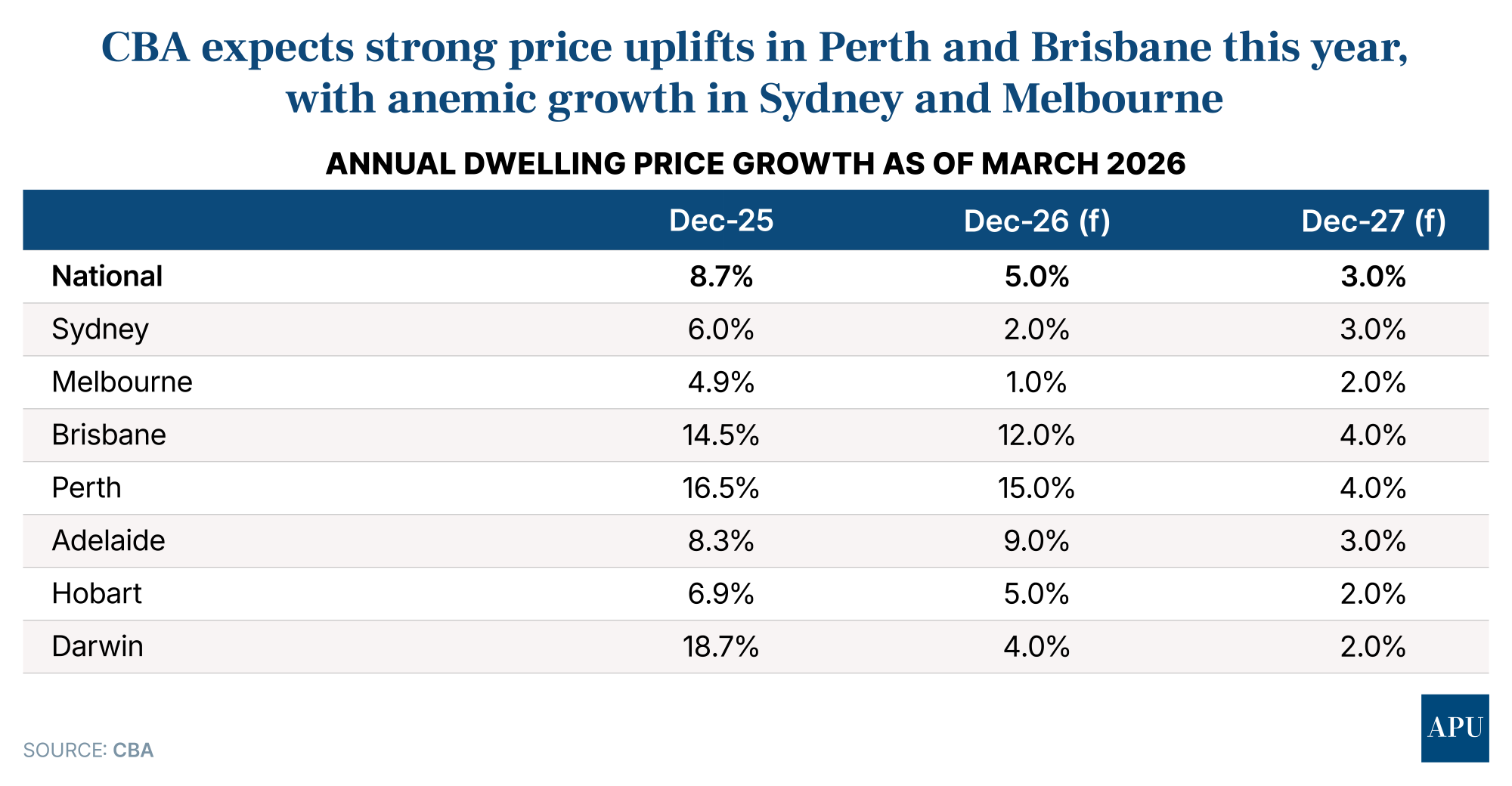
Australia’s largest mortgage lender, the Commonwealth Bank, says national home prices increased by 8.6% over 2025.
In a new economic update, CBA economists, Trent Saunders and Belinda Allen, say sentiment improved following the Reserve Bank of Australia’s moves to cut rates 3 times last year, but note that “much of these price increases can be explained by ongoing tightness of housing supply, with those states that are experiencing tighter conditions also driving the increase in prices.”
They also point out that a noticeable pick up in price growth late last year - particularly in more affordable market segments - was supported by the Federal government’s expanded 5% deposit guarantee scheme.
However, “after a strong run”, the economists say dwelling price growth is expected to slow over the remainder of 2026 to rise by “a bit over 5% over the year to December 2026.”
“The slowdown primarily reflects the effect of higher mortgage rates, with the (RBA’s) February cash rate hike and an anticipated further increase in May set to add to borrowing costs and cool buyer sentiment.”
Notably, the CBA economists make clear they expect the Albanese government to proceed with rumoured changes to the Capital Gains Tax Discount, and possibly even negative gearing.
“The anticipated reduction of the CGT discount from 50% to around 25%, expected to be implemented at the time of the May Budget, will also weigh on prices,” they say.
“We estimate this policy change to subtract 0.9ppts of annual price growth by the end of 2027.
“The final driver of the softer price outlook is an easing of population growth, which subtracts a further 0.8ppts of our 2027 forecast.
“In addition to its effect on prices, the closing of the gap between population and dwelling stock growth will also take some pressure off rents.”
While Trent Saunders and Belinda Allen are predicting national growth of 5% in 2026 and a tepid 3% in 2027, they expect a wide divergence of price performance, particularly during the rest of this year.
“The mid-sized capital cities are forecast to continue to outperform Sydney (2%) and Melbourne (just 1%) this year, with the gap most pronounced in Perth (15%) and Brisbane (12%).
“Price growth in both cities continues to be supported by strong market momentum, a tight supply-demand balance, and robust economic conditions.”
However, the CBA economists say the strong growth in Perth and Brisbane will not last beyond 2026, “as higher interest rates take hold, housing construction picks up, population slows, and affordability constraints become more binding.”
By the end of 2027, both booming cities are expected to see just 4% annual growth.
As for Australia’s two largest housing markets…
Trent Saunders and Belinda Allen say affordability is expected to remain a “significant headwind” in Sydney, with elevated interest rates “doing little to ease pressure on buyers.”
“The moderation in (price) growth should also be supported by relatively higher levels of construction compared with the mid-sized capitals.”
The CBA Economics team believes Melbourne’s outlook is “a bit more nuanced.”
“A comparatively lower price base means that affordability constraints aren't as tight as they are in Sydney.
“However,” their report says, “higher rates of construction in recent years, relatively softer local economic conditions, and Victoria’s less investor-friendly tax backdrop are likely to keep a lid on a stronger rebound.”
On the other hand, they say there’s the possibility of an “upside scenario" for Melbourne.
“With the net outflow of residents from Victoria now largely closed, and Melbourne having lagged in price growth in recent years, the city is more affordable compared to peers.
“If demand catches up to the market’s improved affordability, Melbourne could see stronger-than-expected price growth over the next 18 months.”
Westpac
Certainly, that latter scenario is the one favoured by Westpac in its latest “Housing Pulse” publication.
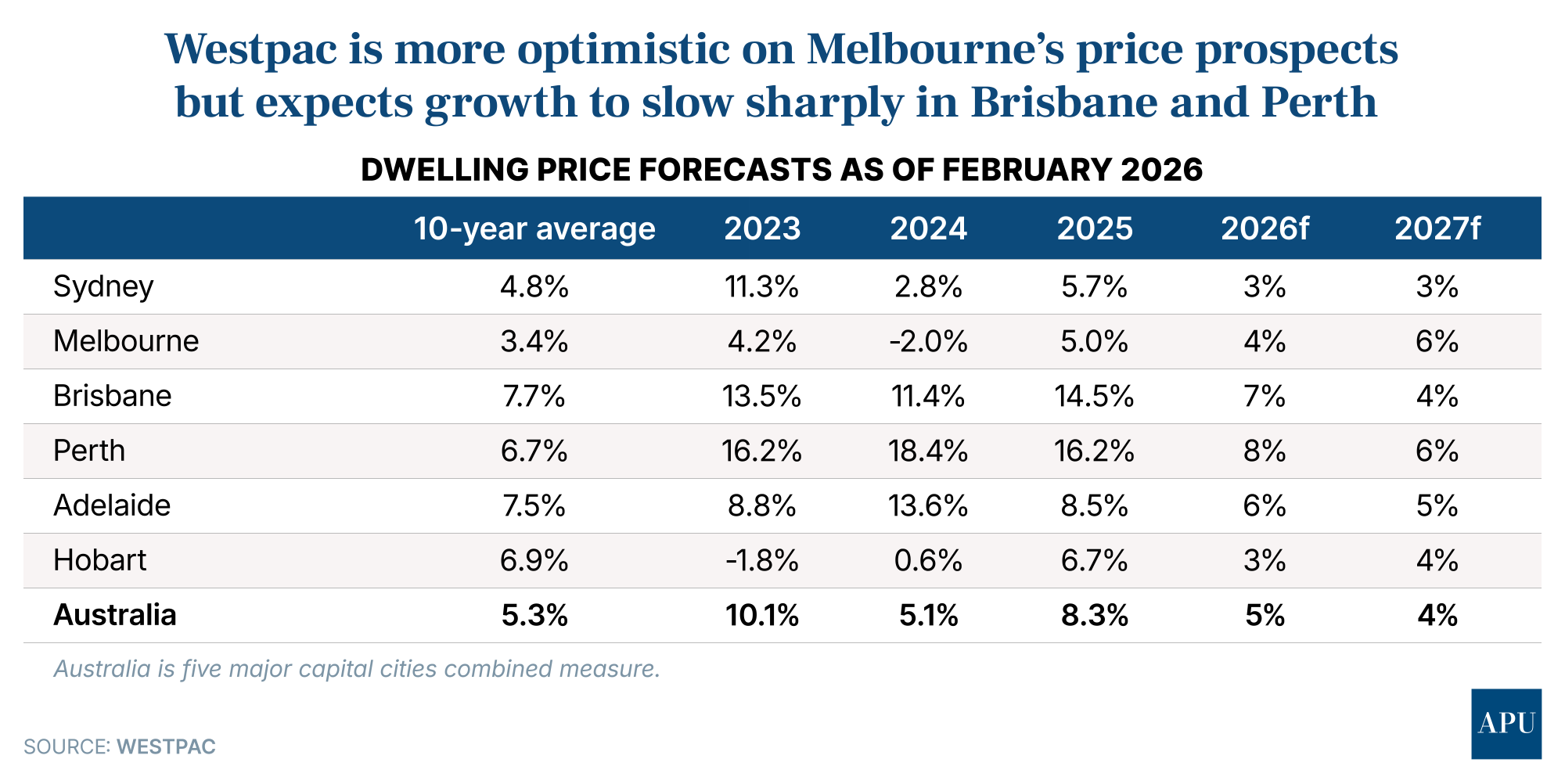
It forecasts Melbourne will see steady price growth of around 4% this year, before growth ticks up to 6% in 2027.
Westpac economists Matthew Hassan and Neha Sharma describe supply conditions in the Victorian capital as “less tight” than other cities, but note Melbourne has “more headroom for medium-term price gains.”
Sydney property is forecast to be “basically flat in real terms” across the next two years, with price growth of 3% in each year.
However, it’s when it gets to the booming capital city markets of Brisbane, Perth and Adelaide that Westpac’s 2026 forecasts differ wildly from Commonwealth Bank.
Westpac expects price growth in Brisbane to more than halve to 7%, down from 14.5% last year.
The bank's economists say the Queensland capital is “entering uncharted territory”, with a pitched battle currently taking place between extremely tight housing supply and “very stretched affordability."
It’s clear that while the Commonwealth Bank team thinks the scarcity of housing in Brisbane will keep upward pressure on prices and growth in double figures this year, Westpac believes the pool of potential buyers in the Queensland capital will shrink, as more and more are priced out and their borrowing capacity shrinks with higher interest rates.
The story is similar in Perth.
While Westpac notes that rental vacancy rates are extremely low, it says the cost of building new homes in the WA capital “are high and rising fast”, discouraging more potential new home buyers.
Like Brisbane, Westpac expects price growth to more than halve this year in the WA capital, from 16.2% in 2025 to 8%.
Adelaide is the only capital city market where the Commonwealth Bank expects to see stronger growth in 2026 than last year, forecasting prices to rise 9% this year, up from 8.5% in 2025.
But Westpac’s Matthew Hassan and Neha Sharma see an easing in the City of Churches, saying “prices have already come off a very strong run”, tipping a more modest 6% growth this year.
More generally, Westpac notes that since its last Housing Pulse report in November 2025, the interest rate outlook “has materially changed with a February rate hike now expected to be followed by another 25bp hike in May and an extended pause with a cut only coming in late 2027.”
Its economists say “early signs suggest housing markets have retained reasonable momentum in early 2026 despite the changed interest rate situation.”
Nevertheless, Westpac’s “key view” is that “affordability constraints become a more binding limit on growth across markets,” and with more interest rate rises on the horizon, this will “bite a little harder and earlier” than previously thought.
The take-out
So what’s the main takeaway from these latest forecasts from Australia’s two biggest mortgage lenders?
While CBA and Westpac clearly have very different housing models, they agree on one key metric - no Australian capital city will see prices go backwards in 2026 and 2027, despite the prospect of higher interest rates.
Although Commonwealth Bank’s Housing Update and Westpac’s latest Housing Pulse make much of so-called "affordability constraints” tempering the sharp price growth we have seen in most cities, Trent Saunders, Belinda Allen, Neha Sharma and Matthew Hassan seem to keep coming back to the main underlying issue facing the residential property market: There are simply not enough homes where Australians actually want to live and there’s unlikely to be enough housing supply for the foreseeable future.
The laws of supply and demand mean that as long as that shortage persists, dwelling prices are only likely to keep going one way - up.








.jpg?width=1920&height=1080&name=WTF%20Is%20Happening%20To%20The%20Housing%20Market!%20$500%20Billion%20Wiped%20Out%20As%20Prices%20Fall%20Faster%20Every%20Month%20Scott%20Kuru%20YPU%20027%20(1).jpg)
%20Scott%20Kuru%20YPU%20025.jpg?width=1920&height=1080&name=This%20Is%20Worse%20Than%20A%20Recession%20RBA%20Admits%20Australias%20Wage%20Collapse%20Cant%20Be%20Stopped%20(Prepare%20Now)%20Scott%20Kuru%20YPU%20025.jpg)





















.jpg?width=1920&height=1080&name=EXPOSED%20How%20The%20Govt%20Let%20These%20Oil%20Giants%20Get%20Away%20With%20Paying%20Zero%20Tax%20For%20Aussie%20Gas%20Scott%20Kuru%20DPU%20256%20(1).jpg)







%20Scott%20Kuru%20DPU%20248.jpg?width=1920&height=1080&name=Major%20Banks%20CAUGHT%20Preparing%20For%20Australia%E2%80%99s%20Biggest%20Housing%20Crash%20(Defaults%20%26%20Bankruptcies%20Coming)%20Scott%20Kuru%20DPU%20248.jpg)
%20Scott%20Kuru%20DPU%20247.jpg?width=1920&height=1080&name=This%20Is%20How%20Australia%20Gets%20Pushed%20Into%20the%20Next%20Big%20Reset%20(Trust%20Collapse%20Has%20Officially%20Begun)%20Scott%20Kuru%20DPU%20247.jpg)







%20Scott%20Kuru%20DPU%20239.jpg?width=1920&height=1080&name=URGENT%20Life%20In%20Australia%20Has%20Become%20Impossible%20For%20Millions%20Of%20Aussies%20(It%E2%80%99s%20About%20To%20Get%20Worse)%20Scott%20Kuru%20DPU%20239.jpg)








%20Scott%20Kuru%20DPU%20227.jpg?width=1920&height=1080&name=URGENT%20ALERT%20Australia%E2%80%99s%20Property%20Market%20Is%20Sliding%20Into%20Something%20Much%20Bigger%20(Prepare%20Now)%20Scott%20Kuru%20DPU%20227.jpg)