











 SIGN UP FOR FREE NEWSLETTER

The Albanese Government’s plan to redirect property investors from established homes into new housing appears to be changing where investors buy, but early evidence suggests many are simply pulling back from the market altogether.
ABS lending data show the share of investor loans going towards new housing has jumped to historically high levels since the May Federal Budget.
But the increase is being driven overwhelmingly by a collapse in lending for established properties, rather than a surge in investors buying newly built homes.
Separate data from mortgage aggregator Loan Market Group show investor mortgage lodgements have fallen 44% since January, while activity in both established and new housing has weakened sharply.
Together, the figures paint a picture of an investor market being reshaped by higher interest rates and major tax changes.
But they also show the increase in new-home investment the Government had hoped for is not materialising, with potentially serious implications for an already undersupplied rental market.
The details
The May Budget changed the tax treatment of residential property investment, including removing negative gearing for newly purchased established homes while retaining it for new builds.
The aim was to reduce investor competition with first-home buyers for existing properties and redirect investment towards homes that genuinely add to housing supply.
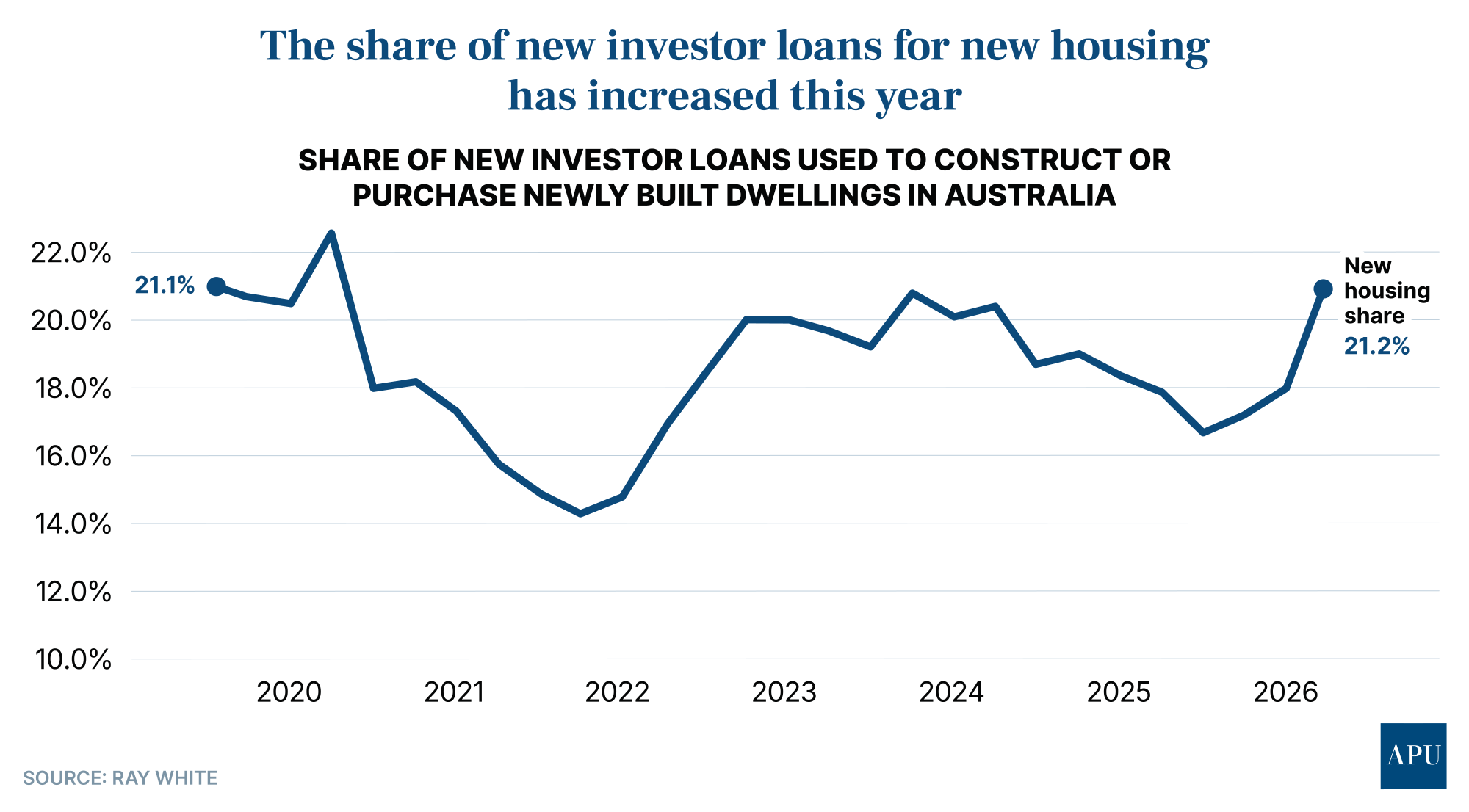
Ray White chief economist Nerida Conisbee says ABS figures show the proportion of investor loans directed towards new housing increased from 17.9% in June 2025 to 21.2% in June 2026.
Most of that increase occurred in the June quarter of 2026, when the share jumped from 18%.
“This is a substantial increase, and also historically high,” Ms Conisbee says.
But the raw numbers tell a more complicated story.
Investor loans for new homes increased by just 441 in the June quarter of 2026, from 10,482 to 10,923.
Over the same period, investor loans for established properties plunged by 7,080, from 47,727 to 40,647.
“For every additional investor loan for a new home, there were approximately 16 fewer loans for established properties,” Ms Conisbee says.
Overall investor loan commitments fell 8.6% during the quarter.
“The increasing share of new housing is therefore being driven primarily by investors withdrawing from established properties, rather than a substantial increase in investment in new homes,” she says.
Separate data from Loan Market Group, which aggregates activity from more than 6,000 mortgage brokers nationally, suggests the pullback has continued.
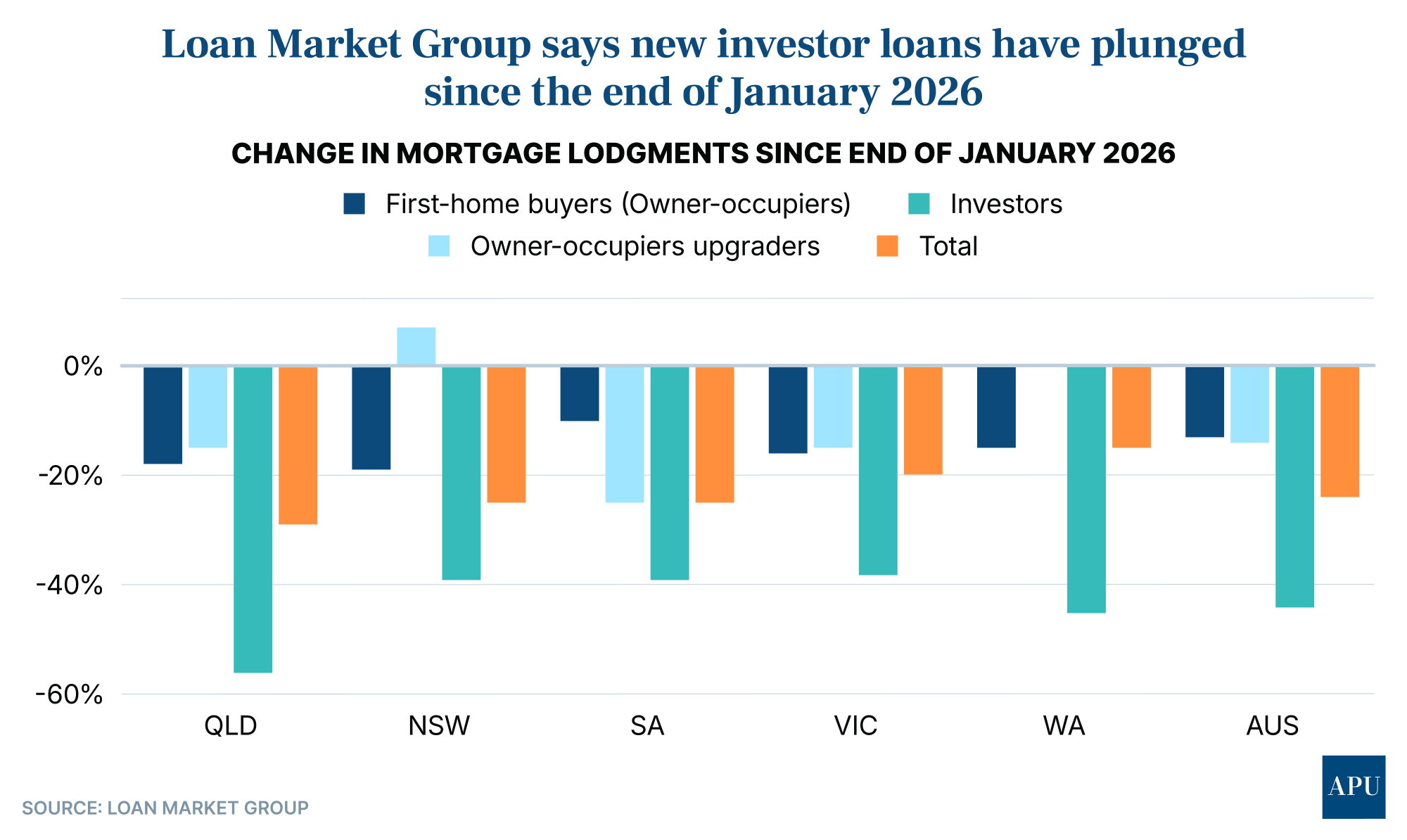
According to figures reported in The Australian newspaper, investor mortgage lodgements have fallen 44% since January, with Queensland and Western Australia recording some of the biggest declines.
Loan values for established properties were down 56%, while mortgages on new housing stock were also 10% lower over the same period.
Loan Market chief financial officer Cherie Bell says the Budget tax changes landed just as borrowers were being hit by a renewed round of RBA rate rises.
“The budget announcements obviously created a whole lot of noise in the market, but with interest rates going up at the same time, it was a double whammy,” Ms Bell says.
“Obviously, investors were the biggest hit, but first-home buyers and owner-occupier upgraders have all seen declining application volume.”
Loan Market says refinancing now accounts for around three in five loans lodged through its network, another sign borrowers are increasingly focused on managing existing debt rather than taking on new mortgages.
Ray White’s analysis shows investor interest in new housing has increased across every state over the past year, but the latest quarter was much more mixed.
Queensland recorded 252 additional investor loans for new housing during the June quarter of 2026 and Western Australia added 223.
NSW increased by only 30, while Victoria fell by 21 and South Australia by 15.
That suggests the policy may be starting to shift investor behaviour, but not at the scale needed to significantly lift new housing construction.
Ray White’s Nerida Conisbee argues the bigger barriers to building new housing remain construction costs, expensive finance, skilled labour shortages and projects that simply do not stack up financially.


“Changing investor tax incentives does little to address these problems,” she says.
There were some encouraging signs in the June quarter of 2026, with national dwelling completions increasing 5.8% to 47,168 homes.
But more recent approvals data have been less reassuring.
Total dwelling approvals fell 6.1% in August, including a 21.2% fall in private-sector dwellings other than houses — the category that includes apartments and townhouses.
Detached-house approvals increased 3.7%.
Monthly approvals are volatile, but the weakness in higher-density housing is significant, as apartments are the type of development that often relies heavily on investor presales to obtain finance.
The Government’s decision to restrict borrowing arrangements for residential property through self-managed super funds adds another complication.
Ms Conisbee says SMSF investors have historically provided another potential source of buyers for new apartments, meaning the restrictions could work against the wider push to attract investors into newly built housing.
The take-out
The June-quarter ABS numbers only partly capture the period after the May Budget.
And four RBA rate rises this year make it impossible to separate the effect of the tax changes aimed at property investors cleanly from the substantial impact of higher borrowing costs.
But the emerging pattern is becoming clearer.
Investors appear to be allocating a greater share of their borrowing towards new homes.
The problem is that the investor market itself has become substantially smaller.
As Ms Conisbee puts it: “Redirecting investors towards new homes is not the same as getting more homes built.”
And that is likely to mean a smaller rental pool of properties for an expanding tenant base.