










 SIGN UP FOR FREE NEWSLETTER
Higher-than-expected inflation figures have strengthened the case for the Reserve Bank of Australia to raise rates again at its November board meeting next week.
It’s bad news for mortgage holders, who have already endured four interest rate rises this year.
The figures were released as the RBA Governor Michele Bullock told a parliamentary committee that while the Australian economy appeared to be slowing, both international and domestic inflation pressures had worsened since August.
The details
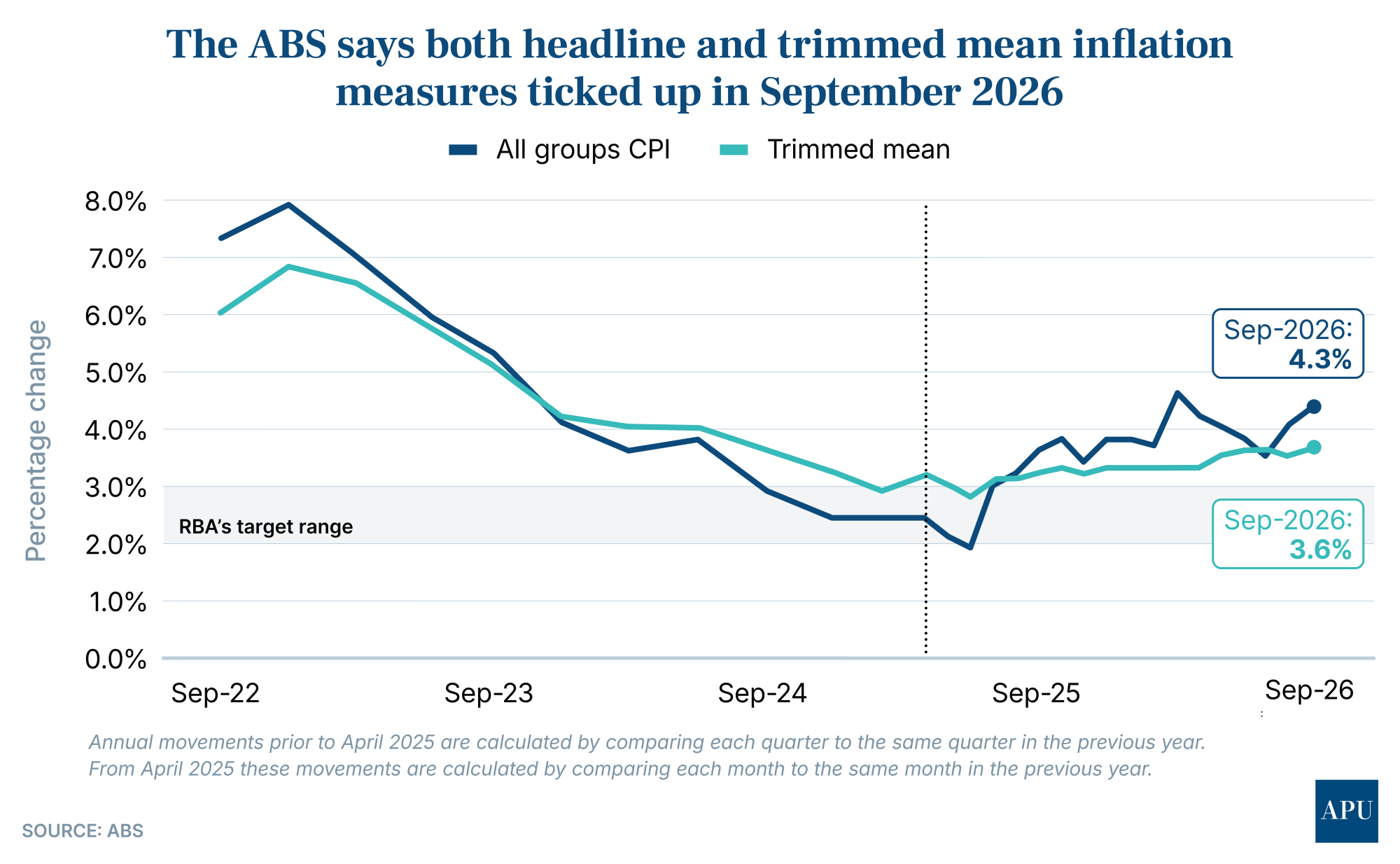
The Australian Bureau of Statistics says its headline inflation measure - the Consumer Price Index - rose 4.3% in the 12 months to September 2026, ticking up from 4.0% in the 12 months to August.
Significantly, the RBA’s preferred inflation measure, the trimmed mean, came in at 3.6%, up from a revised 3.5% in the 12 months to August 2026.
The central bank, which has already raised the cash rate four times this year to a 15-year high, is tasked with maintaining inflation between 2% and 3% over time, using interest rates as its principal monetary policy tool.
The ABS’ Housing category was the largest contributor to annual inflation in September, rising by 5.2%.
This “reflected rising costs for both New dwellings and Electricity,” says ABS Head of Price Statistics Rachael McCririck.
“New dwelling prices rose 4.7% in the 12 months to September as builders passed on higher costs for materials and labour,” she says, although Ms McCririck noted this had eased from 5.4% the previous month.
Unsurprisingly, the ABS says Transport was the second largest contributor to annual inflation in September, rising by 8.7%, due to higher fuel prices because of the disruption to oil supplies caused by conflict in the Middle East.
“On a monthly basis, Automotive fuel prices rose 9.4% in September, compared to a rise of 14.8% in August,” Ms McCririck says.
“This was driven by higher world oil prices.”

Shortly before the release of the inflation data, RBA Governor Michele Bullock addressed a hearing of the Senate Economics Legislation Committee.
“Although growth in the Australian economy is slowing as expected, some of the international and domestic upside risks to inflation have materialised or are materialising,” Ms Bullock said.
“Oil and related prices have increased sharply again and will add materially to inflation, both directly and indirectly, as businesses facing increasing pressures from higher transport and related costs attempt to pass them on.”
But Ms Bullock also argued that international events, such as the conflict in the Middle East, were not solely to blame for Australia’s inflation woes.
“We still see inflation arising from domestic capacity pressures,” she said.
Importantly, the ABS says automotive fuel was excluded from the trimmed mean calculation in September, yet underlying inflation still rose.
My Bui, an economist at AMP, says she’s not surprised.
“Services inflation is actually higher than the imported inflation right now,” she told the ABC.
“So, looking at those figures tells me that there is a sticky inflation problem here.
“Recall that the RBA actually hiked interest rates before fuel prices went up this year,” she says.
“The RBA cannot solve the fuel price problems or imported food price problem, but what it can do is that it can probably kill off inflation…in other discretionary areas, things like construction, going out for fun, going to entertainment events, or going to the hairdressers,” Ms Bui says.
While AMP believes the RBA will have no choice but to raise the cash rate at its monetary policy board meeting next week, taking the cash rate to 4.85%, Ms Bui says she believes this will be the last hike in this current interest rate cycle.
However, she says it's likely a rate hike next week will lead to more unemployment.
“For now, I would say that their (the RBA’s) priority is just inflation.
“They probably can stomach a bit of a higher increase in unemployment rate as well as more declines in jobs growth this year, which has already declined.
“Rate hikes do work because they also impact businesses in the sense their borrowing costs go up so they would hire fewer people or give lower wage rises to wage earners.
“So we do expect to see a lot more weakness in the labour market,” she says.
Ms Bui’s remarks came as the ABS also released labour market data, which showed that the main difficulty in finding work in 2025-26 was “too many applicants for available jobs”.
“About one in five people – or 22% – reported too many applicants as their main barrier for finding work,” says Sean Crick, the ABS Head of Labour Statistics.
“82% of people who wanted a job, were looking for work, and were available to start within 4 weeks reported difficulties in getting a job.”
Following the release of the ABS data, money markets strengthened their bets on a rate rise by the RBA next week, from a 65% to an 89% chance.