









.png?width=292&height=292&name=Copy%20Link%20(1).png)

 SIGN UP FOR FREE NEWSLETTER
Following Parliament's approval of the Albanese Government's sweeping housing tax reforms, key housing industry groups have warned that a last-minute deal struck with the Greens could undermine one of Labor's central housing promises.
The Urban Development Institute of Australia (UDIA), the Housing Industry Association (HIA) and the Property Council of Australia say the government's decision to prevent self-managed super funds (SMSFs) from borrowing to invest in residential property risks reducing new housing supply at the very time Australia is trying to build more homes.
The industry's concerns centre on the role SMSF investors play in financing brand-new apartment and townhouse developments before construction even begins.
The details
The SMSF borrowing restrictions were announced as part of Labor's agreement with the Greens to secure passage of the government's broader housing tax package, including changes to negative gearing and capital gains tax.
Under the reforms, SMSFs will no longer be able to use so-called “limited recourse borrowing arrangements” or LRBAs to purchase residential property.
The Government argues SMSF borrowing accounts for less than 1% of residential lending and says the changes close a loophole that would otherwise allow some investors to retain tax advantages after other property tax concessions are scaled back.
But housing developers argue the importance of SMSFs cannot be measured simply by the number of loans they take out.
Instead, they say SMSF investors play an outsized role in providing the early pre-sales developers need before banks will approve construction finance.
UDIA National President Oscar Stanley says discussions with developers, financiers, mortgage brokers and commercial lenders across Australia have delivered a consistent message.
"This policy will make it harder to fund new housing and will ultimately reduce supply," Mr Stanley says.
He argues the policy could effectively wipe out around 40,000 privately built new rental homes, which is roughly the same number of social and affordable homes meant to be funded by the government’s $10 billion Housing Australia Future Fund by mid-2029.
The three industry groups argue the government has already accepted that its Budget tax reforms will reduce housing supply by around 35,000 dwellings over the next decade.
Adding SMSF borrowing restrictions, they say, risks making that outcome significantly worse.
"Apartment developments rely on meeting pre-sale thresholds, and SMSF investors play a critical role in getting these projects out of the ground," says HIA Chief Executive (Industry & Policy) Simon Croft.
The Property Council's Mike Zorbas agrees.
"New housing supply is king.
"Construction and capital costs already prevent new projects taking flight.
"Changes to SMSFs are the latest handbrake on investment nobody asked for..."
Why SMSFs matter
Industry groups say the concern is not that SMSFs dominate Australia's housing market.
Rather, they tend to concentrate in exactly the parts of the market governments say they want to encourage—new apartments, townhouses and house-and-land packages.
The Australian Financial Review reports SMSF investors often account for around 20% to 30% of apartment project pre-sales.
Those early buyers help developers satisfy lenders' financing requirements, allowing projects to proceed.
"A large percentage of these (SMSF) sales, if they weren't being made, would stop many projects from being delivered, and therefore affecting supply, housing affordability, and rents," Colliers project marketing director Ashley Bramich told the AFR.
Official figures released last week showed dwelling approvals fell for a third consecutive month in May, highlighting the broader challenge facing Australia's housing pipeline.
The AFR also reports some developers are already seeing buyers withdraw from projects.
One south-east Queensland townhouse developer, who asked not to be identified, said finance uncertainty had already caused prospective SMSF buyers to walk away.
"I've done maybe one sale in three weeks and had multiple properties under contract... just pull the pin.
"Banks won't fund me without the sales."
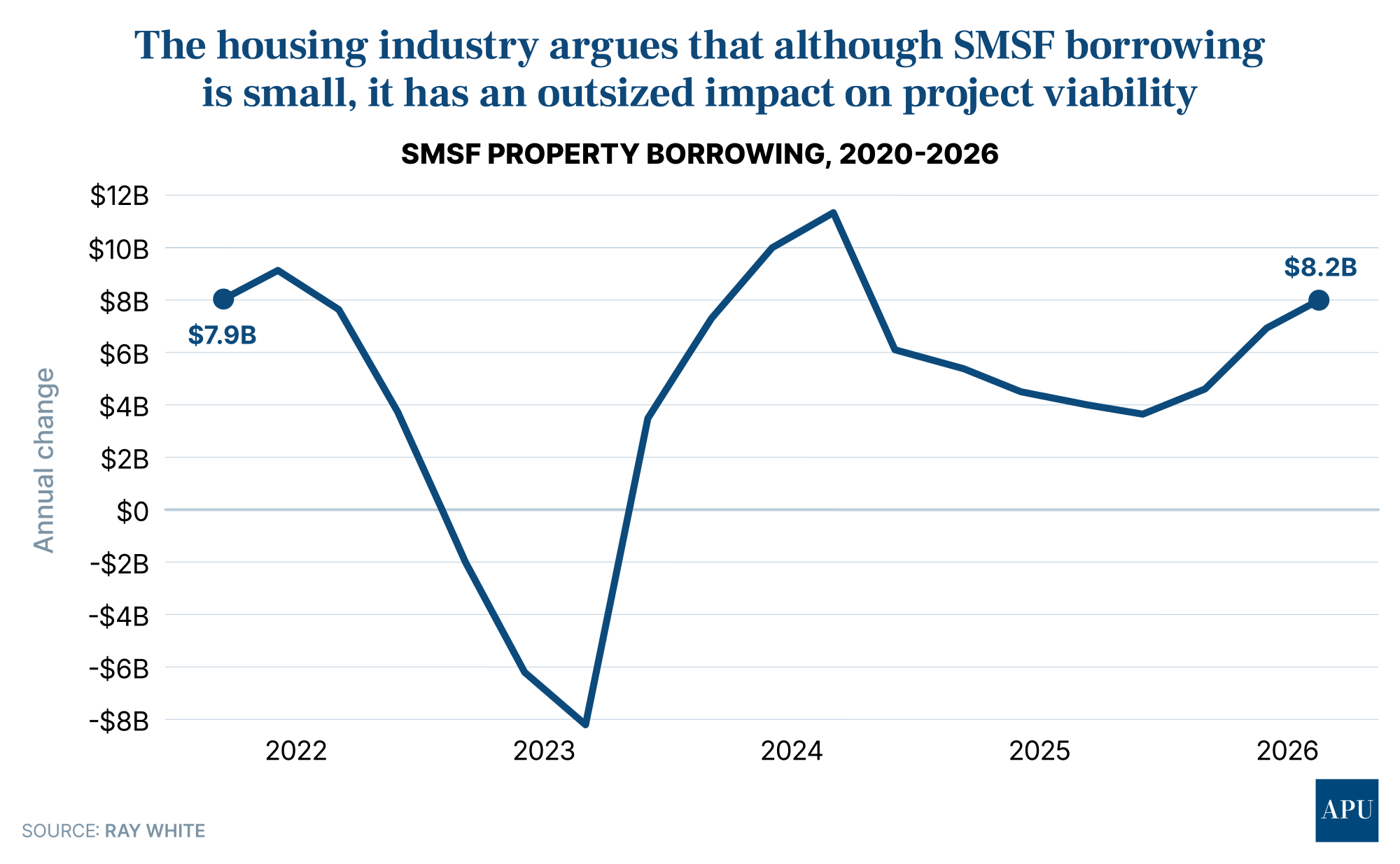
“This is where the policy risk becomes much larger than the headline SMSF borrowing numbers suggest,” says Ray White Chief Economist Nerida Conisbee.
“New housing supply does not begin at settlement.
“It begins when a developer is trying to prove to a lender that enough buyers are committed for the project to proceed,” she says.
“For larger apartment projects, pre-sales are often the difference between a project receiving construction finance or remaining stuck on paper.”
The housing industry bodies say they’re not asking the Government to abandon its broader tax reforms.
Instead, UDIA, HIA and the Property Council say they want one specific amendment: continue allowing SMSFs to invest in new residential housing, while restricting investment in established dwellings.
They are also calling for closer consultation with industry, a review of the combined impact of the reforms if housing outcomes prove worse than Treasury's Budget forecasts, and policies that accelerate housing supply rather than restrict private investment.
Mr Stanley says the issue comes back to a simple principle.
"Every policy should be working to increase the number of homes we build, not unintentionally reducing them."







.jpg?width=1920&height=1080&name=WTF%20Is%20Happening%20To%20The%20Housing%20Market!%20$500%20Billion%20Wiped%20Out%20As%20Prices%20Fall%20Faster%20Every%20Month%20Scott%20Kuru%20YPU%20027%20(1).jpg)
%20Scott%20Kuru%20YPU%20025.jpg?width=1920&height=1080&name=This%20Is%20Worse%20Than%20A%20Recession%20RBA%20Admits%20Australias%20Wage%20Collapse%20Cant%20Be%20Stopped%20(Prepare%20Now)%20Scott%20Kuru%20YPU%20025.jpg)



























.jpg?width=1920&height=1080&name=EXPOSED%20How%20The%20Govt%20Let%20These%20Oil%20Giants%20Get%20Away%20With%20Paying%20Zero%20Tax%20For%20Aussie%20Gas%20Scott%20Kuru%20DPU%20256%20(1).jpg)







%20Scott%20Kuru%20DPU%20248.jpg?width=1920&height=1080&name=Major%20Banks%20CAUGHT%20Preparing%20For%20Australia%E2%80%99s%20Biggest%20Housing%20Crash%20(Defaults%20%26%20Bankruptcies%20Coming)%20Scott%20Kuru%20DPU%20248.jpg)
%20Scott%20Kuru%20DPU%20247.jpg?width=1920&height=1080&name=This%20Is%20How%20Australia%20Gets%20Pushed%20Into%20the%20Next%20Big%20Reset%20(Trust%20Collapse%20Has%20Officially%20Begun)%20Scott%20Kuru%20DPU%20247.jpg)







%20Scott%20Kuru%20DPU%20239.jpg?width=1920&height=1080&name=URGENT%20Life%20In%20Australia%20Has%20Become%20Impossible%20For%20Millions%20Of%20Aussies%20(It%E2%80%99s%20About%20To%20Get%20Worse)%20Scott%20Kuru%20DPU%20239.jpg)










%20Scott%20Kuru%20DPU%20227.jpg?width=1920&height=1080&name=URGENT%20ALERT%20Australia%E2%80%99s%20Property%20Market%20Is%20Sliding%20Into%20Something%20Much%20Bigger%20(Prepare%20Now)%20Scott%20Kuru%20DPU%20227.jpg)





%20Scott%20Kuru%20DPU%20221.jpg?width=1920&height=1080&name=The%20AI%20Situation%20in%20Australia%20Just%20Hit%20a%20Point%20of%20No%20Return...%20(Major%20Bank%20Proves%20It)%20Scott%20Kuru%20DPU%20221.jpg)