









.png?width=292&height=292&name=Copy%20Link%20(1).png)

 SIGN UP FOR FREE NEWSLETTER
Image by Wayne Taylor/The Sydney Morning Herald
Australia’s housing market has been rattled by higher interest rates, sweeping investor tax changes and a global energy shock, but the nation’s second largest bank says tight supply and strong population growth should help prevent a major property downturn.
In its latest Housing Pulse report, Westpac says the Federal Budget’s changes to negative gearing and capital gains tax will drive a major shift in investor behaviour.
While the bank’s Economics team says this could push national property prices lower in the near term, it is not forecasting a housing market crash.
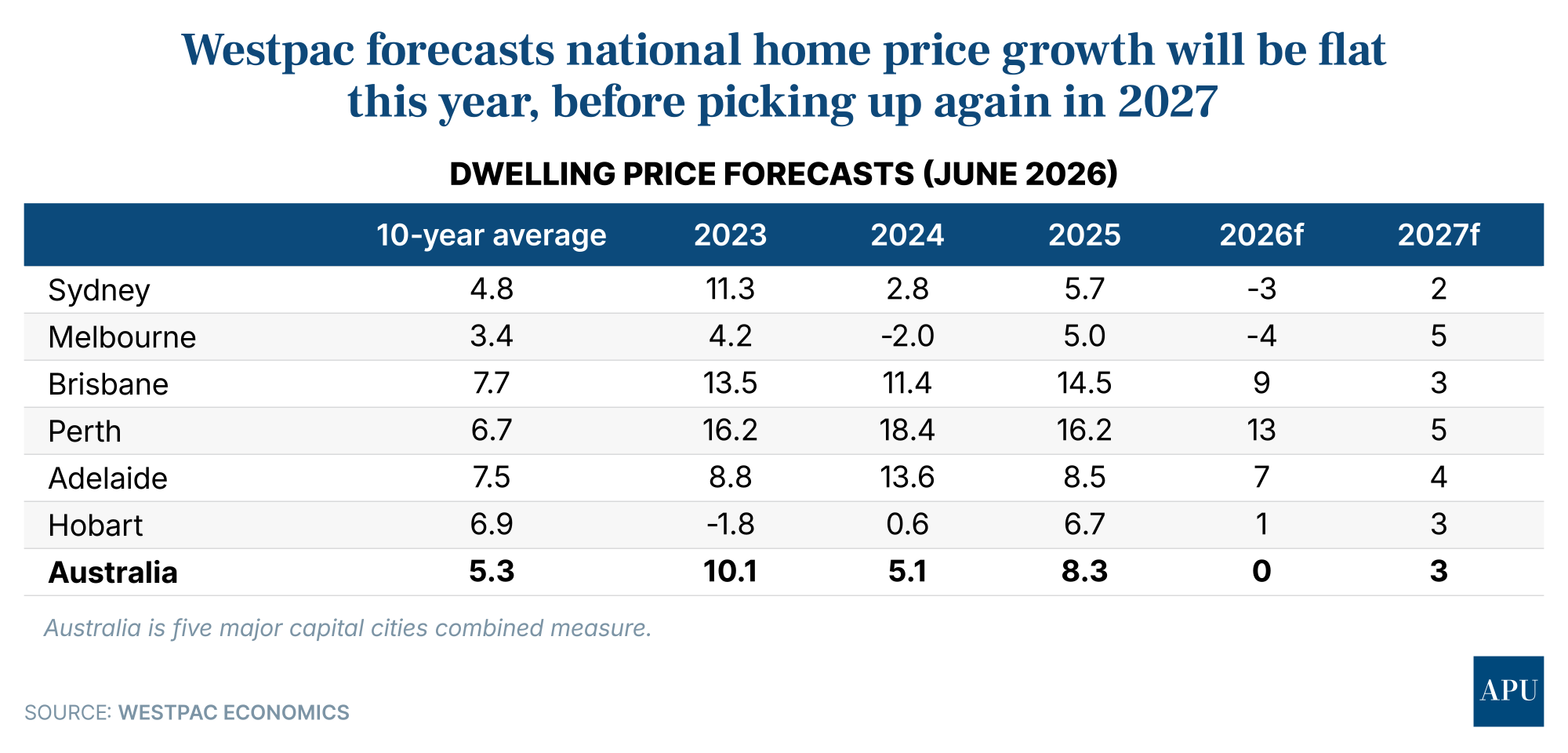
Instead, Westpac expects dwelling prices across Australia’s major capital cities to finish 2026 flat, before returning to modest growth next year.
The details
Westpac says Australia’s property market has been hit by three major shocks since its last quarterly “Housing Pulse” report was released in March.
They are the Middle East conflict and its impact on global energy prices, two 0.25% Reserve Bank interest rate rises and the Albanese Government’s major property tax changes announced in the May Federal Budget.
“The combined effect has already produced a significant weakening in both markets and housing-related sentiment,” Westpac says.
National dwelling prices have been largely flat over the past three months, suggesting the market has already begun to absorb the impact of higher interest rates and policy uncertainty.
That marks a clear slowdown from the previous three-month gain of 2.1% and the 2.9% quarterly pace recorded through the second half of 2025.
However, Westpac notes annual price growth across Australia’s big cities was still a relatively firm 7.8% at the end of May.
The bank’s central forecast is that national dwelling prices will fall by about 2% over the next six months, after rising about 2% earlier in 2026, leaving prices broadly unchanged for the calendar year.
That is a weaker outlook than before, but indicates a market absorbing a major policy and interest rate shock, rather than collapsing under it.
The biggest structural change identified by Westpac is the Government’s overhaul of negative gearing and capital gains tax.
Under the proposed reforms, future investors buying existing dwellings will no longer be able to use negative gearing deductions against non-property income.
The capital gains tax discount will also move from a flat 50% discount to an inflation-based system, with a new minimum tax rate of 30%.
However, existing investors will be largely protected through so-called “grandfathering” arrangements, while investors who buy newly built homes will still be able to negatively gear and choose between the 50% capital gains tax discount and the new inflation-based system.
Westpac says those exemptions are important because they reduce the risk of a mass investor sell-off.
“The grandfathering of changes strongly encourages current holders of leveraged investments that are negatively geared to retain these assets in a negatively geared way for as long as possible,” the Housing Pulse report says.
At the same time, the tax treatment of new builds will become much more attractive.
“The carve out for newly built dwellings also means investment in these will be significantly more attractive compared to investment in existing dwellings,” Westpac says.
Westpac now expects new investor activity to fall sharply overall, but says the share of investor housing finance going into newly built dwellings should rise from about 20% to around 40%.
Over time, the bank says that could help redirect more private capital into new housing supply.
Westpac also says consumers’ house price expectations have pulled back sharply but remain far from the extreme pessimism seen in previous downturns.
Its Consumer House Price Expectations Index has fallen 26% over the four months to June, from a cycle high of 173.9 to 128.2.
That brings expectations back near long-run average levels.
However, the Housing Pulse report says the index remains “well above previous lows”, with a small majority of consumers still expecting prices to rise over the year ahead.
It says those expectations are “well above the ‘net negative’ lows seen in 2022 and in previous cycles, suggesting prices are reasonably well-anchored.”
One of the reasons Westpac is not forecasting a severe property downturn is that the physical supply of housing remains constrained.
Even though listings have risen as buyer demand has slowed, total stock on market is still low by long-run standards.
Across the major capitals, sales are still running at around 1.25 times new listings, above the long-run average of 1.16.
Total listings are equivalent to about 2.5 months of current sales, up from the record low of 2.06 months late last year, but still well below the 20-year average of 3.4 months.
Westpac says inventory is now above average in Sydney and Melbourne, but remains “extremely tight everywhere else.”
That means many markets are still being supported by a shortage of available homes.
The Housing Pulse report points out that the property market is not moving evenly across the country.
Westpac forecasts Sydney dwelling prices will fall 3% in 2026, before rising 2% in 2027.
Melbourne home prices are expected to fall 4% this year before rebounding by 5% next year.
The bank says Sydney prices are already slipping lower and look susceptible to a near-term “air pocket”, while Melbourne has a weaker starting point but more scope for medium-term gains.
The outlook is much stronger in several other capitals.
Brisbane prices are forecast to rise 9% in 2026 and another 3% in 2027.
Perth remains the standout, with Westpac tipping a 13% gain this year and a further 5% rise next year.
Adelaide is also expected to remain resilient, with home prices forecast to rise 7% in 2026 and 4% in 2027.
Hobart is tipped to record only 1% growth this year, before rising 3% next year.












.jpg?width=1920&height=1080&name=WTF%20Is%20Happening%20To%20The%20Housing%20Market!%20$500%20Billion%20Wiped%20Out%20As%20Prices%20Fall%20Faster%20Every%20Month%20Scott%20Kuru%20YPU%20027%20(1).jpg)
%20Scott%20Kuru%20YPU%20025.jpg?width=1920&height=1080&name=This%20Is%20Worse%20Than%20A%20Recession%20RBA%20Admits%20Australias%20Wage%20Collapse%20Cant%20Be%20Stopped%20(Prepare%20Now)%20Scott%20Kuru%20YPU%20025.jpg)


























.jpg?width=1920&height=1080&name=EXPOSED%20How%20The%20Govt%20Let%20These%20Oil%20Giants%20Get%20Away%20With%20Paying%20Zero%20Tax%20For%20Aussie%20Gas%20Scott%20Kuru%20DPU%20256%20(1).jpg)







%20Scott%20Kuru%20DPU%20248.jpg?width=1920&height=1080&name=Major%20Banks%20CAUGHT%20Preparing%20For%20Australia%E2%80%99s%20Biggest%20Housing%20Crash%20(Defaults%20%26%20Bankruptcies%20Coming)%20Scott%20Kuru%20DPU%20248.jpg)
%20Scott%20Kuru%20DPU%20247.jpg?width=1920&height=1080&name=This%20Is%20How%20Australia%20Gets%20Pushed%20Into%20the%20Next%20Big%20Reset%20(Trust%20Collapse%20Has%20Officially%20Begun)%20Scott%20Kuru%20DPU%20247.jpg)







%20Scott%20Kuru%20DPU%20239.jpg?width=1920&height=1080&name=URGENT%20Life%20In%20Australia%20Has%20Become%20Impossible%20For%20Millions%20Of%20Aussies%20(It%E2%80%99s%20About%20To%20Get%20Worse)%20Scott%20Kuru%20DPU%20239.jpg)










%20Scott%20Kuru%20DPU%20227.jpg?width=1920&height=1080&name=URGENT%20ALERT%20Australia%E2%80%99s%20Property%20Market%20Is%20Sliding%20Into%20Something%20Much%20Bigger%20(Prepare%20Now)%20Scott%20Kuru%20DPU%20227.jpg)