









.png?width=292&height=292&name=Copy%20Link%20(1).png)

 SIGN UP FOR FREE NEWSLETTER
Image from Getty Images
Australia’s housing market is set for a softer period of growth after the Federal Budget’s sweeping property tax changes, but Commonwealth Bank says the impact on prices and rents may be more moderate than many investors fear.
In a detailed post-budget housing analysis, CBA Senior Economist Trent Saunders says the government’s decision to limit negative gearing to newly built homes and overhaul the capital gains tax regime will reduce the attractiveness of established housing as an investment asset, particularly for highly leveraged investors.
However, the bank - Australia’s largest housing lender - says it does not expect a housing market collapse.
Instead, CBA forecasts national dwelling prices will grow by 3% over 2026 and another 3% in 2027 - a downgrade from its previous forecast of 5% growth next year, but still positive overall.
The details
The Commonwealth Bank analysis focuses heavily on how the budget changes might alter investor behaviour and housing market dynamics, rather than simply examining the policy announcements themselves.
“The combined effect should lower established dwelling prices relative to the previous baseline, modestly increase rental pressure over time, reduce turnover, and provide some relative support for new construction,” Mr Saunders says.
The biggest change, according to CBA, is the effective removal of negative gearing for investors buying existing homes.
Under the new rules, losses on established investment properties can no longer be immediately deducted against wage income and other earnings.
Instead, those losses must be “quarantined” and carried forward to offset future rental income or capital gains.
CBA says that dramatically changes the short-term cash-flow equation for investors.
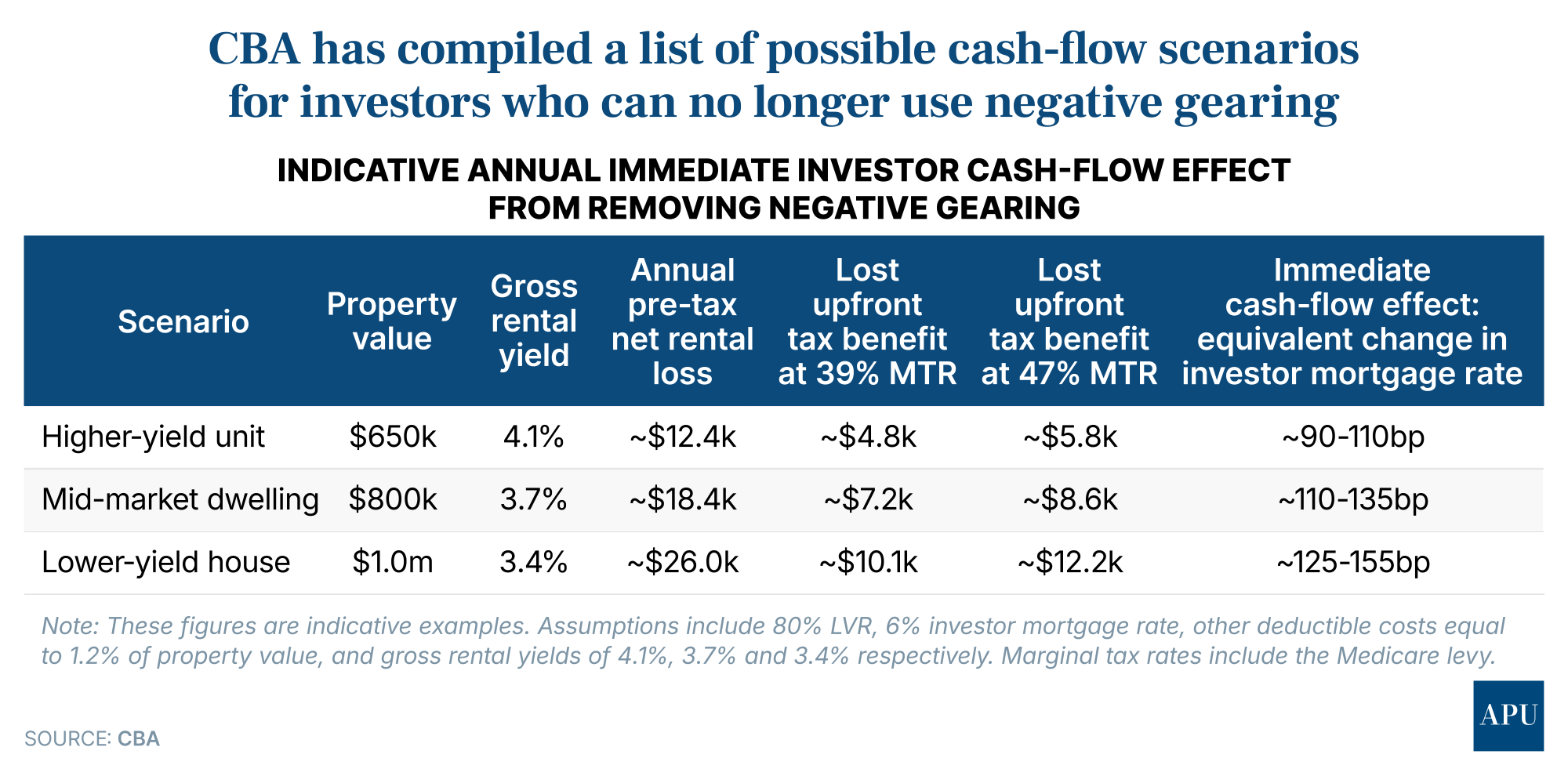
Using a series of modelling scenarios, the bank estimates the loss of upfront tax deductions is roughly equivalent to an increase in investor mortgage rates of between 0.9% and 1.55% in immediate cash-flow terms.
For a typical investor purchasing an $800,000 established dwelling with an 80% loan-to-value ratio, CBA estimates the removal of negative gearing would strip away around $8,600 a year in upfront tax benefits for someone on the top marginal tax rate.
“The largest near-term impact comes from the removal of negative gearing for established dwellings,” Mr Saunders says.
“Negative gearing affects investor cash flow each year a property is loss-making.”
However, CBA argues the ultimate long-term impact is less severe than headline figures suggest, because investors can still carry forward losses into future years.
“That benefit is delayed, less valuable in present-value terms, and no longer helps investors fund annual holding costs,” CBA’s Trent Saunders says.
“But it will undoubtedly reduce some of the effect of this policy change on broader housing market conditions.”

The second major reform - replacing the 50% capital gains tax discount with inflation indexation and a minimum 30% tax rate - is also expected to affect investor appetite, although CBA says the impact is more nuanced than many assume.
“Replacing the 50% discount with indexation does not always increase the tax burden,” Mr Saunders says.
“The effect depends on the relationship between inflation and house price growth.”
According to CBA’s modelling, if dwelling price growth only modestly exceeds inflation, the new indexed system can actually produce similar - or in some cases better - tax outcomes than the existing flat 50% discount.
The bank estimates the two systems become broadly equivalent when annual house price growth sits around 4.5% to 5% over a decade-long holding period.
Importantly, CBA believes the government’s decision to preserve both negative gearing and CGT concessions for newly built homes could redirect investor demand toward new supply.
“The net effect will depend on whether the incentive to buy new dwellings… is strong enough to offset the broader reduction in investor demand for housing,” Mr Saunders says.
“We expect that it will be.”
That shift could provide some support for apartment construction and higher-density housing projects, where investor pre-sales are critical to securing finance.
Still, the bank warns that elevated construction costs linked to the Middle East conflict and rising interest rates are already making many projects harder to stack up financially.
As a result, CBA expects the broader housing market to slow, particularly in investor-heavy segments such as apartments, townhouses and lower-priced established housing.
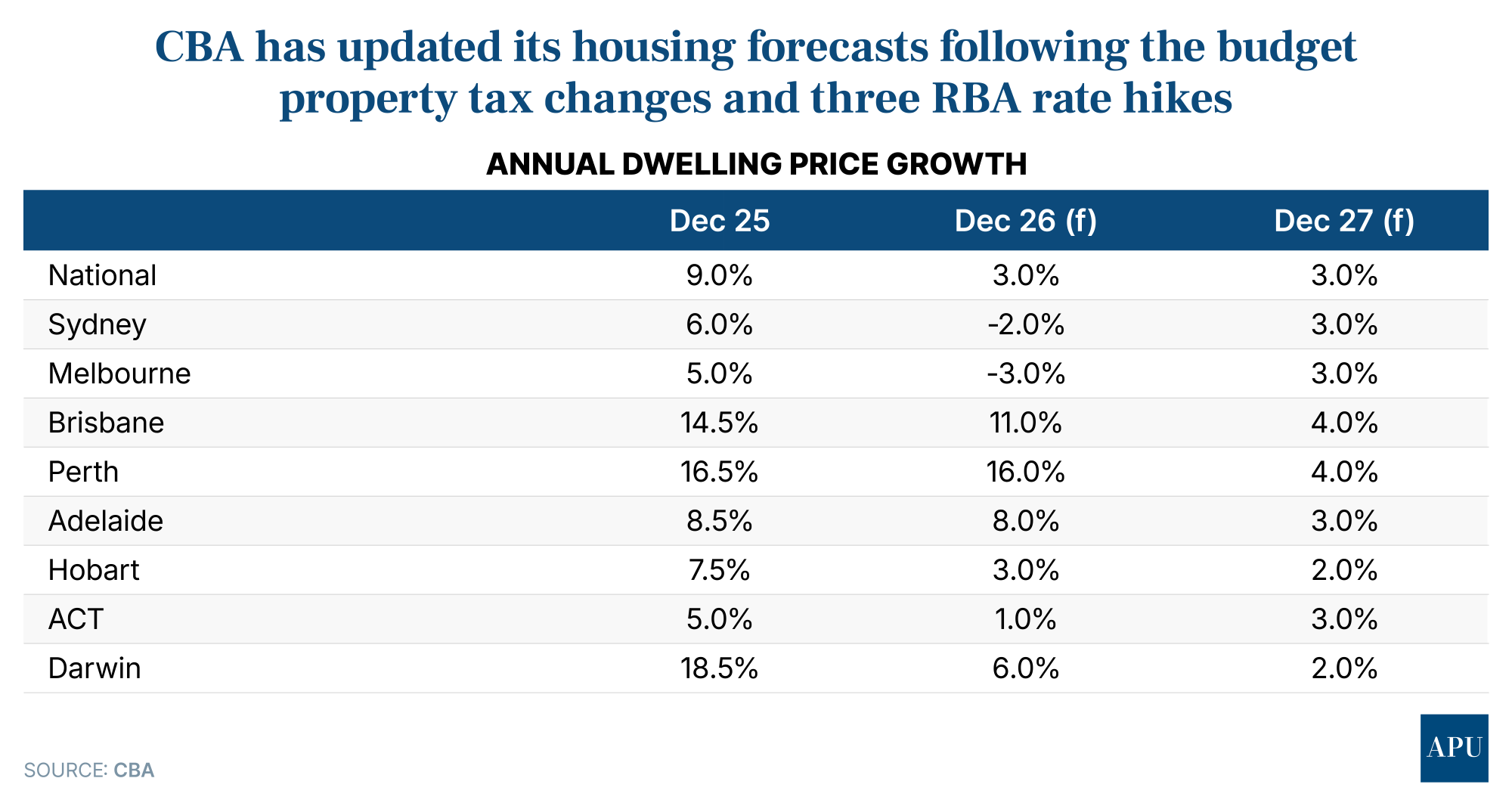
The bank’s updated forecasts now predict Sydney dwelling prices will fall 2% through 2026, while Melbourne is expected to decline 3%.
By contrast, Brisbane and Perth are still tipped to record strong growth of 11% and 16% respectively this year, although both forecasts have been revised lower.
Nationally, CBA estimates the combined tax changes will eventually leave dwelling prices around 3% lower than they otherwise would have been, but the transition is expected to occur gradually.
“We estimate this policy change will subtract 0.6 percentage points from annual price growth by the end of this year and just under 1 percentage point from growth over 2027,” Mr Saunders says.
The bank also believes the impact on rents is likely to be relatively small.
“Treasury estimates that rents could increase by around $2 per week for a household paying the current median rent, which is broadly in line with our estimates,” the report says.
One of the more surprising conclusions from the Commonwealth Bank analysis is that the bigger short-term risk may come not from the tax changes themselves, but from sentiment.
“A key risk is that there is a larger short-term response of house prices due to the effect of these policy changes on sentiment,” Mr Saunders says.
“If this occurred, price growth could ease by more than we expect based on fundamentals alone over the coming year.”
Even so, CBA’s broader assessment suggests the bank sees the changes as a moderate cooling measure rather than a dramatic reset for Australian housing.
The report repeatedly notes that grandfathering provisions for existing investors, the ability to carry forward losses and ongoing support for newly built housing will all help soften the impact.
And while the tax overhaul reduces the appeal of established investment property, Commonwealth Bank’s central case remains one of slower growth, not a housing market crash.




.jpg?width=1920&height=1080&name=WTF%20Is%20Happening%20To%20The%20Housing%20Market!%20$500%20Billion%20Wiped%20Out%20As%20Prices%20Fall%20Faster%20Every%20Month%20Scott%20Kuru%20YPU%20027%20(1).jpg)
%20Scott%20Kuru%20YPU%20025.jpg?width=1920&height=1080&name=This%20Is%20Worse%20Than%20A%20Recession%20RBA%20Admits%20Australias%20Wage%20Collapse%20Cant%20Be%20Stopped%20(Prepare%20Now)%20Scott%20Kuru%20YPU%20025.jpg)




























.jpg?width=1920&height=1080&name=EXPOSED%20How%20The%20Govt%20Let%20These%20Oil%20Giants%20Get%20Away%20With%20Paying%20Zero%20Tax%20For%20Aussie%20Gas%20Scott%20Kuru%20DPU%20256%20(1).jpg)







%20Scott%20Kuru%20DPU%20248.jpg?width=1920&height=1080&name=Major%20Banks%20CAUGHT%20Preparing%20For%20Australia%E2%80%99s%20Biggest%20Housing%20Crash%20(Defaults%20%26%20Bankruptcies%20Coming)%20Scott%20Kuru%20DPU%20248.jpg)
%20Scott%20Kuru%20DPU%20247.jpg?width=1920&height=1080&name=This%20Is%20How%20Australia%20Gets%20Pushed%20Into%20the%20Next%20Big%20Reset%20(Trust%20Collapse%20Has%20Officially%20Begun)%20Scott%20Kuru%20DPU%20247.jpg)







%20Scott%20Kuru%20DPU%20239.jpg?width=1920&height=1080&name=URGENT%20Life%20In%20Australia%20Has%20Become%20Impossible%20For%20Millions%20Of%20Aussies%20(It%E2%80%99s%20About%20To%20Get%20Worse)%20Scott%20Kuru%20DPU%20239.jpg)










%20Scott%20Kuru%20DPU%20227.jpg?width=1920&height=1080&name=URGENT%20ALERT%20Australia%E2%80%99s%20Property%20Market%20Is%20Sliding%20Into%20Something%20Much%20Bigger%20(Prepare%20Now)%20Scott%20Kuru%20DPU%20227.jpg)





%20Scott%20Kuru%20DPU%20221.jpg?width=1920&height=1080&name=The%20AI%20Situation%20in%20Australia%20Just%20Hit%20a%20Point%20of%20No%20Return...%20(Major%20Bank%20Proves%20It)%20Scott%20Kuru%20DPU%20221.jpg)