









.png?width=292&height=292&name=Copy%20Link%20(1).png)

 SIGN UP FOR FREE NEWSLETTER
A recent analysis of data by The Australian newspaper has shown that Adelaide has been this century’s star property price performer.
Often dismissed as a sleepy “big country town”, Adelaide has delivered the strongest long-term property price growth of any capital city since the year 2000.
In fact, over the past 25 years, the South Australian capital has outperformed Sydney, Melbourne and Brisbane for price growth across both houses and units, despite its smaller population, lower wages and reputation as a place younger people once left to find work.
My research team and I recently did our own deep dive into Adelaide’s housing market.
You can see my YouTube video on that here.
The details
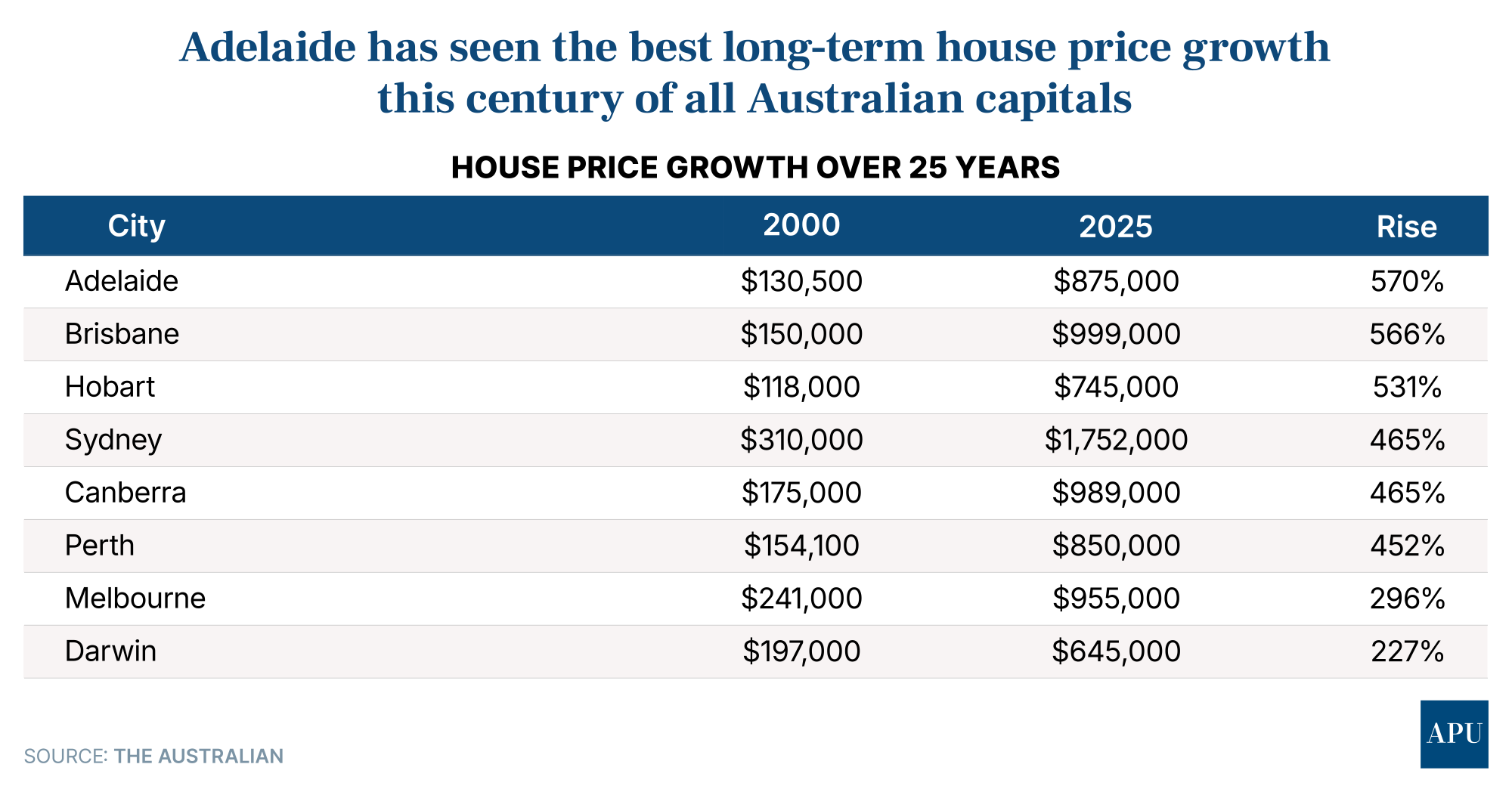
“How could the relatively quiet City of Churches … outgrow Sydney and the other big eastern states capitals?” asks The Australian’s Personal Finance writer Anthony Keane, seemingly surprised at his own findings.
Yet Mr Keane’s analysis of Real Estate Institute of Australia data clearly shows Adelaide’s median house price has surged 570% since 2000, taking prices from $130,500 to $875,000.
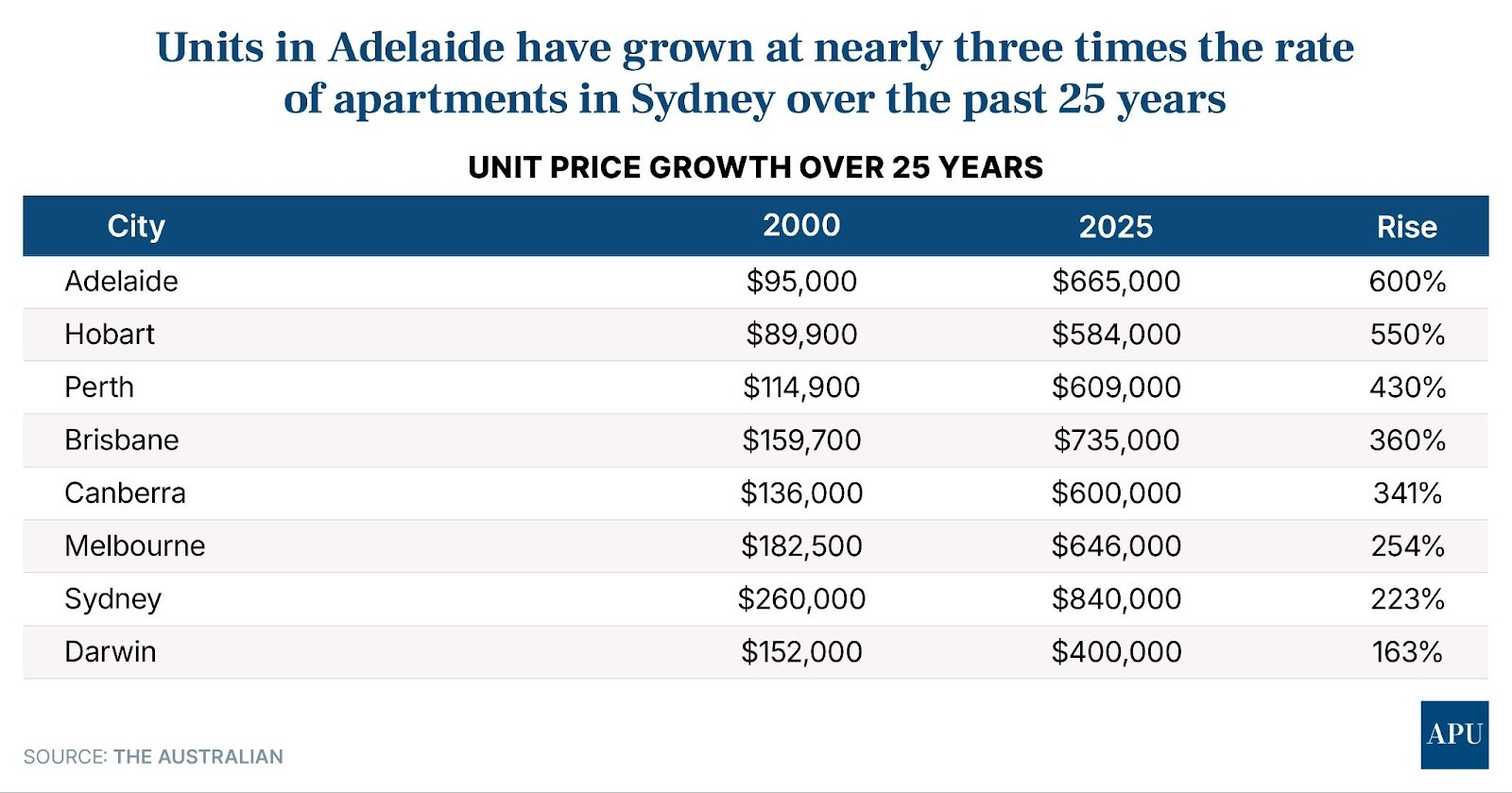
Over the same period, unit and apartment prices jumped an even more remarkable 600%, rising from $95,000 to $665,000.
Both are the strongest growth rates nationally over that period.
By comparison, Brisbane recorded the second-strongest house price growth, rising 566%, while Hobart ranked second for national unit price growth at 550%.
Sydney recorded 465% house price growth, taking median prices from $310,000 to a whopping $1,752,000.
Over the same period, units and apartments in Sydney managed just 223% growth.
Melbourne property has underperformed relative to other capitals this century, recording house price growth of 296% over the past 25 years, taking prices from a median of $241,000 to $955,000.
The last 25 years has also seen Sydney’s median house price premium over Melbourne blow out from 29% to 83%.
However, the price differential for units has actually shrunk.
In 2000, Sydney’s median unit price saw a commanding 42% premium over Melbourne.
In 2025, that shrank to 30%, with Sydney’s unit median at $840,000 and Melbourne’s at $646,000.
Ray White Chief Economist Nerida Conisbee says Adelaide entered the pandemic as one of Australia’s most affordable capital cities, a crucial advantage once housing demand boomed.
“There’s differing times when Adelaide has had big spurts, but I think you would probably find that the biggest spurt has been in the last six years,” Ms Conisbee told The Australian.
“Adelaide was a city where younger people tended to leave to get jobs, whereas I think the jobs are now being created in Adelaide, and that’s really helped.”
She points to a strengthening state economy underpinned by tourism, mining and agriculture, alongside a government actively courting investment.
That economic momentum has translated directly into property demand, lifting prices well beyond what many analysts once thought possible for the city.
While Adelaide’s long-term performance is undeniable, several experts caution that the next phase of the city’s property cycle is unlikely to match the last.
Property Investors Council of Australia Chair Ben Kingsley expects Adelaide’s relative outperformance to fade over time.
“It is clear that there will be regression to the mean,” he told The Australian’s Anthony Keane.
“Over the next 10, 15 to 25 years, it’s unlikely that Adelaide’s performance will outstrip that of the major capitals.”
In the near term, Mr Kingsley expects Adelaide prices to ease back toward the middle or bottom of the national pack, as much-needed new housing supply comes online.
“Less pressure from a population point of view will see Adelaide come off the peak.
“That’s not a declining market, it’s just coming off the peak,” he says.
Ray White’s Nerida Conisbee agrees the city’s extraordinary catch-up phase is largely complete.
“Adelaide won’t see the same level of growth in the next 10 years as it has in the past 10 years,” she says.
Even with growth moderating, Adelaide is expected to remain a solid performer.
REA Group’s PropTrack forecasts prices to rise 6 to 9% in 2026, below the pace of Brisbane and booming Perth, but ahead of Sydney and Melbourne.
KPMG has predicted Adelaide house prices will grow a strong 8.2% over 2026, before easing to 6.6% in 2027.
Adelaide units will see more muted growth of 3.3% this year, before picking up slightly to 3.8% price growth in 2027.
Real Estate Institute of South Australia chair Cain Cooke told Anthony Keane Adelaide has evolved from “slow-and-steady to Australia’s strongest and most dependable market”.
“We remain more affordable than Sydney and Melbourne, though the gap is closing as interstate interest grows.
“Compared with Brisbane and Perth, Adelaide is less volatile, with growth that’s more even and supply pressures that are challenging but manageable.”
With population growth projections pointing to another 700,000 residents by 2051, Mr Cooke believes demand will continue to underpin prices, but without the explosive gains of the pandemic-era boom.
“While we won’t see the rapid gains of the Covid era,” he says, “above-inflation growth remains the most likely trajectory.”











.jpg?width=1920&height=1080&name=WTF%20Is%20Happening%20To%20The%20Housing%20Market!%20$500%20Billion%20Wiped%20Out%20As%20Prices%20Fall%20Faster%20Every%20Month%20Scott%20Kuru%20YPU%20027%20(1).jpg)
%20Scott%20Kuru%20YPU%20025.jpg?width=1920&height=1080&name=This%20Is%20Worse%20Than%20A%20Recession%20RBA%20Admits%20Australias%20Wage%20Collapse%20Cant%20Be%20Stopped%20(Prepare%20Now)%20Scott%20Kuru%20YPU%20025.jpg)























.jpg?width=1920&height=1080&name=EXPOSED%20How%20The%20Govt%20Let%20These%20Oil%20Giants%20Get%20Away%20With%20Paying%20Zero%20Tax%20For%20Aussie%20Gas%20Scott%20Kuru%20DPU%20256%20(1).jpg)






%20Scott%20Kuru%20DPU%20248.jpg?width=1920&height=1080&name=Major%20Banks%20CAUGHT%20Preparing%20For%20Australia%E2%80%99s%20Biggest%20Housing%20Crash%20(Defaults%20%26%20Bankruptcies%20Coming)%20Scott%20Kuru%20DPU%20248.jpg)
%20Scott%20Kuru%20DPU%20247.jpg?width=1920&height=1080&name=This%20Is%20How%20Australia%20Gets%20Pushed%20Into%20the%20Next%20Big%20Reset%20(Trust%20Collapse%20Has%20Officially%20Begun)%20Scott%20Kuru%20DPU%20247.jpg)







%20Scott%20Kuru%20DPU%20239.jpg?width=1920&height=1080&name=URGENT%20Life%20In%20Australia%20Has%20Become%20Impossible%20For%20Millions%20Of%20Aussies%20(It%E2%80%99s%20About%20To%20Get%20Worse)%20Scott%20Kuru%20DPU%20239.jpg)








%20Scott%20Kuru%20DPU%20227.jpg?width=1920&height=1080&name=URGENT%20ALERT%20Australia%E2%80%99s%20Property%20Market%20Is%20Sliding%20Into%20Something%20Much%20Bigger%20(Prepare%20Now)%20Scott%20Kuru%20DPU%20227.jpg)