










 SIGN UP FOR FREE NEWSLETTER

Image by Steven Siewert/Domain
Australian house prices have recorded their steepest quarterly fall on record, according to property data company Domain, with every capital city going backwards at the same time for only the second time in the company’s records.
However, for buyers who’ve spent years watching prices race away from them, there’s a more encouraging side to the latest Domain House Price Report: affordability is improving, negotiating power is shifting towards purchasers and several markets remain comfortably above where they were a year ago, despite the recent correction.
The details
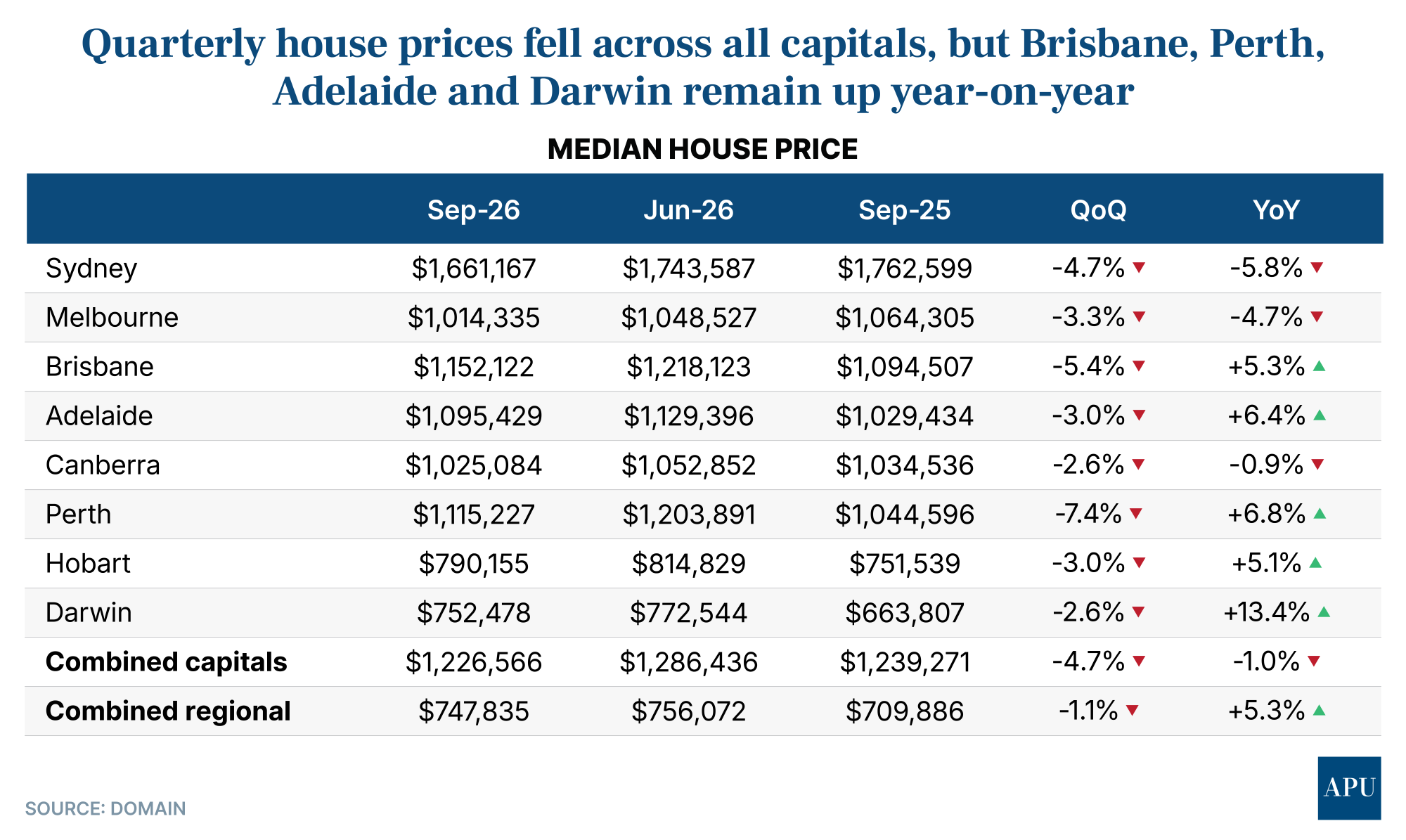
Across Domain’s combined capital cities measure, median house prices fell 4.7% in the September quarter of 2026, while unit prices fell a smaller 3.5%.
Domain says higher interest rates, cost-of-living pressures and weaker investor demand have hit confidence, while longer selling times and increased discounting are giving buyers more choice and bargaining power.
For would-be buyers who can still obtain finance, that’s a very different market from the frenzied conditions of recent years.
The biggest quarterly falls were recorded in Perth, where the median house price dropped 7.4%, or $88,664, to $1.115 million.
Sydney houses fell 4.7%, wiping an estimated $82,420 from the median in just three months and taking prices back to $1.661 million.
They are now 7.9% below their December 2025 peak.
Brisbane suffered its steepest quarterly fall on record, with house prices dropping 5.4%, or $66,001, to $1.152 million after 14 consecutive quarters of growth.
Melbourne’s median house price fell 3.3%, or $34,192, to $1.014 million and is now at its lowest level in more than five years.
Domain chief residential economist Nicola Powell says the downturn has broadened quickly.
“What began as weakness concentrated in some cities has broadened considerably … the turnaround has come quickly,” she says.
“And it’s not just isolated to Sydney and Melbourne, which it previously was; it has broadened geographically, and it has deepened.”
Buyers are gaining the upper hand
The obvious downside of falling prices is that existing owners can lose equity, particularly those who bought near the top of the market.
But the flipside is that buyers are finally regaining negotiating power.
Domain says auction clearance rates are weak, homes are taking longer to sell and vendors are increasingly having to discount asking prices or switch auction campaigns to private treaty sales.
In Sydney, Ms Powell says weak consumer confidence is now central to the downturn.
“I think a lack of confidence is at the core of everything, and it’s almost this kind of mix of psychology and economics,” she says.
“You’ve seen all of these headwinds clash and collide all at once, and what’s coming out is falling prices [gaining] momentum.”
That’s bad news for vendors who are in a hurry to sell.
But it can create opportunities for buyers who are less pressured, have secure finance and are prepared to negotiate.
The medium-term view
While the quarterly figures appear grim, not every market is actually down over the year.
Several capital-city markets are still worth more than they were a year ago.
Despite Brisbane’s record quarterly price fall, its median house price remains 5.3% higher than in September 2025.
Adelaide houses are still up 6.4% annually, Perth houses 6.8%, Hobart 5.1% and Darwin 13.4%.
Regional house prices are also 5.3% higher than a year ago.
Units show a similar pattern.
Brisbane unit prices remain an impressive 10.5% higher annually, Perth units are up 9.4%, Hobart 3.5% and Darwin is up a strong 12.5%.
Darwin was also the only capital where unit prices rose during the September quarter, increasing 2.2%.
While prices are falling from recent peaks, in several markets they are partly unwinding some of the extraordinary gains accumulated during the previous boom.
AMP’s Deputy Chief Economist Diana Mousina describes the downturn as a “recalibration of the market”.
“A lot of people have this assumption that the Australian property market never experiences price declines, and it’s a really false narrative because there are plenty of cycles that go on both at the national level, but more importantly at the capital city level, regional versus urban, between houses and apartments,” she says.
Units continue to hold up better
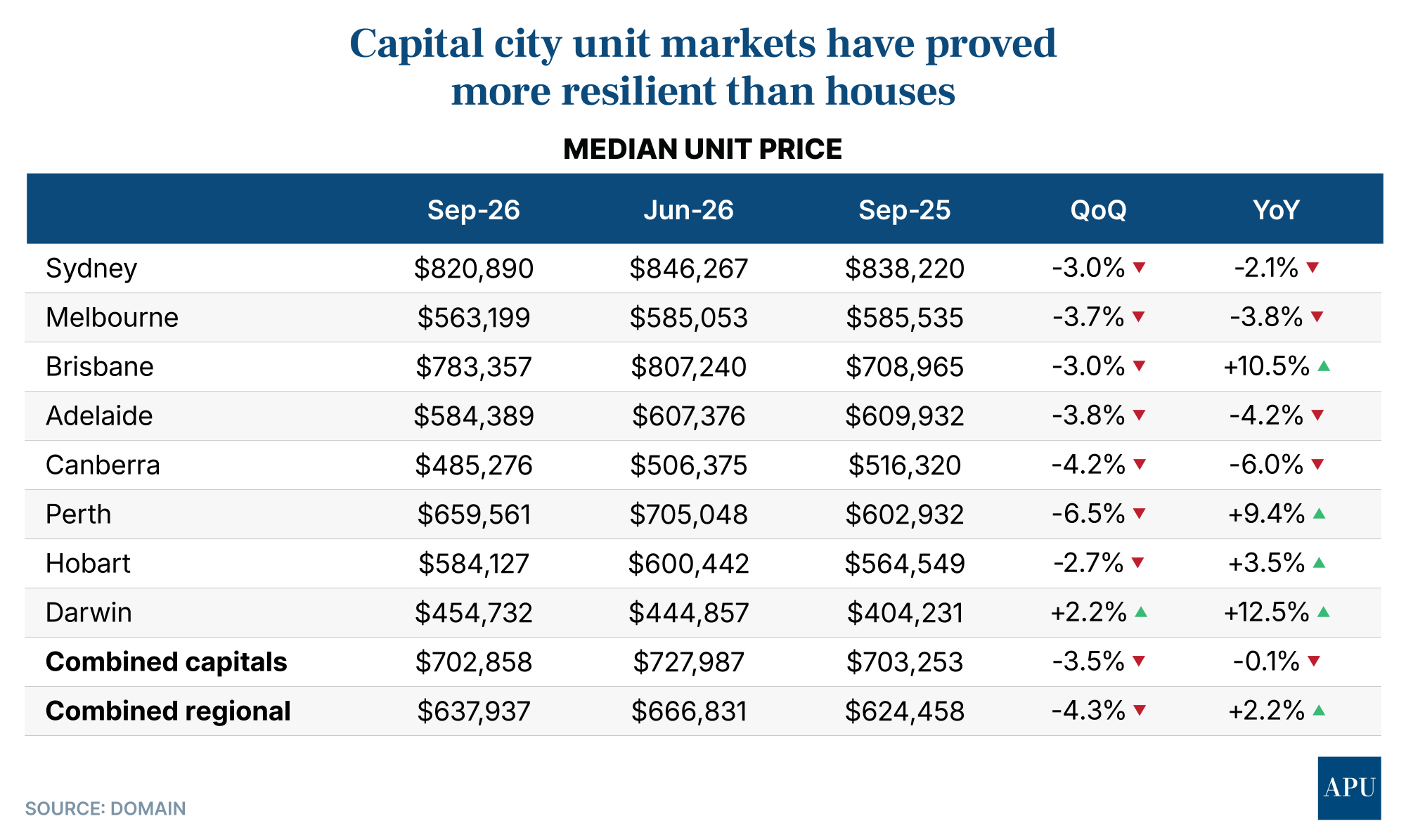
Another positive for buyers and investors is that units remain more resilient than houses.
Across the combined capitals, unit prices fell 3.5% in the September quarter compared with 4.7% for houses.
Domain attributes some of that resilience to affordability, with buyers increasingly gravitating towards apartments as detached houses remain expensive.
That could become increasingly important if borrowing capacity remains constrained because of persistently high interest rates and the prospect of further RBA rate rises.
In Brisbane, for example, houses fell 5.4% during the quarter while units fell 3%.
In Sydney, houses dropped 4.7% and units 3%.
Melbourne set to turn?
While the outlook for price growth in Melbourne remains weak in the near term, AMP sees at least one positive.
“If you’re looking for a silver lining, the pace of the falls is slowing a bit,” Ms Mousina says.
AMP expects Melbourne prices to bottom before some other capitals because they have already fallen further and affordability has improved more substantially.
“There could be a little bit more to go on that front ... by the middle of next year prices will bottom out,” she says.
The take-out
For buyers who were locked out of the property market during the post-Covid boom, the current correction may finally give them some room to move.
Prices are lower, sellers are more negotiable, buyers have greater choice and units in particular are offering a relatively affordable entry point.
And in several cities, the annual picture remains surprisingly resilient despite the size of the quarterly falls.