









.png?width=292&height=292&name=Copy%20Link%20(1).png)

 SIGN UP FOR FREE NEWSLETTER
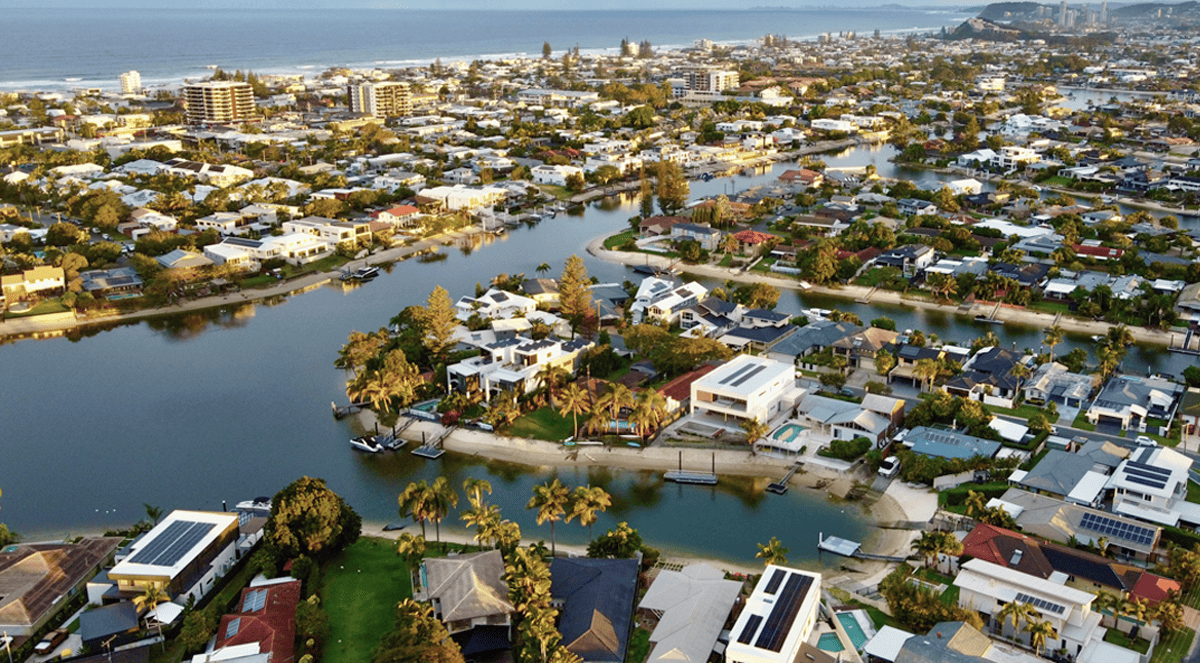
Image by Bailey Rytenskild
Two separate analyses have underlined the long-term strength and stability of Australian residential property.
The first, by data analytics firm Cotality, shows that over the past 40 years there have been only six periods when housing values went backwards.
Cotality’s findings also show strong periods of property growth often occurred when least expected.
The second, by The Australian newspaper, finds property has delivered stronger growth over the past 25 years than even the soaring US sharemarket.
Cotality’s 40-year time-line
.svg)
Cotality says Australia’s housing market has a long history of defying conventional wisdom, with periods of extraordinary growth occurring under unexpected conditions.
The data analytics company examined forty years of data, which showed that housing often performed best during high-interest-rate environments and global crises.
“Sometimes home values surge when you least expect it,” says Tim Lawless, Cotality’s Research Director.
“In 1988, with interest rates near 15% and rising, Australian home values skyrocketed by 31%.
“Fast forward to 2021, amid a global pandemic and closed borders, national values jumped almost 25%,” he says.
Mr Lawless says these “standout years” serve to remind us that housing markets are influenced by more than just interest rates.
“Fiscal stimulus, credit availability, migration trends and economic shocks all play a role in shaping outcomes,” he says.
“Periods of extreme growth often coincide with broader economic shifts, not just monetary policy.”
In order of growth, the top growth years over the past four decades are:
1988: 31.2%
2021: 24.5%
2003: 18.1%
2001: 15.9%
1987: 15.3%
Interestingly, the analysis also shows that 2025 was the 11th highest calendar year for Australian residential housing value growth over the past forty years.
Cotality also notes that over the past forty years, there have only been six periods when home values have actually fallen, and only once by over 5%.
The Australian newspaper’s 25-year retrospective
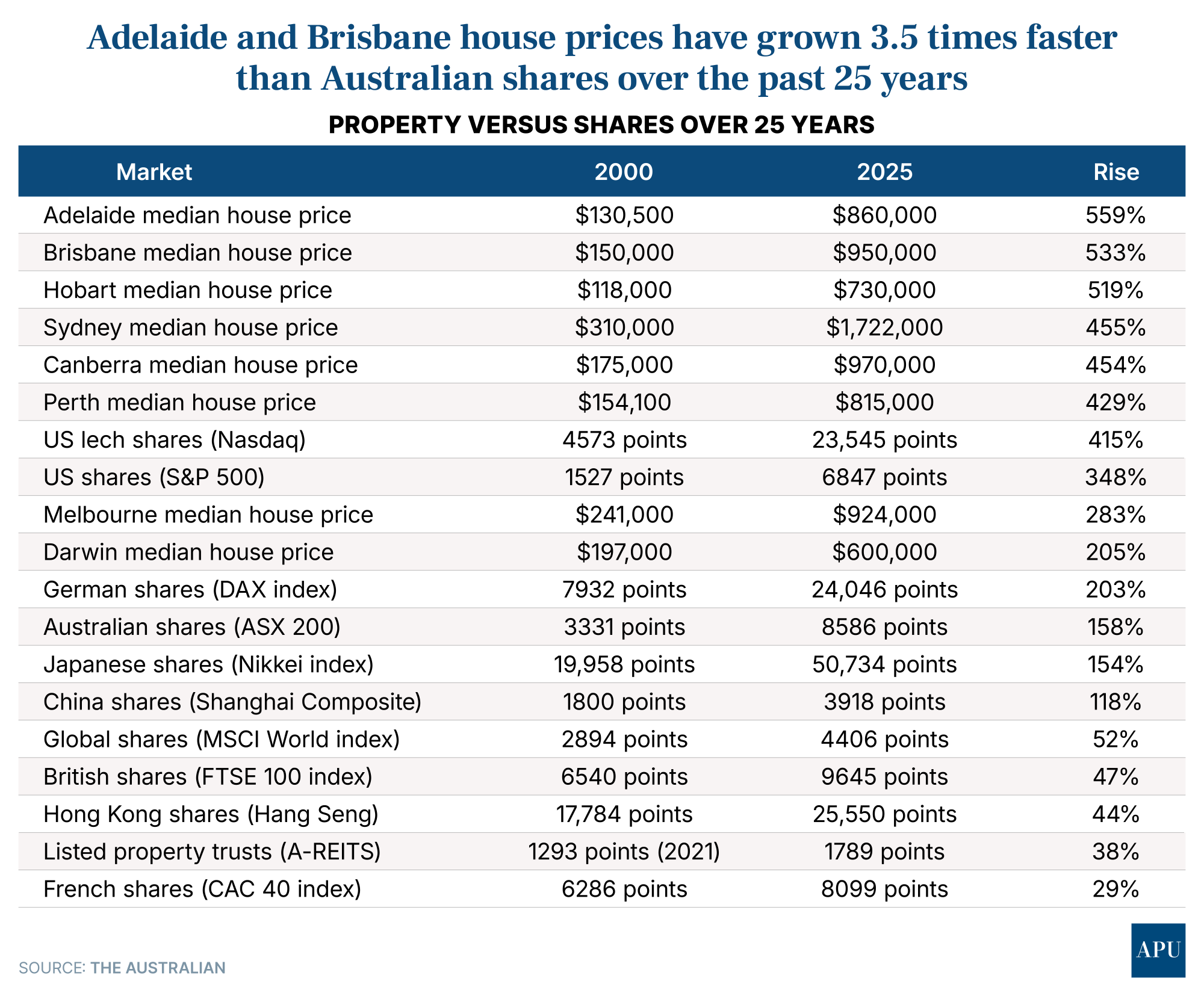
A separate analysis by The Australian newspaper, comparing long-term property price growth with major local and global share indices, shows Australian capital city house prices occupy the top six spots for returns since the early 2000s, each delivering at least 400%.
Topping the list was Adelaide.
Long regarded as a steady, unspectacular market, Adelaide has seen house prices rise 559% since early 2000.
Median house values have climbed from $130,500 to about $860,000, according to Real Estate Institute of Australia data.
Brisbane follows closely, with houses up 533% from $150,000 to $950,000, while Hobart has recorded 519% growth to reach a median of $730,000.
Sydney - one of the world’s most expensive cities - ranks fourth, with growth of 455%, lifting the median house price to about $1.72 million.
By comparison, the strongest sharemarket performers over the same 25-year period were US equities.
Despite the dotcom crash and the global financial crisis, the Nasdaq index climbed 415%, while the S&P 500 rose 348%.
Over the same period, Australia’s benchmark share indicator - the ASX 200 index - managed just a 158% lift.
However, The Australian’s Personal Finance writer Anthony Keane points out that the outcome shifts dramatically depending on where the clock starts.
Extending the analysis back to early 1995 - before the late-1990s technology boom and bust - US shares dominate, with the Nasdaq surging 2781% and the S&P 500 up 1442%.
Mr Keane says that an earlier starting point also reshuffles the property rankings.
Sydney becomes the nation’s strongest housing market, delivering 770% growth, boosted by a powerful pre-Olympics upswing in the late 1990s, when median house prices jumped from $198,000 to $310,000.
AMP’s Chief Economist and Head of Investment Strategy Shane Oliver says Australian property had delivered an “extraordinary performance over the last 25 years”, though US shares remained the standout over longer time frames.


“There’s always an issue with starting points – if you start in 2000, you are starting at the top of the tech boom,” he told Anthony Keane.
“In the 2000s, property was really taking off on the back of the shift to lower interest rates and the surge in immigration.”
But looking back even further, Dr Oliver says returns from shares and property are remarkably similar.
“If you go back to the 1920s, allowing for dividends and rents in property, shares and property have similar returns over the very, very long term.
“In the last 100 years, shares and property have returned around 11% each per annum – they go through periods where one exceeds the other, and the period could go on for decades.
“Are we going to see another quarter-century like the one we’ve just seen?
“Maybe, but the price-to-income ratios are through the roof, and we are bumping up against affordability constraints, which could put a cap on how much (property) prices keep going up.”
Anthony Keane also sought the views of Tribeca Financial Head of Advice Robert Devlin, who says property benefits from “significant tax incentives”, including the family home’s exemption from capital gains tax.
“I think once we get down to returns net of fees, tax, etcetera, the comparison gets more nuanced and complicated,” he says, “but largely no surprises to see property doing really well, and we think having exposure to the property market in some form is a great idea for most people.”
AMP’s Shane Oliver also highlights property’s relative stability.
“Property did not suffer the sharp swings in sentiment and prices that shares did,” he says.
“I often conclude that over long periods of time they’re similar, so you have both in a portfolio.”













.jpg?width=1920&height=1080&name=WTF%20Is%20Happening%20To%20The%20Housing%20Market!%20$500%20Billion%20Wiped%20Out%20As%20Prices%20Fall%20Faster%20Every%20Month%20Scott%20Kuru%20YPU%20027%20(1).jpg)
%20Scott%20Kuru%20YPU%20025.jpg?width=1920&height=1080&name=This%20Is%20Worse%20Than%20A%20Recession%20RBA%20Admits%20Australias%20Wage%20Collapse%20Cant%20Be%20Stopped%20(Prepare%20Now)%20Scott%20Kuru%20YPU%20025.jpg)



























.jpg?width=1920&height=1080&name=EXPOSED%20How%20The%20Govt%20Let%20These%20Oil%20Giants%20Get%20Away%20With%20Paying%20Zero%20Tax%20For%20Aussie%20Gas%20Scott%20Kuru%20DPU%20256%20(1).jpg)







%20Scott%20Kuru%20DPU%20248.jpg?width=1920&height=1080&name=Major%20Banks%20CAUGHT%20Preparing%20For%20Australia%E2%80%99s%20Biggest%20Housing%20Crash%20(Defaults%20%26%20Bankruptcies%20Coming)%20Scott%20Kuru%20DPU%20248.jpg)
%20Scott%20Kuru%20DPU%20247.jpg?width=1920&height=1080&name=This%20Is%20How%20Australia%20Gets%20Pushed%20Into%20the%20Next%20Big%20Reset%20(Trust%20Collapse%20Has%20Officially%20Begun)%20Scott%20Kuru%20DPU%20247.jpg)







%20Scott%20Kuru%20DPU%20239.jpg?width=1920&height=1080&name=URGENT%20Life%20In%20Australia%20Has%20Become%20Impossible%20For%20Millions%20Of%20Aussies%20(It%E2%80%99s%20About%20To%20Get%20Worse)%20Scott%20Kuru%20DPU%20239.jpg)











%20Scott%20Kuru%20DPU%20227.jpg?width=1920&height=1080&name=URGENT%20ALERT%20Australia%E2%80%99s%20Property%20Market%20Is%20Sliding%20Into%20Something%20Much%20Bigger%20(Prepare%20Now)%20Scott%20Kuru%20DPU%20227.jpg)