









.png?width=292&height=292&name=Copy%20Link%20(1).png)

 SIGN UP FOR FREE NEWSLETTER
The Reserve Bank of Australia raised the official cash rate by 25 basis points to 3.85% on the 3rd of February 2026, citing renewed concerns about inflation pressures in the economy.
The hawkish language used by Governor Michele Bullock at her traditional post-decision press conference and the grim inflation outlook contained in the RBA’s latest forecasts appear to pave the way for at least one more interest rate hike this year.
Financial markets have already priced in around an 85% chance of another 25 basis point hike by the RBA at its May monetary policy committee meeting.
However, research by a former RBA economist and loan information from two of Australia’s “Big 4” banks raise questions about the traditional view of how monetary policy works.
It also casts doubt on the widely accepted view that housing price growth will slow or even turn negative in 2026, because of a higher interest rate climate.
The details
New research from the e61 Institute, an independent economic think-tank, finds that most Australian households with a mortgage will not react to higher interest rates by cutting their household spending.
Rather, they will reduce their so-called “mortgage buffers”.
This finding has major implications for the RBA’s efforts to tame inflation and bring it back to its 2-3% target, “muting some of the short-run impact of monetary policy,” according to the e61 Institute Research Director, Gianni La Cava.
Dr La Cava is a former senior RBA economist who used to lead a team at the central bank that examined macroeconomic issues using microeconomic data.
In layman's terms, he’s an expert in the way individual and household behaviour affects the performance of the entire economy.
The traditional view of the so-called “transmission of monetary policy” in Australia is thought to run like this:
When interest rates are lower, borrowers reduce their mortgage interest repayments, lift their disposable income and spend more money on goods and services.
When rates are higher, borrowers pay more in mortgage interest, cut back their disposable income and spend less.
This drop in demand eventually causes suppliers of goods and services to lower their prices - or at least keep them on hold for longer - in order to lift sales.
“This “cash flow channel” is generally seen as central to how monetary policy works in Australia,” Gianni La Cava says.
However, in a recent paper called “Rethinking mortgage debt and monetary policy”, Dr La Cava argues that the cash flow channel is currently weaker than many assume.
Using de-identified bank transaction data for December 2024 to April 2025, Dr La Cava and his team studied the effect of the cash flow channel following the RBA’s decision to cut rates in February 2025 - the first rate reduction by the central bank in four and a half years.
“The first step worked exactly as textbooks predict,” Dr La Cava says.
“Average mortgage interest charges fell by about $140 per month.
“That was a meaningful lift in household cash flow.
“But the second step did not follow.
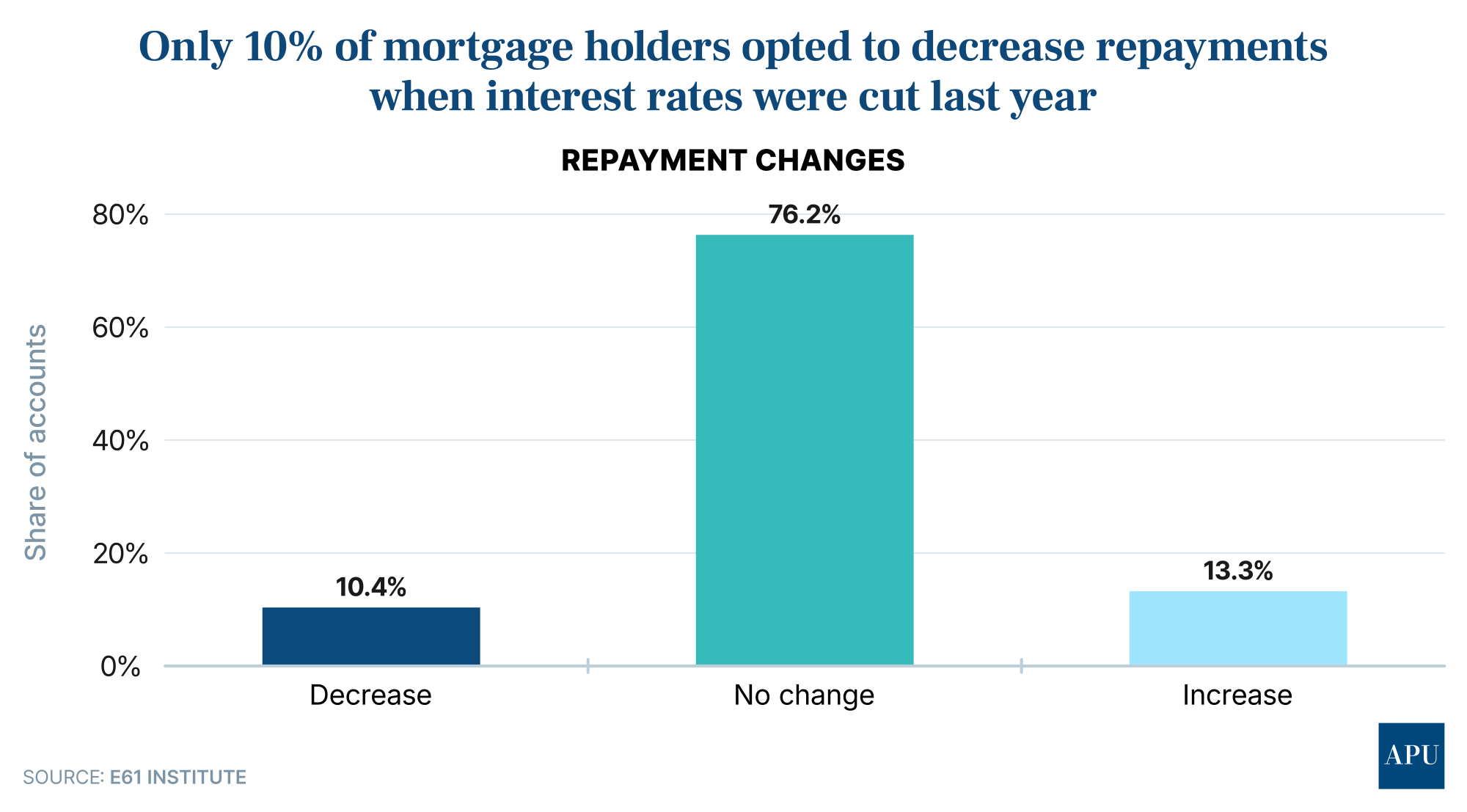
“Only 10% of households reduced the size of their regular mortgage repayments after the cuts.”
Gianni La Cava says this pattern was consistent across banks, including one that automatically lowers scheduled repayments for borrowers paying the minimum monthly loan repayment.
So why didn’t lower interest rates translate into lower mortgage repayments, especially as most Australians with property loans are on variable rates, which are invariably linked to movements in the official cash rate?
Dr La Cava says there are two reasons.
The first is what he calls “repayment inertia”.
This is a situation in which households do not adjust their ACTUAL repayments in line with REQUIRED repayments.
When rates fall, minimum repayments can decline.
However, most Australian banks do not automatically change repayment schedules.
It’s up to borrowers to actually request a repayment reduction.
They need to take the initiative and actively contact their bank if they want to pay less each month.
“If a borrower leaves their total repayment unchanged, the difference becomes an additional principal reduction,” e61’s Gianni La Cava says.
“The rate cut is automatically converted into higher saving through faster mortgage amortisation.”
The second reason Dr La Cava cites are liquidity and prepayment buffers.
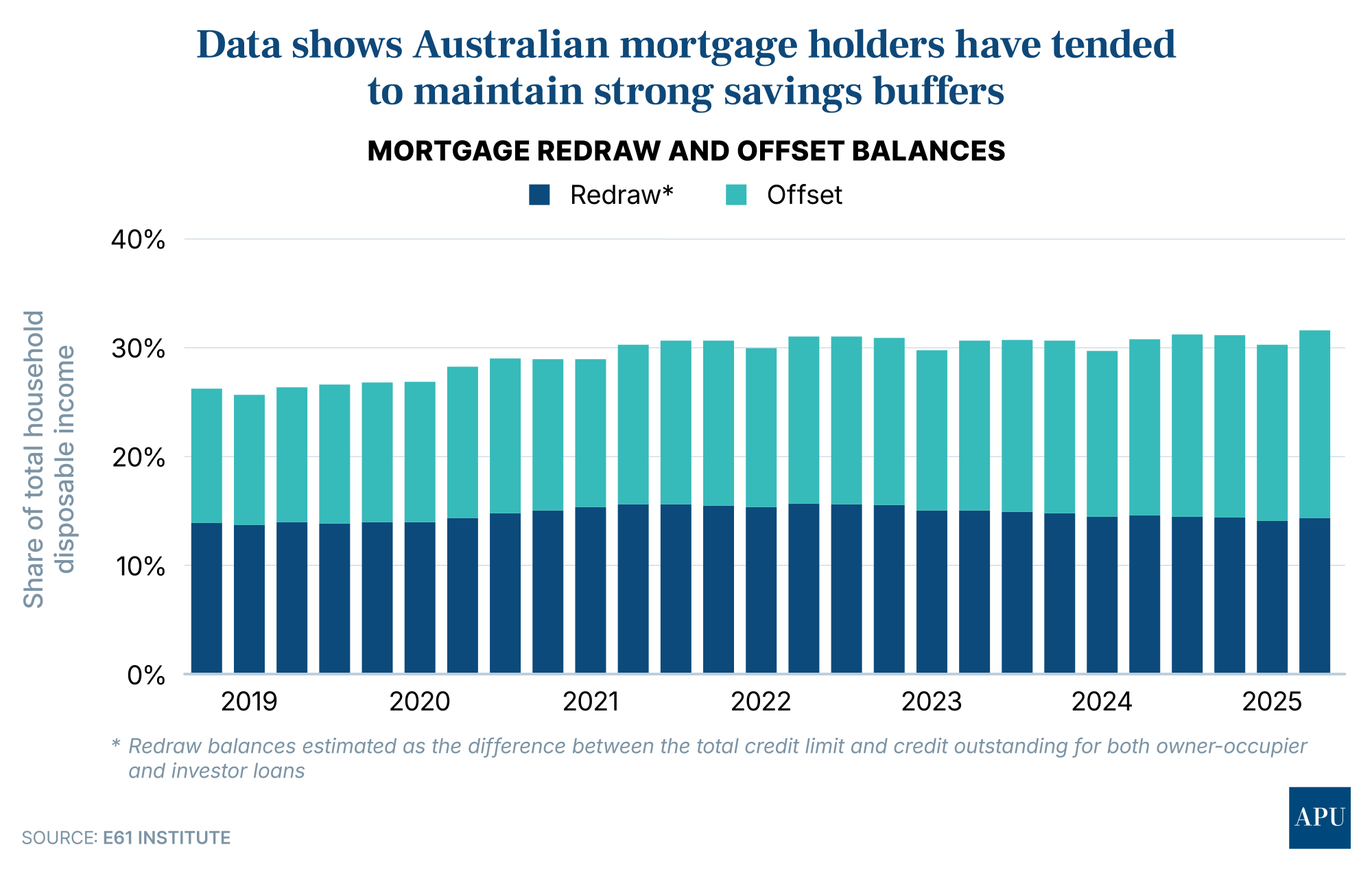
This is the extra cash that households accumulate over time in offset and redraw accounts.
“Borrowers with larger liquidity buffers are less likely to adjust their spending when required repayments change, because they can more easily smooth spending in the face of fluctuations in cash flow,” he says.
Dr La Cava says there have been noticeable changes in the size of the buffers Australian households with mortgages have kept over the past 5 or so years.
“At the start of the 2022 tightening phase (immediately post COVID), they were unusually large,” he says, referring to the period when the RBA began raising the official cash rate from a record low of 0.1%.
“Many borrowers could cover required repayments for extended periods without cutting consumption,” Dr La Cava says.
“That served to blunt the spending response to higher rates.”
Those savings were then run down during the hiking cycle and by the time of the 2025 rate cuts, many borrowers had relatively thin buffers.
“The cuts since then have partly been used by households to rebuild those buffers,” he says.
His research suggests that a 100-basis point (or 1%) reduction in interest rates leads to an average 0.5% increase in mortgage buffers after 6 months.
While Dr La Cava says buffers are no longer at the exceptionally high levels seen at the start of the earlier hiking cycle, most households still have a sizeable financial cushion.
He estimates about 11% of borrowers have large enough money saved to cover their median monthly spending for at least 2 years.
The e61 Institute’s findings are backed by estimates from the long-running Household, Income and Labour Dynamics in Australia (HILDA) survey run by the Melbourne Institute.
It found that at the peak of the RBA’s last tightening cycle (when the cash rate reached 4.35%), only about 2% of mortgage borrowers reported being behind on their repayments, while more than half said they were ahead.
“This suggests that, although buffers have been eroded from earlier highs, most borrowers are not right up against their cash flow limits,” Dr La Cava says.
“The macro implication is that the latest interest rate rise will likely have a limited impact on spending through the cash flow channel.
“Most of the reduction in cash flow will be met by lower saving and reduced mortgage buffers.
“Household spending will continue to be insensitive to further interest rate hikes, so long as the buffers are not eroded too much.
“When repayment inertia is high and liquidity buffers remain prevalent, the path from the cash rate to the checkout counter is slower and runs more through mortgage balances than shopping baskets,” he concludes.
Gianni La Cava and the e61 Institute’s findings are backed up by recent revelations from two of Australia’s “Big 4” banks.
National Australia Bank recently said that eight out of every ten of its mortgage customers did NOT reduce their home loan repayments through last year’s three RBA rate cuts.
The Commonwealth Bank - Australia’s largest mortgage lender - has also said that up to 95% of its customers kept their repayments where they were at the start of 2025, effectively ignoring the three rate cuts by the RBA last year.
If you have a loan at the NAB, the CBA or the ANZ Bank, you actually have to physically go into a bank branch or ring up their lending teams to request lower repayments when interest rates are cut.
It seems many customers at these banks were either oblivious to this requirement or had enough household cashflow to be happy to divert more of their money to paying off the principal on their home loans faster.
It’s only customers with loans at Westpac or Macquarie Bank or some other smaller lenders that would have seen their monthly repayments automatically reduce when rates were cut.

The take-out
So what does it mean if the “cash-flow channel” effect is weaker that many believe?
Firstly, it could mean inflation is higher for longer.
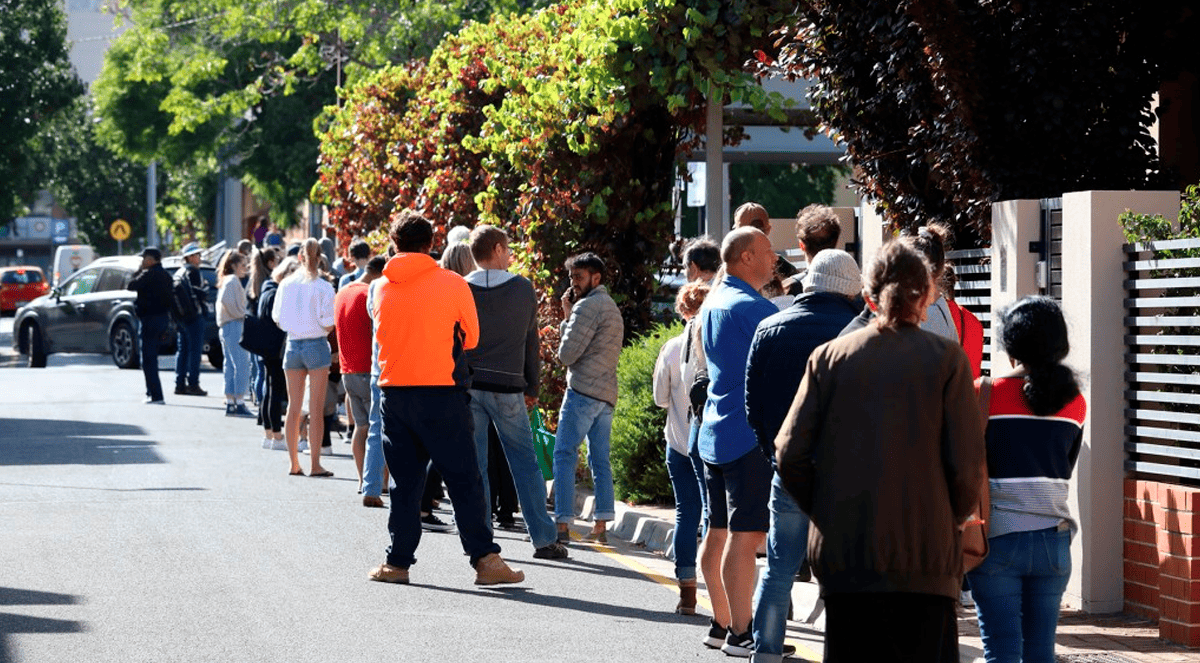
Only a third of Australians live in a home with a mortgage over it.
If most of these households aren’t necessarily cutting back on their spending because they currently have adequate savings buffers, there’s going to be little incentive for providers of goods and services to discount prices.
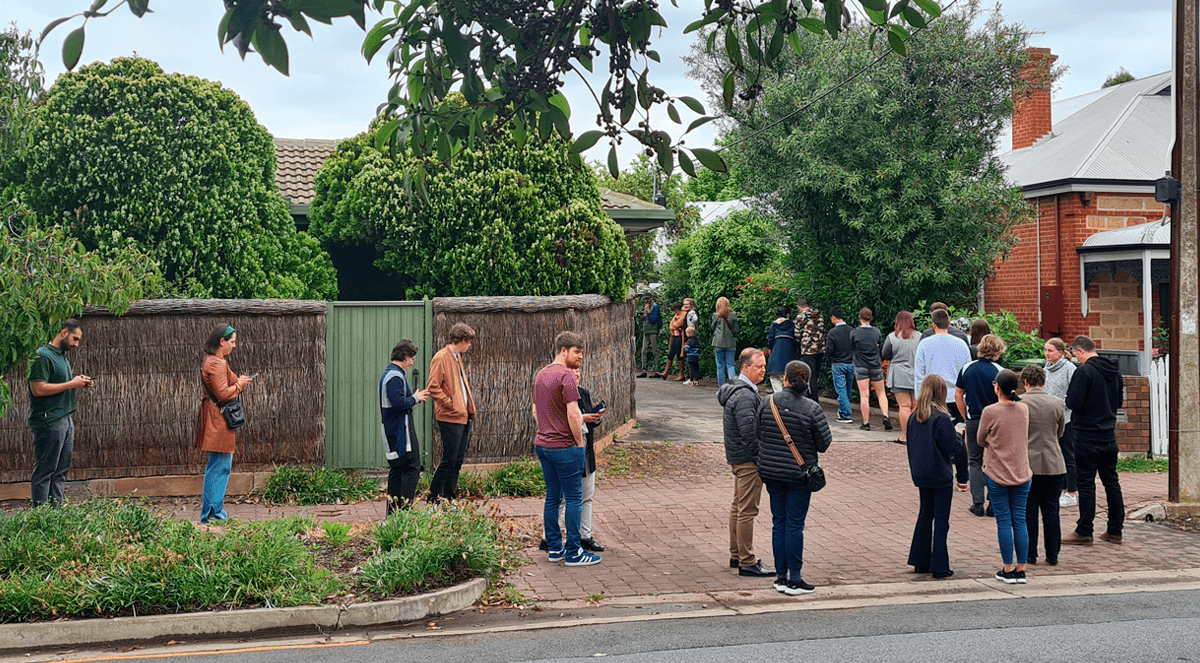
Secondly, many assume higher interest rates means lower or even negative home price growth.
However, this assumption was proved spectacularly wrong when property prices soared to new highs as the RBA jacked up interest rates no less than 13 times between May 2022 and November 2023.
Bank data and the e61 Institute’s research seem to demonstrate that very few mortgaged households are in dire financial straits.
So the scenario of thousands of stressed households being forced into a “fire-sale” of their homes, sending property prices plummeting, seems far-fetched.
Instead, it seems Australian households with a mortgage are prepared to cop higher loan repayments on the chin, winding back some of the savings buffers they have built up over time, or accepting that less of their mortgage repayments will go towards cutting down the principal on their loans
Meanwhile, the fundamentals for further home price growth - strong demand from population growth and low levels of new supply - aren’t going anywhere.






.jpg?width=1920&height=1080&name=WTF%20Is%20Happening%20To%20The%20Housing%20Market!%20$500%20Billion%20Wiped%20Out%20As%20Prices%20Fall%20Faster%20Every%20Month%20Scott%20Kuru%20YPU%20027%20(1).jpg)
%20Scott%20Kuru%20YPU%20025.jpg?width=1920&height=1080&name=This%20Is%20Worse%20Than%20A%20Recession%20RBA%20Admits%20Australias%20Wage%20Collapse%20Cant%20Be%20Stopped%20(Prepare%20Now)%20Scott%20Kuru%20YPU%20025.jpg)






















.jpg?width=1920&height=1080&name=EXPOSED%20How%20The%20Govt%20Let%20These%20Oil%20Giants%20Get%20Away%20With%20Paying%20Zero%20Tax%20For%20Aussie%20Gas%20Scott%20Kuru%20DPU%20256%20(1).jpg)






%20Scott%20Kuru%20DPU%20248.jpg?width=1920&height=1080&name=Major%20Banks%20CAUGHT%20Preparing%20For%20Australia%E2%80%99s%20Biggest%20Housing%20Crash%20(Defaults%20%26%20Bankruptcies%20Coming)%20Scott%20Kuru%20DPU%20248.jpg)
%20Scott%20Kuru%20DPU%20247.jpg?width=1920&height=1080&name=This%20Is%20How%20Australia%20Gets%20Pushed%20Into%20the%20Next%20Big%20Reset%20(Trust%20Collapse%20Has%20Officially%20Begun)%20Scott%20Kuru%20DPU%20247.jpg)






%20Scott%20Kuru%20DPU%20239.jpg?width=1920&height=1080&name=URGENT%20Life%20In%20Australia%20Has%20Become%20Impossible%20For%20Millions%20Of%20Aussies%20(It%E2%80%99s%20About%20To%20Get%20Worse)%20Scott%20Kuru%20DPU%20239.jpg)









%20Scott%20Kuru%20DPU%20227.jpg?width=1920&height=1080&name=URGENT%20ALERT%20Australia%E2%80%99s%20Property%20Market%20Is%20Sliding%20Into%20Something%20Much%20Bigger%20(Prepare%20Now)%20Scott%20Kuru%20DPU%20227.jpg)