









.png?width=292&height=292&name=Copy%20Link%20(1).png)

 SIGN UP FOR FREE NEWSLETTER

Every time home prices move, interest rates change or governments announce another housing policy, the debate usually centres on two familiar groups: first-home buyers and property investors.
But according to one of Australia's leading property advisory firms, everyone has been watching the wrong people.
New research from Charter Keck Cramer argues the biggest force shaping Australia's housing market isn't investors or first-home buyers at all.
It's the millions of Australians who already own a home and are buying another one.
The details
Charter Keck Cramer calls this cohort "Next Time Buyers": owner-occupiers moving because life has changed.
They may be upgrading for a growing family, downsizing after children leave home, relocating for work, separating after divorce or simply moving to a different lifestyle.
And according to Charter Keck Cramer, this is the group that really determines whether Australia's housing market keeps functioning.
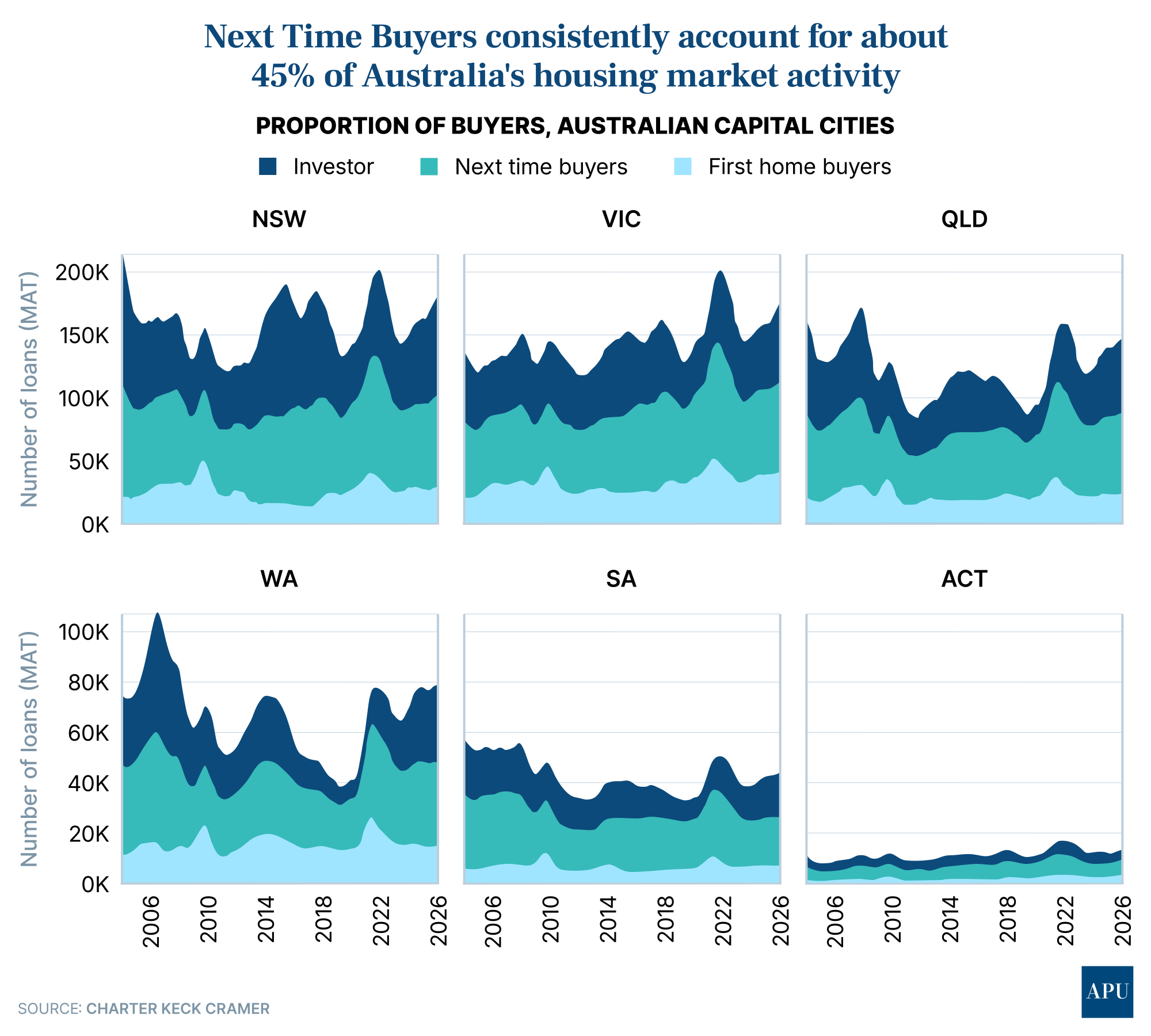
Drawing on more than two decades of ABS housing data, Charter Keck Cramer's Richard Temlett and Nicolo Traverso argue that public discussion has become overly focused on investors and first-home buyers simply because they're easier to measure.
"However, Charter Keck Cramer's research shows that for the last 20+ years, the cohort that actually drives Australian housing is the Next Time Buyer," they say.
Their report finds that since 2004, Next Time Buyers have consistently accounted for between 37.8% and 50.0% of buyers across Australia's capital cities, averaging 44.9%.
By comparison, first-home buyer activity has fluctuated dramatically as governments introduced and withdrew grants and incentives, while investor participation has risen and fallen with interest rates, lending rules and tax settings.
The authors say that stability makes Next Time Buyers the real engine of the housing cycle.
Unlike investors chasing returns or first-home buyers responding to government incentives, they move because life requires it.
"They are active because buying and selling a home is what a household does when life demands it," the report says.
Why Next Time Buyers are so important
Charter Keck Cramer argues these buyers do something unique.
When they purchase a property, they usually sell another one at the same time.
That creates listings, releases existing homes onto the market, keeps transactions flowing and allows prices to be “discovered” across the market.
In other words, they keep the property ladder moving.
"When a Next Time Buyer purchases, they often also list and sell their existing home," the authors write.
"Put simply, they are critical to market liquidity."
When that group slows down, the effects spread well beyond existing home sales.
The report says this leads to fewer people upgrading or downsizing, fewer homes coming onto the market and fewer buyers able to progress through the housing ladder.
That can lower overall housing turnover, weaken price certainty and eventually affect new housing supply.
The link between Next Time Buyers and new housing
Perhaps the report's most significant finding is the relationship between Next Time Buyers and construction.
Charter Keck Cramer analysed more than 20 years of ABS data on loan commitments, building approvals, commencements and completions.
"The most important finding is that Next Time Buyers are the strongest and most immediate leading indicator of new dwelling approvals," the report says.
By contrast, first-home buyers tend to follow housing cycles rather than initiate them.
The research suggests government incentives for first-home buyers may boost activity after supply is already increasing in response to Next Time Buyer activity, rather than triggering additional construction themselves.
Investor activity plays a different role.
According to Richard Temlett and Nicolo Traverso, investors are traditionally more closely linked to apartment developments already underway than to the creation of new detached housing.



Why the market is slowing
Charter Keck Cramer argues many of today's housing challenges can be traced back to this overlooked group of buyers becoming less active.
Higher interest rates, mortgage "lock-in", stamp duty, affordability pressures, uncertainty about prices, limited suitable housing stock and lengthy construction delays have all made it harder for existing owners to move.
"When Next Time Buyers stop moving, the market can become illiquid," the report says.
That matters because fewer transactions today can mean fewer homes built tomorrow.
The authors warn that this comes at a particularly awkward time, with Australia already falling behind its Housing Accord construction targets.
"This will translate into lower levels of future supply as well as lower pricing," they say.
As a result, Charter Keck Cramer argues governments should pay much closer attention to encouraging Next Time Buyers if they genuinely want a healthier housing market.
And the authors are clear about the reform they believe would make the biggest difference.
“The number one change would be replacing stamp duty with a broad-based annual land tax,” they conclude, arguing that this would help prevent Next Time Buyers from being hit with a huge financial penalty simply for moving.













.jpg?width=1920&height=1080&name=WTF%20Is%20Happening%20To%20The%20Housing%20Market!%20$500%20Billion%20Wiped%20Out%20As%20Prices%20Fall%20Faster%20Every%20Month%20Scott%20Kuru%20YPU%20027%20(1).jpg)

%20Scott%20Kuru%20YPU%20025.jpg?width=1920&height=1080&name=This%20Is%20Worse%20Than%20A%20Recession%20RBA%20Admits%20Australias%20Wage%20Collapse%20Cant%20Be%20Stopped%20(Prepare%20Now)%20Scott%20Kuru%20YPU%20025.jpg)





























.jpg?width=1920&height=1080&name=EXPOSED%20How%20The%20Govt%20Let%20These%20Oil%20Giants%20Get%20Away%20With%20Paying%20Zero%20Tax%20For%20Aussie%20Gas%20Scott%20Kuru%20DPU%20256%20(1).jpg)







%20Scott%20Kuru%20DPU%20248.jpg?width=1920&height=1080&name=Major%20Banks%20CAUGHT%20Preparing%20For%20Australia%E2%80%99s%20Biggest%20Housing%20Crash%20(Defaults%20%26%20Bankruptcies%20Coming)%20Scott%20Kuru%20DPU%20248.jpg)
%20Scott%20Kuru%20DPU%20247.jpg?width=1920&height=1080&name=This%20Is%20How%20Australia%20Gets%20Pushed%20Into%20the%20Next%20Big%20Reset%20(Trust%20Collapse%20Has%20Officially%20Begun)%20Scott%20Kuru%20DPU%20247.jpg)







%20Scott%20Kuru%20DPU%20239.jpg?width=1920&height=1080&name=URGENT%20Life%20In%20Australia%20Has%20Become%20Impossible%20For%20Millions%20Of%20Aussies%20(It%E2%80%99s%20About%20To%20Get%20Worse)%20Scott%20Kuru%20DPU%20239.jpg)











%20Scott%20Kuru%20DPU%20227.jpg?width=1920&height=1080&name=URGENT%20ALERT%20Australia%E2%80%99s%20Property%20Market%20Is%20Sliding%20Into%20Something%20Much%20Bigger%20(Prepare%20Now)%20Scott%20Kuru%20DPU%20227.jpg)