









.png?width=292&height=292&name=Copy%20Link%20(1).png)

 SIGN UP FOR FREE NEWSLETTER
Australia’s latest inflation figures have come in below market expectations, but economists warn the result is unlikely to be enough to remove the risk of another Reserve Bank interest rate hike this year.
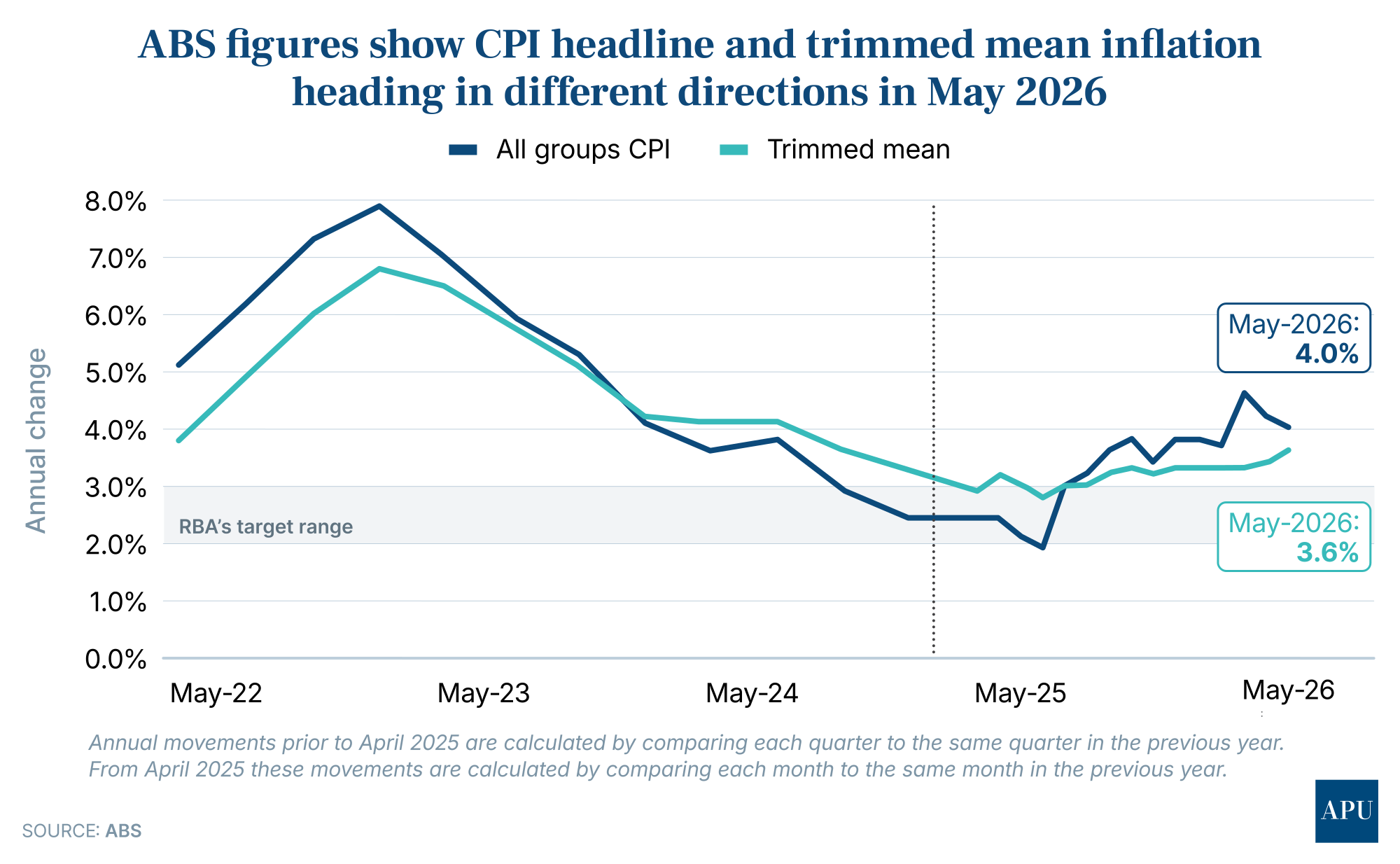
The Australian Bureau of Statistics says the Consumer Price Index fell 0.7% in May 2026, bringing annual headline inflation down to 4.0% from 4.2% in April.
That was better than most market watchers expected and appeared, at first glance, to be welcome news for households already dealing with higher mortgage repayments, rising rents and elevated living costs.
But the more important number for the Reserve Bank moved in the opposite direction.
Trimmed mean inflation, the RBA’s preferred measure of underlying price pressures, rose 0.4% in May and lifted to 3.6% over the year, up from 3.4% in April.
That means underlying inflation remains well above the RBA's 2-3% target band and has moved further away from it over the past month.
The details
The ABS says the main reason headline inflation fell in May was the sharp drop in fuel costs.
Fuel prices declined 11.9% in May, helping drag down the broader transport category and offsetting increases elsewhere in the economy.
There were also falls in clothing and footwear, and recreation and culture, with holiday travel and accommodation particularly weak after the Easter and school holiday period.
While headline inflation has eased to 4.0%, underlying inflation is now running at 3.6% and is at its highest annual pace since the second half of 2024.
The concern for the Reserve Bank will be that while lower fuel prices have taken some immediate heat out of the economy, broader inflation pressures appear to be spreading.
The ABS says housing costs rose 6.5% over the year to May, led by electricity, new dwelling costs and rents.
Electricity prices were up 21.1% over the year, largely because of the end of Commonwealth and state government electricity rebates.
New dwelling costs rose 5.6% annually and jumped 0.9% in the month of May alone — the strongest monthly increase since late 2022.
The ABS noted that project home builders in most cities had raised base prices to pass through fuel surcharges and higher material costs.
That suggests the Middle East conflict and the earlier spike in global oil and freight costs are still feeding into the domestic economy, even after oil prices have eased from their highs.
Westpac economists Neha Sharma and Sian Fenner said the May CPI result provided “a stronger signal that second-order effects from the Middle East supply shock are becoming more visible across consumer prices.”
They said higher fuel, transport and commodity costs were continuing to feed through to a broader range of categories, including energy, freight, plastics and chemicals.
“The key question is whether these price increases reverse as cost pressures ease, or whether they persist,” they said.
Westpac expects trimmed mean inflation to rise 1.0% in the June quarter, taking annual trimmed mean inflation to 3.8%.
As a result, Westpac is sticking with its view that the RBA will raise interest rates again, most likely at its August meeting.
“The May data reinforce the RBA’s concern that inflation remains too high and that a period of slower growth will be needed to return inflation to target,” the Westpac economists said.
ANZ’s Madeline Dunk and Adam Boyton took a more benign view, describing the May inflation data as “mixed”.
“There were also increasing signs of second-hand flow through appearing in the broader inflation basket,” they wrote in an economic update.
Based on the May numbers, ANZ expects quarterly trimmed mean inflation to rise 0.9% in the June quarter and annual trimmed mean inflation to come in at 3.7%.
That would be slightly below the RBA’s own forecast of 3.8%.
When combined with the recent slowing in economic activity, ANZ believes the result supports its view that the cash rate has already peaked.
Other economists are also divided.
Deloitte Access Economics partner Stephen Smith told ABC News that the data was “an unwelcome reminder that Australia’s inflation problem is not yet solved, with another rate hike in 2026 still likely.”
Harry Murphy Cruise from Oxford Economics Australia said higher input, freight and agricultural costs were still passing through to consumer prices, meaning inflation pressures would take time to fade even after oil prices normalise.
However, BetaShares chief economist David Bassanese warned that the RBA may already have tightened enough, saying there was an increasing risk the combination of rate rises, weaker confidence and budget-related uncertainty could push the economy into recession by the end of the year.
That’s the dilemma now facing the Reserve Bank.
On one hand, headline inflation has fallen, fuel prices are easing and the economy is slowing.
On the other, underlying inflation is still too high, housing costs remain stubborn and businesses appear to be passing higher input costs on to consumers.
The next crucial data point will be the June quarter CPI, due next month.
If trimmed mean inflation continues to rise, the RBA may decide it has little choice but to lift rates again.
If inflation eases and economic growth continues to slow, the current cash rate of 4.35% may ultimately prove to be the peak of this tightening cycle.












.jpg?width=1920&height=1080&name=WTF%20Is%20Happening%20To%20The%20Housing%20Market!%20$500%20Billion%20Wiped%20Out%20As%20Prices%20Fall%20Faster%20Every%20Month%20Scott%20Kuru%20YPU%20027%20(1).jpg)
%20Scott%20Kuru%20YPU%20025.jpg?width=1920&height=1080&name=This%20Is%20Worse%20Than%20A%20Recession%20RBA%20Admits%20Australias%20Wage%20Collapse%20Cant%20Be%20Stopped%20(Prepare%20Now)%20Scott%20Kuru%20YPU%20025.jpg)
























.jpg?width=1920&height=1080&name=EXPOSED%20How%20The%20Govt%20Let%20These%20Oil%20Giants%20Get%20Away%20With%20Paying%20Zero%20Tax%20For%20Aussie%20Gas%20Scott%20Kuru%20DPU%20256%20(1).jpg)





%20Scott%20Kuru%20DPU%20248.jpg?width=1920&height=1080&name=Major%20Banks%20CAUGHT%20Preparing%20For%20Australia%E2%80%99s%20Biggest%20Housing%20Crash%20(Defaults%20%26%20Bankruptcies%20Coming)%20Scott%20Kuru%20DPU%20248.jpg)
%20Scott%20Kuru%20DPU%20247.jpg?width=1920&height=1080&name=This%20Is%20How%20Australia%20Gets%20Pushed%20Into%20the%20Next%20Big%20Reset%20(Trust%20Collapse%20Has%20Officially%20Begun)%20Scott%20Kuru%20DPU%20247.jpg)







%20Scott%20Kuru%20DPU%20239.jpg?width=1920&height=1080&name=URGENT%20Life%20In%20Australia%20Has%20Become%20Impossible%20For%20Millions%20Of%20Aussies%20(It%E2%80%99s%20About%20To%20Get%20Worse)%20Scott%20Kuru%20DPU%20239.jpg)










%20Scott%20Kuru%20DPU%20227.jpg?width=1920&height=1080&name=URGENT%20ALERT%20Australia%E2%80%99s%20Property%20Market%20Is%20Sliding%20Into%20Something%20Much%20Bigger%20(Prepare%20Now)%20Scott%20Kuru%20DPU%20227.jpg)