








.png?width=292&height=292&name=Copy%20Link%20(1).png)

 SIGN UP FOR FREE NEWSLETTER
Image by Lei Shi/Flickr
In bad news for mortgage holders, the odds of the Reserve Bank of Australia raising the official cash rate at its next board meeting have increased, following the release of the nation’s latest inflation data.
The quarterly statistics show that inflation - both headline and core - increased in the last three months of 2025.
With inflation now moving up and further away from the central bank’s mandated target band of 2 to 3%, it seems likely the RBA could increase rates from the current 3.6% to 3.85% at its first meeting for 2026, which takes place next week.
That 0.25% hike would be an increase which most banks and financial institutions would pass on in full to retail customers on variable rate mortgages.
The details
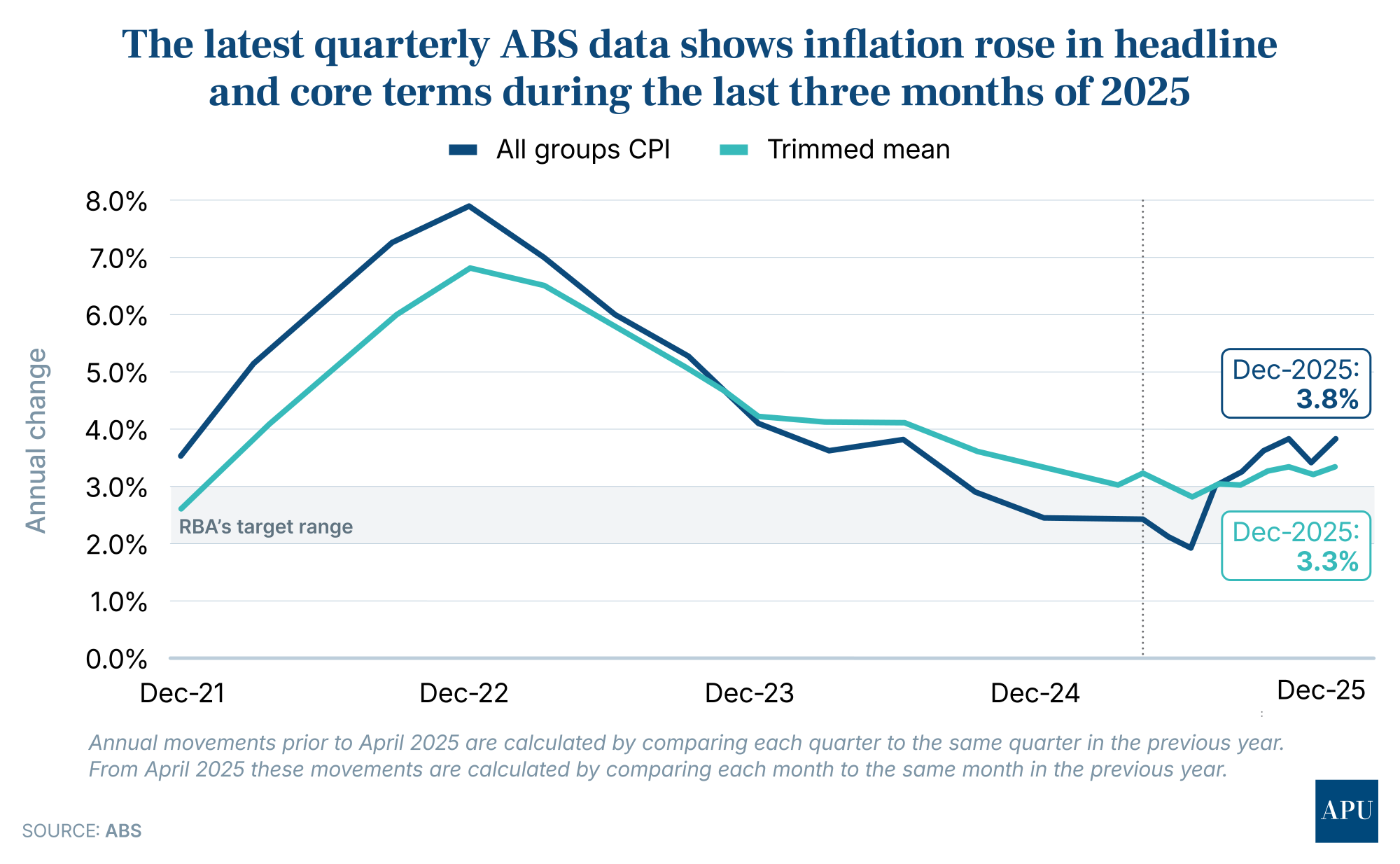
The Australian Bureau of Statistics says Australia’s official inflation measure, the Consumer Price Index, rose 3.8% in the 12 months to the end of December 2025, up from a 3.4% rise in the year to the end of November.
The ABS says the largest contributors to annual inflation over the past 12 months came in the Housing category (+5.5%), which includes rents and building costs, Food and non-alcoholic beverages (+3.4%) and Recreation and culture (+4.4%).
Crucially, the figures also show the RBA’s preferred core inflation measure - the so-called “trimmed mean” - was 3.3% in the 12 months to December 2025, up from 3.2% in the year to the end of November.
Trimmed mean inflation for the December quarter came in at 0.9%, above market expectations.
“On any read, inflation has picked up at the end of last year,” is how ABC Finance reporter Alicia Barry sums it up.
AMP’s Deputy Chief Economist, Diana Mousina, says the stronger-than-expected inflation numbers, particularly the uptick in the trimmed mean measure, pave the way for a rate hike when the central bank’s monetary policy committee meets next week.
“I think 0.9% (increase in the quarterly trimmed mean) probably gets us to a rate hike in February, because it's just too much above where the RBA was forecasting inflation to be when they last made their forecasts in November,” she says.
“And clearly, we've seen this pickup in inflation in six months from the second half of June last year and I think that the RBA would just be too uncomfortable with that, given that the employment situation, according to the data last week, also looks pretty solid.”
Alex Joiner, the Chief Economist at IFM Investors, agrees:
“Along with the upside surprise on headline inflation, there’s a strong case for the RBA to hike next week.”
Following the release of the inflation figures, money markets immediately priced in the chance of a 0.25% RBA February rate hike from around 60% to more than 70%.
While AMP’s Diana Mousina believes a rate rise in February is now likely, she doesn’t necessarily see more hikes by the RBA in the immediate future.
“I think what we may see is actually an environment where it's sort of like a “one-and-done” rate hike and maybe we don't need any more from here.
“Maybe we just need to recalibrate policy a little bit, to get interest rates a bit higher for inflation to settle at a level where the central bank is a bit more comfortable.”
Following the release of the inflation numbers, ANZ and Westpac have officially changed their interest rate calls, with both banks saying they also now expect a rate rise next week.
But like AMP’s Diana Mousina, Westpac and ANZ believe the RBA could then keep rates on hold for some time.
“While price pressures lifted through the second half of 2025, most top-down inflation indicators continue to suggest that a moderation of inflation back into the (RBA’s) target range is likely over 2026 and into 2027,” says Adam Boyton, ANZ’s Head of Australian Economics.
“Accordingly, we view this as a single ‘insurance’ tightening, not the start of a series of rate hikes.”
The prospect of Australia’s central bank hiking interest rates as early as next week is a stunning turnaround from financial market expectations just a few months ago of several more interest rate cuts in 2026.
In fact, it was only in August that the Reserve Bank cut the cash rate for a third time in 2025, lowering the cash rate from 3.85% down to 3.6%.
So would having to reverse course on interest rates so soon after cutting them raise credibility issues for the Reserve Bank, which is already under pressure for its slow response to an inflation break-out as the Covid pandemic came to an end?
AMP’s Diana Mousina doesn’t believe so.
“I don't think it's necessarily bad that the RBA cut rates in August last year,” she says.
“I think it was necessary at that time to support the labour market.
“And if we didn't have those rate cuts last year, then we probably wouldn't have had the recovery to consumer growth that we've had or to the private sector - we've had pretty good outcomes in private business investment.
“We've had a tick-up in residential construction - that's all really important.
“I think it's just that the (inflation) tick-up has occurred a bit quicker than most people were expecting it to.”
Implications for the housing market
Despite more mortgage pain for existing home owners - especially those struggling with existing levels of repayments which are relatively high by recent historical standards - any decision by the Reserve Bank of Australia to raise rates next week seems unlikely to have much impact on the property market.
Those hoping home prices will fall or become more affordable are likely to be disappointed, especially in light of the continuing underlying shortage of homes in this country for our existing population - estimated by AMP to be anywhere between 200,000 and 300,000.
A new Cotality confidence survey concludes that the property market enters 2026 from a position of strength, following last year’s strong national 8.6% lift in home values, which added more than $70,000 to the price of the median Australian home.
“There is a cloud of uncertainty around inflation and interest rate settings as well as affordability challenges, all of which are likely to weigh on housing confidence,” Cotality’s Head of Research, Tim Lawless, says.
“However, given we aren’t likely to see a material supply response in 2026 either, this should help to offset any downside risk to home values trending substantially lower.”







.jpg?width=1920&height=1080&name=WTF%20Is%20Happening%20To%20The%20Housing%20Market!%20$500%20Billion%20Wiped%20Out%20As%20Prices%20Fall%20Faster%20Every%20Month%20Scott%20Kuru%20YPU%20027%20(1).jpg)
%20Scott%20Kuru%20YPU%20025.jpg?width=1920&height=1080&name=This%20Is%20Worse%20Than%20A%20Recession%20RBA%20Admits%20Australias%20Wage%20Collapse%20Cant%20Be%20Stopped%20(Prepare%20Now)%20Scott%20Kuru%20YPU%20025.jpg)





















.jpg?width=1920&height=1080&name=EXPOSED%20How%20The%20Govt%20Let%20These%20Oil%20Giants%20Get%20Away%20With%20Paying%20Zero%20Tax%20For%20Aussie%20Gas%20Scott%20Kuru%20DPU%20256%20(1).jpg)






%20Scott%20Kuru%20DPU%20248.jpg?width=1920&height=1080&name=Major%20Banks%20CAUGHT%20Preparing%20For%20Australia%E2%80%99s%20Biggest%20Housing%20Crash%20(Defaults%20%26%20Bankruptcies%20Coming)%20Scott%20Kuru%20DPU%20248.jpg)
%20Scott%20Kuru%20DPU%20247.jpg?width=1920&height=1080&name=This%20Is%20How%20Australia%20Gets%20Pushed%20Into%20the%20Next%20Big%20Reset%20(Trust%20Collapse%20Has%20Officially%20Begun)%20Scott%20Kuru%20DPU%20247.jpg)







%20Scott%20Kuru%20DPU%20239.jpg?width=1920&height=1080&name=URGENT%20Life%20In%20Australia%20Has%20Become%20Impossible%20For%20Millions%20Of%20Aussies%20(It%E2%80%99s%20About%20To%20Get%20Worse)%20Scott%20Kuru%20DPU%20239.jpg)







%20Scott%20Kuru%20DPU%20227.jpg?width=1920&height=1080&name=URGENT%20ALERT%20Australia%E2%80%99s%20Property%20Market%20Is%20Sliding%20Into%20Something%20Much%20Bigger%20(Prepare%20Now)%20Scott%20Kuru%20DPU%20227.jpg)