









.png?width=292&height=292&name=Copy%20Link%20(1).png)

 SIGN UP FOR FREE NEWSLETTER
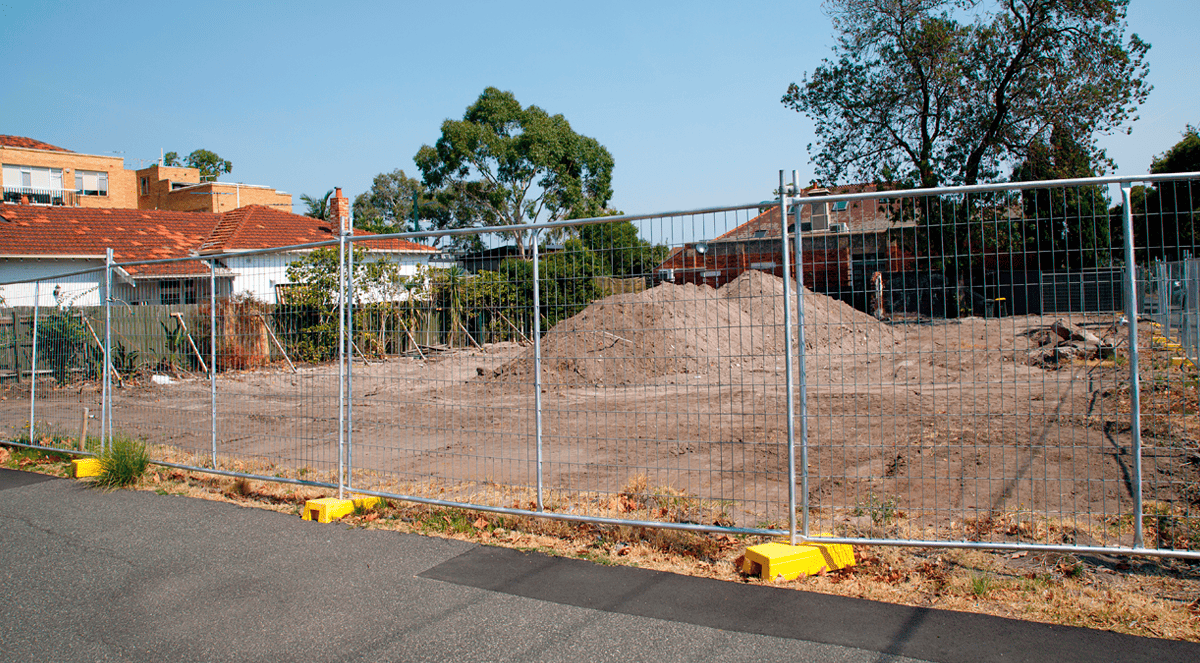
Australia’s flagship housing target is falling further out of reach, with the nation now more than 112,000 homes behind schedule, less than two years into the five-year program.
Housing analyst Cameron Kusher says the latest Australian Bureau of Statistics building data confirms the National Housing Accord was never properly set up to succeed and is now likely to miss its target by a wide margin.
The details
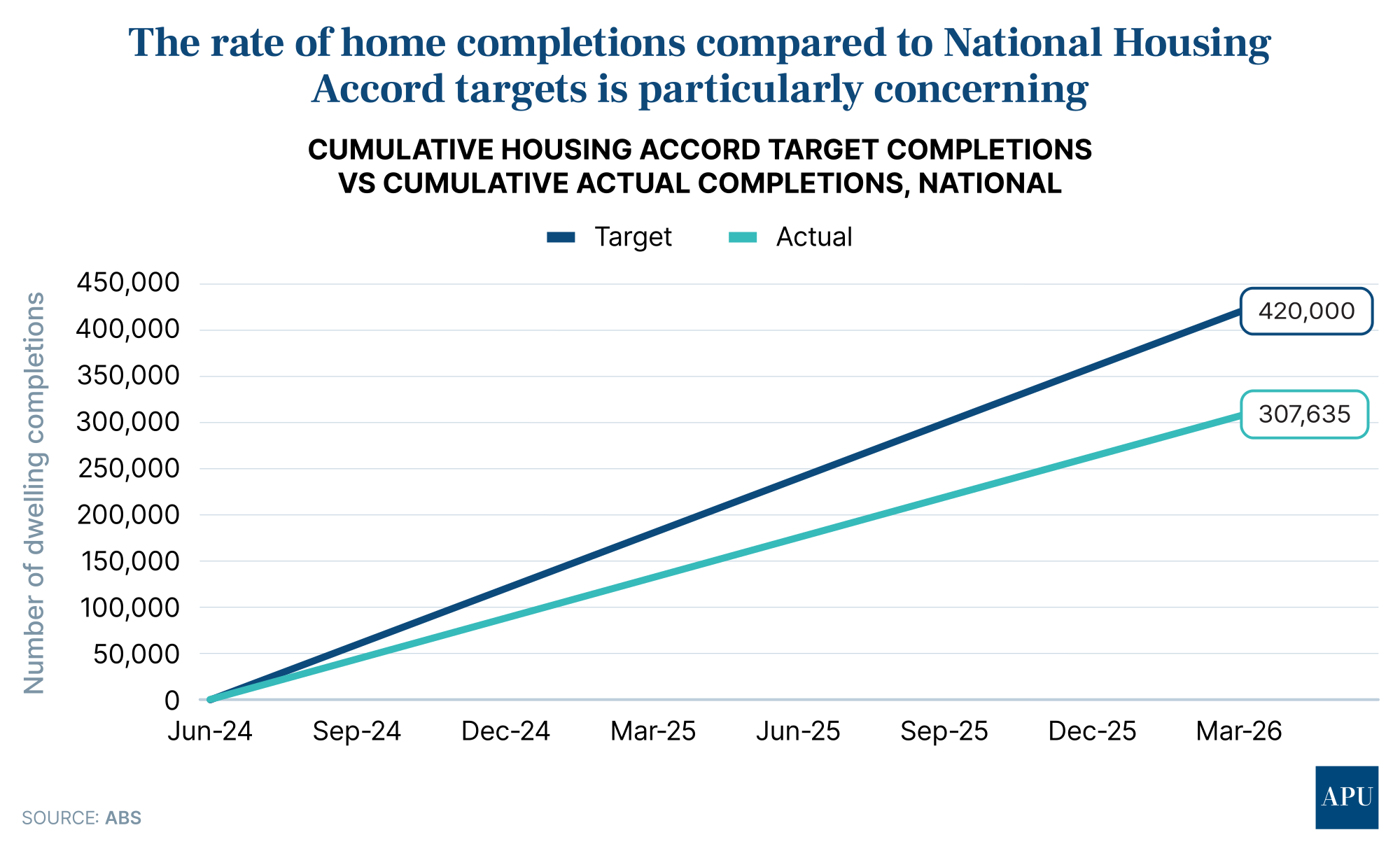
The National Housing Accord - a 2022 agreement between the federal, state and local governments, unions, big building companies and industry groups like Master Builders - calls for 1.2 million well-located homes to be completed between July 2024 and June 2029.
That’s an average of 240,000 homes a year, or 60,000 every quarter.
The Accord is an attempt to address the housing crisis and start chipping away at the underlying structural shortage of homes for Australia’s growing population.
But the most recent building data from the ABS shows only 43,816 homes were completed in the March 2026 quarter, while new construction starts fell to 48,012.
After the first 21 months of the Accord, Australia should have completed 420,000 homes.
Instead, it has delivered just 307,635, leaving the country 112,365 dwellings behind the required pace.
Writing in his Oz Property Insights newsletter, housing analyst Cameron Kusher argues the target was announced without the economic, financial and construction conditions needed to make it achievable.
“The progress being made is insufficient and it is clear that the target of 1.2 million new homes over a five year period is set to be missed by a wide margin,” he says.
The scale of the challenge was formidable from the start.
Australia needed to commence more than 60,000 homes every quarter before and throughout the Accord period to give builders enough time to complete them by June 2029.
Yet Australia has never previously sustained that pace of construction.
During the first seven quarters of the Accord, the strongest result was in December 2025, when 54,072 homes commenced construction.
Every other quarter recorded fewer than 50,000 starts.
By the end of March 2026, just 331,903 homes had commenced - 88,097 fewer than the 420,000 needed to remain on schedule.
Cameron Kusher says the outlook is even more concerning when measured by completions, which ultimately determine whether a new home has actually been added to the housing stock.
The September 2024 quarter remains the strongest completion result of the Accord so far, with 45,410 homes delivered.
But even that was almost 15,000 below the quarterly target.
To make up the accumulated shortfall and still deliver 1.2 million homes by June 2029, Australia would now need to complete roughly 69,000 homes every quarter for the remainder of the program, far above anything achieved since the Accord began.
Record pipeline, slow delivery
At first glance, one part of the latest data appears encouraging.
There were 243,864 dwellings under construction in Australia at the end of March 2026, the highest number on record.
That included 90,972 houses and 151,902 apartments, townhouses and other higher-density dwellings.
But Mr Kusher says the unusually large pipeline is also evidence of a serious problem: homes are entering construction but taking too long to finish.
“This record-high volume of dwellings under construction has occurred despite the fact that commencements haven’t been particularly high, which says to me there is a problem moving dwellings from commencement to completion,” he says.
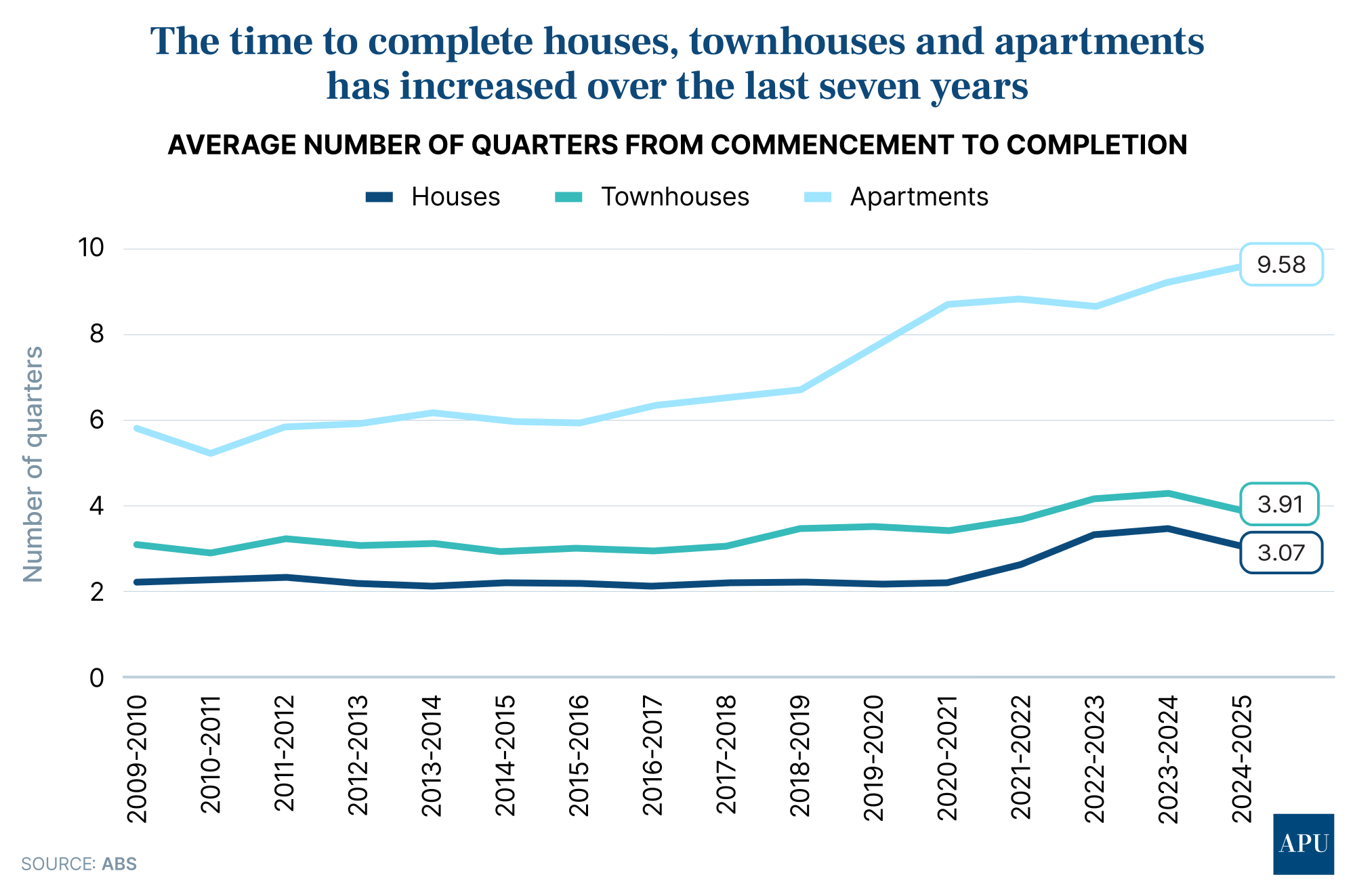
Building times have lengthened across all major dwelling types over the last seven years.
In 2019-20, houses took an average of 2.18 quarters to move from commencement to completion, while townhouses took 3.53 quarters and apartments 7.69 quarters.
The latest annual data shows all three take longer, with apartment projects requiring almost two additional quarters or an extra six months.
Labour shortages, material delays, builder capacity constraints and the sheer complexity of large developments can all hold up delivery.
Mr Kusher points out that, even excluding homes started during the March quarter, there were almost 196,000 dwellings already under construction - more than enough to close the Accord’s current deficit if they could be finished quickly.
But he sees little prospect of a sudden improvement while builders continue reporting trade and material shortages.
Why the target was always difficult
The Accord was launched into one of the least favourable home-building environments in years.
By June 2024, construction material costs had risen 32% in four years.
House construction costs were 42% higher, while the cost of building apartments and other attached dwellings had increased by 25%.
Inflation was elevated, interest rates were at their highest level since 2011, and borrowing had become much more expensive for both developers and potential buyers.
New housing also frequently costs more than comparable established property, leaving developers with the challenge of finding enough purchasers able and willing to pay a new build premium.
“In order to achieve all of this you of course have to find 1.2 million individuals that want to and have the capacity to purchase a brand new home at current prices,” Mr Kusher says.
Mr Kusher contrasts today’s conditions with the stronger construction cycle of the mid-to-late 2010s, when interest rates and building-cost inflation were low, foreign investment rules were more supportive of new housing and domestic investors accounted for a larger share of new-home finance.
Those conditions can’t simply be recreated, but he argues governments should have recognised the changed environment and pulled other policy levers much earlier.

What governments could have done
Mr Kusher says governments should have developed a detailed national picture of how many dwellings had development approval, how many were financially feasible and how likely they were to be completed within the Accord period.
Australia does not publish comprehensive national development approval data, making it difficult to know whether the pipeline was ever large enough.
He argues governments could also have provided developers with cheaper finance, covered or deferred infrastructure contributions, considered GST relief for qualifying new homes and devoted more funding to enabling infrastructure.
Residential construction should also have been prioritised, he says, rather than allowing large public infrastructure and data-centre projects to compete for many of the same trades.
Although the Australian Local Government Association was part of the Accord, individual councils were not.
Yet councils often control development approvals and help deliver the local infrastructure needed to unlock housing.
“The federal and state governments can agree to an ambitious housing plan but ultimately approving these projects and delivering the infrastructure to support them is largely the responsibility of local governments,” Mr Kusher writes.
“Without their buy-in it seems the Accord was destined to fail.”
The take-out
Despite his grim assessment, Cameron Kusher does not believe Australia should abandon ambitious housing targets.
But he says governments should acknowledge that 1.2 million homes will not be delivered by June 2029 and begin preparing now to make the same goal more achievable over the following five years.
“We should still be aiming for 1.2 million new homes every five years but all levels of government need to lay the groundwork now so that is achievable, or at least more achievable, over the five years to June 2034,” he says.
The danger is that today’s construction shortfall becomes tomorrow’s deeper housing shortage.
With Australia already struggling to accommodate population growth, every missed completion adds to competition for existing homes, keeps pressure on rents and makes affordability harder to improve.
The Accord housing target is now often referred to by politicians as “aspirational”.
But the housing shortage it was designed to address is very real - and, on the latest numbers, still getting worse.










.jpg?width=1920&height=1080&name=WTF%20Is%20Happening%20To%20The%20Housing%20Market!%20$500%20Billion%20Wiped%20Out%20As%20Prices%20Fall%20Faster%20Every%20Month%20Scott%20Kuru%20YPU%20027%20(1).jpg)

%20Scott%20Kuru%20YPU%20025.jpg?width=1920&height=1080&name=This%20Is%20Worse%20Than%20A%20Recession%20RBA%20Admits%20Australias%20Wage%20Collapse%20Cant%20Be%20Stopped%20(Prepare%20Now)%20Scott%20Kuru%20YPU%20025.jpg)



























.jpg?width=1920&height=1080&name=EXPOSED%20How%20The%20Govt%20Let%20These%20Oil%20Giants%20Get%20Away%20With%20Paying%20Zero%20Tax%20For%20Aussie%20Gas%20Scott%20Kuru%20DPU%20256%20(1).jpg)







%20Scott%20Kuru%20DPU%20248.jpg?width=1920&height=1080&name=Major%20Banks%20CAUGHT%20Preparing%20For%20Australia%E2%80%99s%20Biggest%20Housing%20Crash%20(Defaults%20%26%20Bankruptcies%20Coming)%20Scott%20Kuru%20DPU%20248.jpg)
%20Scott%20Kuru%20DPU%20247.jpg?width=1920&height=1080&name=This%20Is%20How%20Australia%20Gets%20Pushed%20Into%20the%20Next%20Big%20Reset%20(Trust%20Collapse%20Has%20Officially%20Begun)%20Scott%20Kuru%20DPU%20247.jpg)







%20Scott%20Kuru%20DPU%20239.jpg?width=1920&height=1080&name=URGENT%20Life%20In%20Australia%20Has%20Become%20Impossible%20For%20Millions%20Of%20Aussies%20(It%E2%80%99s%20About%20To%20Get%20Worse)%20Scott%20Kuru%20DPU%20239.jpg)











%20Scott%20Kuru%20DPU%20227.jpg?width=1920&height=1080&name=URGENT%20ALERT%20Australia%E2%80%99s%20Property%20Market%20Is%20Sliding%20Into%20Something%20Much%20Bigger%20(Prepare%20Now)%20Scott%20Kuru%20DPU%20227.jpg)